John Green Reads Poetry

So many poems to listen to!

Hey, there’s a missing poem!

Hi! This website is an ongoing labor of love inspired by John’s self-proclaimed love of poetry ¹ and the mission of Ours Poetica

We’re working very hard combing through the vast amounts of online content John and Hank have created ³ — and continue to create! — to find every instance of John reading poetry.⁴ Most of these were short poems that used to appear as an opening segment in the Dear Hank & John pod.⁵

Check out our growing list of missing or lost poetry-related John Green media:

We have a long way to go, and are using the posts’ dates as a way to organize everything chronologically with relevant tags to make everything extra useable!

So if you have a suggestion of something we missed or would like to share a piece of poetry-related media you’ve found…

  1. This is also a recurring riff in many of the opening segments of Dear Hank & John
  2. A lovely play on the Latin phrase Ars Poetica (“The Art of Poetry”)
  3. Examples: 1 | 2
  4. And, occasionally, someone else, such as his wife, his brother, or a poem inspired by one of Hank’s rants. Admittedly, some things are qualified as ‘poems’ rather loosely — John has read lyrics, and other nontraditional items as poetry, and that’s a wonderful thing!
    Because poetry is, always, what we make it.
  5. And are still missed by Nerdfighters everywhere!

Related Resources

Dear Hank & John

Or as he likes to call it: “Dear John & Hank”

Transcripts*
Patreon | X | Email
Listen for free:


Other Resources

Tags & Categories

Click bean to listen to John read poems!
  • A.k.a. Poem 314

    The brothers’ related banter…

    Hank: Alright, John, what’s the news from AFC Wimbledon?
    John: Ah, it’s terrible, Hank
    Hank: Oh no!
    John: We knew that this couldn’t last; we knew that AFC Wimbledon’s amazing start to the season — being in Fourth Place or whatever — was totally unsustainable. But also, we dreamt that it wasn’t unsustainable, we dreamt that it could be sustained, as one always does…

    Dear Hank & John | Ep. 434 “Curt’s Fleas”

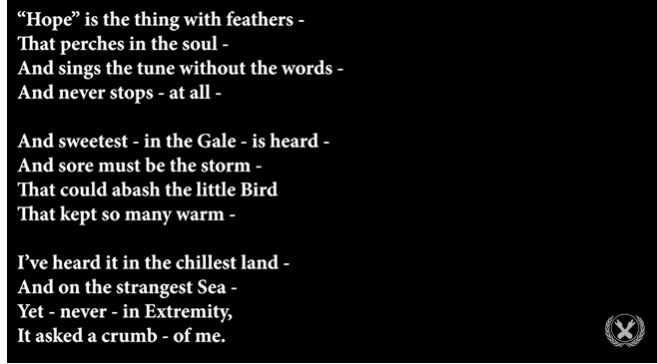
    “Hope” is the thing with feathers –

    That perches in the soul –

    The unquoted portion

    And sings the tune without the words –

    And never stops – at all –

    And sweetest – in the Gale – is heard –

    And sore must be the storm –

    That could abash the little Bird

    That kept so many warm –

    I’ve heard it in the chillest land –

    And on the strangest Sea –

    Yet – never – in Extremity,

    It asked a crumb – of me.

  • Screenshot of the poem
    The 1733 poem was originally censored for mocking the royal family.
    John’s related banter…

    I love em dashes. I don’t love them as much as Emily Dickinson loved them, but I love them.

    An em dash has all kinds of utilities. One might use it in lieu of a colon, or a semicolon, as I just did. Or you might use it in poetry, as Emily Dickinson famously liked to, over and over and over again.

    Now, Jonathan Swift made fun of em dashes back in the 18th century, writing that, [reads poem] But, like, I am a modern wit printing trash, and I, for one, love my dashes.

    vlogbrothers | Which is Correct? — or – ?

    (Unquoted first part)

    All human race would fain be wits,
    And millions miss for one that hits.
    Young’s universal passion, pride,
    Was never known to spread so wide.
    Say, Britain, could you ever boast
    Three poets in an age at most?
    Our chilling climate hardly bears
    A sprig of bays in fifty years;
    While every fool his claim alleges,
    As if it grew in common hedges.
    What reason can there be assign’d
    For this perverseness in the mind?
    Brutes find out where their talents lie:
    A bear will not attempt to fly;
    A founder’d horse will oft debate,
    Before he tries a five-barr’d gate;
    A dog by instinct turns aside,
    Who sees the ditch too deep and wide.
    But man we find the only creature
    Who, led by Folly, combats Nature;
    Who, when she loudly cries, Forbear,
    With obstinacy fixes there;
    And, where his genius least inclines,
    Absurdly bends his whole designs.
    Not empire to the rising sun
    By valour, conduct, fortune won;
    Not highest wisdom in debates,
    For framing laws to govern states;
    Not skill in sciences profound
    So large to grasp the circle round,
    Such heavenly influence require,
    As how to strike the Muse’s lyre.

    Not beggar’s brat on bulk begot;
    Not bastard of a pedler Scot;
    Not boy brought up to cleaning shoes,
    The spawn of Bridewell or the stews;
    Not infants dropp’d, the spurious pledges
    Of gipsies litter’d under hedges;
    Are so disqualified by fate
    To rise in church, or law, or state,
    As he whom Phoebus in his ire
    Has blasted with poetic fire.
    What hope of custom in the fair,
    While not a soul demands your ware?
    Where you have nothing to produce
    For private life, or public use?
    Court, city, country, want you not;
    You cannot bribe, betray, or plot.
    For poets, law makes no provision;
    The wealthy have you in derision:
    Of state affairs you cannot smatter;
    Are awkward when you try to flatter;
    Your portion, taking Britain round,
    Was just one annual hundred pound;
    Now not so much as in remainder,
    Since Cibber brought in an attainder;
    For ever fix’d by right divine
    (A monarch’s right) on Grub Street line.

    Poor starv’ling bard, how small thy gains!
    How unproportion’d to thy pains!
    And here a simile comes pat in:
    Though chickens take a month to fatten,
    The guests in less than half an hour
    Will more than half a score devour.
    So, after toiling twenty days
    To earn a stock of pence and praise,
    Thy labours, grown the critic’s prey,
    Are swallow’d o’er a dish of tea;
    Gone to be never heard of more,
    Gone where the chickens went before.
    How shall a new attempter learn
    Of different spirits to discern,
    And how distinguish which is which,
    The poet’s vein, or scribbling itch?
    Then hear an old experienced sinner,
    Instructing thus a young beginner.

    Consult yourself; and if you find
    A powerful impulse urge your mind,
    Impartial judge within your breast
    What subject you can manage best;
    Whether your genius most inclines
    To satire, praise, or humorous lines,
    To elegies in mournful tone,
    Or prologue sent from hand unknown.
    Then, rising with Aurora’s light,
    The Muse invoked, sit down to write;
    Blot out, correct, insert, refine,
    Enlarge, diminish, interline;
    Be mindful, when invention fails,
    To scratch your head, and bite your nails.

    Your poem finish’d, next your care
    Is needful to transcribe it fair.

    In modern Wit all printed trash, is
    Set off with num’rous Breaks—and Dashes–

    (Unquoted remainder)

    To statesmen would you give a wipe,
    You print it in Italic type.
    When letters are in vulgar shapes,
    ‘Tis ten to one the wit escapes:
    But, when in capitals express’d,
    The dullest reader smokes the jest:
    Or else perhaps he may invent
    A better than the poet meant;
    As learned commentators view
    In Homer more than Homer knew.

    Your poem in its modish dress,
    Correctly fitted for the press,
    Convey by penny-post to Lintot,
    But let no friend alive look into’t.
    If Lintot thinks ’twill quit the cost,
    You need not fear your labour lost:
    And how agreeably surprised
    Are you to see it advertised!
    The hawker shows you one in print,
    As fresh as farthings from the mint:
    The product of your toil and sweating;
    A bastard of your own begetting.

    Be sure at Will’s, the following day,
    Lie snug, and hear what critics say;
    And, if you find the general vogue
    Pronounces you a stupid rogue,
    Damns all your thoughts as low and little,
    Sit still, and swallow down your spittle;
    Be silent as a politician,
    For talking may beget suspicion;
    Or praise the judgment of the town,
    And help yourself to run it down.
    Give up your fond paternal pride,
    Nor argue on the weaker side:
    For, poems read without a name
    We justly praise, or justly blame;
    And critics have no partial views,
    Except they know whom they abuse:
    And since you ne’er provoke their spite,
    Depend upon’t their judgment’s right.
    But if you blab, you are undone:
    Consider what a risk you run:
    You lose your credit all at once;
    The town will mark you for a dunce;
    The vilest dogg’rel Grub Street sends,
    Will pass for yours with foes and friends;
    And you must bear the whole disgrace,
    Till some fresh blockhead takes your place.

    Your secret kept, your poem sunk,
    And sent in quires to line a trunk,
    If still you be disposed to rhyme,
    Go try your hand a second time.
    Again you fail: yet Safe’s the word;
    Take courage and attempt a third.
    But first with care employ your thoughts
    Where critics mark’d your former faults;
    The trivial turns, the borrow’d wit,
    The similes that nothing fit;
    The cant which every fool repeats,
    Town jests and coffeehouse conceits,
    Descriptions tedious, flat, and dry,
    And introduced the Lord knows why:
    Or where we find your fury set
    Against the harmless alphabet;
    On A’s and B’s your malice vent,
    While readers wonder whom you meant:
    A public or a private robber,
    A statesman, or a South Sea jobber;
    A prelate, who no God believes;
    A parliament, or den of thieves;
    A pickpurse at the bar or bench,
    A duchess, or a suburb wench:
    Or oft, when epithets you link,
    In gaping lines to fill a chink;
    Like stepping-stones, to save a stride,
    In streets where kennels are too wide;
    Or like a heel-piece, to support
    A cripple with one foot too short;
    Or like a bridge, that joins a marish
    To moorlands of a different parish.
    So have I seen ill-coupled hounds
    Drag different ways in miry grounds.
    So geographers, in Afric maps,
    With savage pictures fill their gaps,
    And o’er unhabitable downs
    Place elephants for want of towns.

    But, though you miss your third essay,
    You need not throw your pen away.
    Lay now aside all thoughts of fame,
    To spring more profitable game.
    From party merit seek support;
    The vilest verse thrives best at court.
    And may you ever have the luck
    To rhyme almost as ill as Duck;
    And, though you never learn’d to scan verse
    Come out with some lampoon on D’Anvers.
    A pamphlet in Sir Bob’s defence
    Will never fail to bring in pence:
    Nor be concern’d about the sale,
    He pays his workmen on the nail.
    Display the blessings of the nation,
    And praise the whole administration.
    Extol the bench of bishops round,
    Who at them rail, bid —- confound;
    To bishop-haters answer thus:
    (The only logic used by us)
    What though they don’t believe in —-
    Deny them Protestants–thou lyest.

    A prince, the moment he is crown’d,
    Inherits every virtue round,
    As emblems of the sovereign power,
    Like other baubles in the Tower;
    Is generous, valiant, just, and wise,
    And so continues till he dies:
    His humble senate this professes,
    In all their speeches, votes, addresses.
    But once you fix him in a tomb,
    His virtues fade, his vices bloom;
    And each perfection, wrong imputed,
    Is fully at his death confuted.
    The loads of poems in his praise,
    Ascending, make one funeral blaze:
    His panegyrics then are ceased,
    He grows a tyrant, dunce, or beast.
    As soon as you can hear his knell,
    This god on earth turns devil in hell:
    And lo! his ministers of state,
    Transform’d to imps, his levee wait;
    Where in the scenes of endless woe,
    They ply their former arts below;
    And as they sail in Charon’s boat,
    Contrive to bribe the judge’s vote;
    To Cerberus they give a sop,
    His triple barking mouth to stop;
    Or, in the ivory gate of dreams,
    Project excise and South-Sea schemes;
    Or hire their party pamphleteers
    To set Elysium by the ears.

    Then, poet, if you mean to thrive,
    Employ your muse on kings alive;
    With prudence gathering up a cluster
    Of all the virtues you can muster,
    Which, form’d into a garland sweet,
    Lay humbly at your monarch’s feet:
    Who, as the odours reach his throne,
    Will smile, and think them all his own;
    For law and gospel both determine
    All virtues lodge in royal ermine:
    I mean the oracles of both,
    Who shall depose it upon oath.
    Your garland, in the following reign,
    Change but the names, will do again.

    But, if you think this trade too base,
    (Which seldom is the dunce’s case)
    Put on the critic’s brow, and sit
    At Will’s, the puny judge of wit.
    A nod, a shrug, a scornful smile,
    With caution used, may serve a while.
    Proceed no further in your part,
    Before you learn the terms of art;
    For you can never be too far gone
    In all our modern critics’ jargon:
    Then talk with more authentic face
    Of unities, in time and place:
    Get scraps of Horace from your friends,
    And have them at your fingers’ ends;
    Learn Aristotle’s rules by rote,
    And at all hazards boldly quote;
    Judicious Rymer oft review,
    Wise Dennis, and profound Bossu.
    Read all the prefaces of Dryden,
    For these our critics much confide in;
    Though merely writ at first for filling,
    To raise the volume’s price a shilling.

    A forward critic often dupes us
    With sham quotations peri hupsous:
    And if we have not read Longinus,
    Will magisterially outshine us.
    Then, lest with Greek he overrun ye,
    Procure the book for love or money,
    Translated from Boileau’s translation,
    And quote quotation on quotation.

    At Will’s you hear a poem read,
    Where Battus from the table head,
    Reclining on his elbow-chair,
    Gives judgment with decisive air;
    To whom the tribe of circling wits
    As to an oracle submits.
    He gives directions to the town,
    To cry it up, or run it down;
    Like courtiers, when they send a note,
    Instructing members how to vote.
    He sets the stamp of bad and good,
    Though not a word be understood.
    Your lesson learn’d, you’ll be secure
    To get the name of connoisseur:
    And, when your merits once are known,
    Procure disciples of your own.
    For poets (you can never want ’em)
    Spread through Augusta Trinobantum,
    Computing by their pecks of coals,
    Amount to just nine thousand souls:
    These o’er their proper districts govern,
    Of wit and humour judges sovereign.
    In every street a city bard
    Rules, like an alderman, his ward;
    His undisputed rights extend
    Through all the lane, from end to end;
    The neighbours round admire his shrewdness
    For songs of loyalty and lewdness;
    Outdone by none in rhyming well,
    Although he never learn’d to spell.

    Two bordering wits contend for glory;
    And one is Whig, and one is Tory:
    And this, for epics claims the bays,
    And that, for elegiac lays:
    Some famed for numbers soft and smooth,
    By lovers spoke in Punch’s booth;
    And some as justly fame extols
    For lofty lines in Smithfield drolls.
    Bavius in Wapping gains renown,
    And Maevius reigns o’er Kentish town:
    Tigellius placed in Phooebus’ car
    From Ludgate shines to Temple-bar:
    Harmonious Cibber entertains
    The court with annual birth-day strains;
    Whence Gay was banish’d in disgrace;
    Where Pope will never show his face;
    Where Young must torture his invention
    To flatter knaves or lose his pension.

    But these are not a thousandth part
    Of jobbers in the poet’s art,
    Attending each his proper station,
    And all in due subordination,
    Through every alley to be found,
    In garrets high, or under ground;
    And when they join their pericranies,
    Out skips a book of miscellanies.
    Hobbes clearly proves, that every creature
    Lives in a state of war by nature.
    The greater for the smaller watch,
    But meddle seldom with their match.
    A whale of moderate size will draw
    A shoal of herrings down his maw;
    A fox with geese his belly crams;
    A wolf destroys a thousand lambs;
    But search among the rhyming race,
    The brave are worried by the base.
    If on Parnassus’ top you sit,
    You rarely bite, are always bit:
    Each poet of inferior size
    On you shall rail and criticise,
    And strive to tear you limb from limb;
    While others do as much for him.

    The vermin only teaze and pinch
    Their foes superior by an inch.
    So, naturalists observe, a flea
    Has smaller fleas that on him prey;
    And these have smaller still to bite ’em,
    And so proceed ad infinitum.
    Thus every poet, in his kind,
    Is bit by him that comes behind:
    Who, though too little to be seen,
    Can teaze, and gall, and give the spleen;
    Call dunces, fools, and sons of whores,
    Lay Grub Street at each other’s doors;
    Extol the Greek and Roman masters,
    And curse our modern poetasters;
    Complain, as many an ancient bard did,
    How genius is no more rewarded;
    How wrong a taste prevails among us;
    How much our ancestors outsung us:
    Can personate an awkward scorn
    For those who are not poets born;
    And all their brother dunces lash,
    Who crowd the press with hourly trash.

    O Grub Street! how do I bemoan thee,
    Whose graceless children scorn to own thee!
    Their filial piety forgot,
    Deny their country, like a Scot;
    Though by their idiom and grimace,
    They soon betray their native place:
    Yet thou hast greater cause to be
    Ashamed of them, than they of thee,
    Degenerate from their ancient brood
    Since first the court allow’d them food.

    Remains a difficulty still,
    To purchase fame by writing ill.
    From Flecknoe down to Howard’s time,
    How few have reach’d the low sublime!
    For when our high-born Howard died,
    Blackmore alone his place supplied:
    And lest a chasm should intervene,
    When death had finish’d Blackmore’s reign,
    The leaden crown devolved to thee,
    Great poet of the “Hollow Tree.”
    But ah! how unsecure thy throne!
    A thousand bards thy right disown:
    They plot to turn, in factious zeal,
    Duncenia to a common weal;
    And with rebellious arms pretend
    An equal privilege to descend.

    In bulk there are not more degrees
    From elephants to mites in cheese,
    Than what a curious eye may trace
    In creatures of the rhyming race.
    From bad to worse, and worse they fall;
    But who can reach the worst of all?
    For though, in nature, depth and height
    Are equally held infinite:
    In poetry, the height we know;
    ‘Tis only infinite below.
    For instance: when you rashly think,
    No rhymer can like Welsted sink,
    His merits balanced, you shall find
    The Laureate leaves him far behind.
    Concanen, more aspiring bard,
    Soars downward deeper by a yard.
    Smart Jemmy Moore with vigour drops;
    The rest pursue as thick as hops:
    With heads to point the gulf they enter,
    Link’d perpendicular to the centre;
    And as their heels elated rise,
    Their heads attempt the nether skies.

    O, what indignity and shame,
    To prostitute the Muses’ name!
    By flattering kings, whom Heaven design’d
    The plagues and scourges of mankind;
    Bred up in ignorance and sloth,
    And every vice that nurses both.

    Perhaps you say, Augustus shines,
    Immortal made in Virgil’s lines,
    And Horace brought the tuneful quire,
    To sing his virtues on the lyre;
    Without reproach for flattery, true,
    Because their praises were his due.
    For in those ages kings, we find,
    Were animals of human kind.
    But now, go search all Europe round
    Among the savage monsters —-
    With vice polluting every throne,
    (I mean all thrones except our own;)
    In vain you make the strictest view
    To find a —- in all the crew,
    With whom a footman out of place
    Would not conceive a high disgrace,
    A burning shame, a crying sin,
    To take his morning’s cup of gin.

    Thus all are destined to obey
    Some beast of burthen or of prey.

    ‘Tis sung, Prometheus, forming man,
    Through all the brutal species ran,
    Each proper quality to find
    Adapted to a human mind;
    A mingled mass of good and bad,
    The best and worst that could be had;
    Then from a clay of mixture base
    He shaped a —- to rule the race,
    Endow’d with gifts from every brute
    That best the —- nature suit.
    Thus think on —-s: the name denotes
    Hogs, asses, wolves, baboons, and goats.
    To represent in figure just,
    Sloth, folly, rapine, mischief, lust;
    Oh! were they all but Neb-cadnezers,
    What herds of —-s would turn to grazers!

    Fair Britain, in thy monarch blest,
    Whose virtues bear the strictest test;
    Whom never faction could bespatter,
    Nor minister nor poet flatter;
    What justice in rewarding merit!
    What magnanimity of spirit!
    What lineaments divine we trace
    Through all his figure, mien, and face!
    Though peace with olive binds his hands,
    Confess’d the conquering hero stands.
    Hydaspes, Indus, and the Ganges,
    Dread from his hand impending changes.
    From him the Tartar and Chinese,
    Short by the knees, entreat for peace.
    The consort of his throne and bed,
    A perfect goddess born and bred,
    Appointed sovereign judge to sit
    On learning, eloquence, and wit.
    Our eldest hope, divine Iuelus,
    (Late, very late, O may he rule us!)
    What early manhood has he shown,
    Before his downy beard was grown,
    Then think, what wonders will be done
    By going on as he begun,
    An heir for Britain to secure
    As long as sun and moon endure.

    The remnant of the royal blood
    Comes pouring on me like a flood.
    Bright goddesses, in number five;
    Duke William, sweetest prince alive.
    Now sing the minister of state,
    Who shines alone without a mate.
    Observe with what majestic port
    This Atlas stands to prop the court:
    Intent the public debts to pay,
    Like prudent Fabius, by delay.
    Thou great vicegerent of the king,
    Thy praises every Muse shall sing!
    In all affairs thou sole director;
    Of wit and learning chief protector,
    Though small the time thou hast to spare,
    The church is thy peculiar care.
    Of pious prelates what a stock
    You choose to rule the sable flock!
    You raise the honour of the peerage,
    Proud to attend you at the steerage.
    You dignify the noble race,
    Content yourself with humbler place.
    Now learning, valour, virtue, sense,
    To titles give the sole pretence.
    St. George beheld thee with delight,
    Vouchsafe to be an azure knight,
    When on thy breast and sides Herculean,
    He fix’d the star and string cerulean.

    Say, poet, in what other nation
    Shone ever such a constellation!
    Attend, ye Popes, and Youngs, and Gays,
    And tune your harps, and strew your bays:
    Your panegyrics here provide;
    You cannot err on flattery’s side.
    Above the stars exalt your style,
    You still are low ten thousand mile.
    On Lewis all his bards bestow’d
    Of incense many a thousand load;
    But Europe mortified his pride,
    And swore the fawning rascals lied.
    Yet what the world refused to Lewis,
    Applied to George, exactly true is.
    Exactly true! invidious poet!
    ‘Tis fifty thousand times below it.

    Translate me now some lines, if you can,
    From Virgil, Martial, Ovid, Lucan.
    They could all power in Heaven divide,
    And do no wrong on either side;
    They teach you how to split a hair,
    Give George and Jove an equal share.
    Yet why should we be laced so strait?
    I’ll give my monarch butter-weight.
    And reason good; for many a year
    Jove never intermeddled here:
    Nor, though his priests be duly paid,
    Did ever we desire his aid:
    We now can better do without him,
    Since Woolston gave us arms to rout him.
    Caetera desiderantur.
    Link to Us
    Essay Information
    Short Story Contest
    Languages: English, Espanol | Site Copyright © Jalic Inc. 2000 – 2026. All Rights Reserved.As Seen In: USA Today “Hot Sites”

  • A.k.a. “There was no up, there was no down, there was no side to side”

    Sources

    Original: YouTube
    Hank’s Original Short
    Reddit: Transcript

    One year later:
    Instagram
    TikTok
    Facebook

    Her TED Talk: Poetry and music that reaches across the digital void

    Click to read poem

    Before the Big Bang
    there was no up
    there was no down
    there was no side to side
    there was no light
    there was no dark
    nor shape of any kind
    there were no stars or planet Mars
    or protons to collide
    there was no up
    there was no down
    there was no side to side
    and furthermore to underscore this total lacking state
    there was no here
    there was no there
    because there was no space
    and in this endless void which can’t be thought of as a place
    there was no time
    and so no passing minutes, hours, days
    of all the paradoxes
    that belabour common sense
    I think this one’s the greatest
    this time before events
    because how did we go from nothing
    to infinitely dense?
    from immeasurably small
    to inconceivably immense?
    but before we get unmoored from the question at the start
    let’s take a breath and marvel
    at when math becomes an art
    because we don’t have to understand it
    to know there was a time
    when there was no up
    there was no down
    there was no side to side

  • See also: Marianne Moore – John Green Reads Poetry

    John’s related banter…

    It’s Tuesday. So I recently read a book that is about, um.. us.

    It’s called Narratives, Nerd-fighters, and New Media by Jennifer Burek Pierce. It’s an academic work about online community in general and Nerdfighteria in particular, and of course I shouldn’t pretend to be objective about it. I shouldn’t pretend to be objective about anything, actually, but I loved it.

    Anyway, one of the the things discussed in the book is how Nerdfighteria is often constructed as a place, both in the sense that there are, like, maps of Nerdfighteria, and in the sense that there are rules and norms when you are “here” that you understand may be different from the rules and norms elsewhere. But in this imagined place, there is lots of real activities– social connections, art gets made, memes are memed.

    This is definitely going in the background, by the way.

    Anyway, reading this book, I was reminded of that Marianne Moore poem, where she writes that “great poetry involves the creation of imaginary gardens with real toads in them.” Like, the place is imagined, but the people and the work inside of it are very real.

    vlogbrothers | Who Owns Nerdfighteria?

    (Unquoted opening)

    I, too, dislike it: there are things that are important beyond
             all this fiddle.
         Reading it, however, with a perfect contempt for it, one
             discovers that there is in
         it after all, a place for the genuine.
             Hands that can grasp, eyes
             that can dilate, hair that can rise
                 if it must, these things are important not because a

    high-sounding interpretation can be put upon them but because
             they are
         useful; when they become so derivative as to become
             unintelligible, the
         same thing may be said for all of us—that we
             do not admire what
             we cannot understand. The bat,
                 holding on upside down or in quest of something to

    eat, elephants pushing, a wild horse taking a roll, a tireless
             wolf under
         a tree, the immovable critic twinkling his skin like a horse
             that feels a flea, the base-
         ball fan, the statistician—case after case
             could be cited did
             one wish it; nor is it valid
                 to discriminate against “business documents and

    school-books”; all these phenomena are important. One must
             make a distinction
         however: when dragged into prominence by half poets,
             the result is not poetry,
         nor till the autocrats among us can be
             “literalists of
             the imagination”—above
                 insolence and triviality and can present

    for inspection, 

    imaginary gardens with real toads in them,

    (Unquoted remainder)

             shall we have
         it. In the meantime, if you demand on the one hand, in defiance
             of their opinion—
         the raw material of poetry in
             all its rawness, and
             that which is on the other hand,
                 genuine, then you are interested in poetry.

  • Note: This was also read by John Green on Dear Hank & John, Episode 014

    Ours Poetica | YouTube

    Click to read poem

    The world is too much with us; late and soon,
    Getting and spending, we lay waste our powers;—
    Little we see in Nature that is ours;
    We have given our hearts away, a sordid boon!
    This Sea that bares her bosom to the moon;
    The winds that will be howling at all hours,
    And are up-gathered now like sleeping flowers;
    For this, for everything, we are out of tune;
    It moves us not. Great God! I’d rather be
    A Pagan suckled in a creed outworn;
    So might I, standing on this pleasant lea,
    Have glimpses that would make me less forlorn;
    Have sight of Proteus rising from the sea;
    Or hear old Triton blow his wreathèd horn.

  • Some behind-the-scenes details from Hank…

    “Hello.  I’m Hank Green.  This poem is by my grandfather’s brother’s son, so a member of like, a fairly close member of my family.  It was one of the first poems I read as an adult, like, outside of the, the like, structure of school and one of the very first poems I enjoyed at all, and I enjoyed it because it’s about like, how cool bugs are, which I love, and it’s also about like, knowing stuff but also being wrong at the same time, like, like, being wrong while you’re right, and it’s about foolishness.”

    Ours Poetica | YouTube

    Click to read

    She plucks my sleeve.
    Young man, she says, you need to spray.
    You have aphids on your roses.  

    In a dark serge coat and a pill-box hat
    by god it’s my third-grade Sunday-school teacher,
    shrunken but still stern, the town’s 
    most successful corporate attorney’s mother.
    She doesn’t remember me.  I holster
    my secateurs, smile publicly, 
    and reply, Ma’am,

    did you know that a female aphid is born 
    carrying fertile eggs?  Come look.
    There may be five or six generations
    cheek by jowl on this “Peace” bud.
    Don’t they remind you
    of refugees 
    crowding on the deck of a tramp steamer?
    Look through my hand lens–
    they’re translucent.  You can see their dark innards 
    like kidneys in aspic.

    Yes, ma’am, they are full time inebriates,
    and unashamed of their nakedness.
    But isn’t there something wild and uplifting
    about their complete indifference
    to the human prospect?

    And then I do something wicked.  Ma’am, I say,
    I love aphids!  And I squeeze 
    a few dozen from the nearest bud
    and eat them.

    After the old woman scuttles away
    I feel ill
    and sit down to consider
    what comes next.  You see,
    aphids
    aren’t sweet
    as I had always imagined.
    Even though rose wine is their only food.
    aphids
    are bitter.

  • John’s related banter…

    I’ve also found Youtube videos helpful from watching Grant at 3Blue1Brown explain exponential growth to me to watching Jane Wang at Ours Poetica read me a poem. Right now, I find poetry especially helpful because it gives language and form to so much that I’m feeling.

    Hank, Robert Frost once famously said that the only way out is through, and I believe that. I also believe that the only way through is together. So let us find ways to work with and for one another and to serve and help one another especially the most vulnerable among us. And let us make it out the only way we can, together.

    Hank, I’ll see you on Friday.

    vlogbrothers | together.

    (Unquoted first part)

    I didn’t make you know how glad I was
    To have you come and camp here on our land.
    I promised myself to get down some day
    And see the way you lived, but I don’t know!
    With a houseful of hungry men to feed
    I guess you’d find… It seems to me
    I can’t express my feelings any more
    Than I can raise my voice or want to lift
    My hand (oh, I can lift it when I have to).
    Did ever you feel so? I hope you never.
    It’s got so I don’t even know for sure
    Whether I am glad, sorry, or anything.
    There’s nothing but a voice-like left inside
    That seems to tell me how I ought to feel,
    And would feel if I wasn’t all gone wrong.
    You take the lake. I look and look at it.
    I see it’s a fair, pretty sheet of water.
    I stand and make myself repeat out loud
    The advantages it has, so long and narrow,
    Like a deep piece of some old running river
    Cut short off at both ends. It lies five miles
    Straight away through the mountain notch
    From the sink window where I wash the plates,
    And all our storms come up toward the house,
    Drawing the slow waves whiter and whiter and whiter.
    It took my mind off doughnuts and soda biscuit
    To step outdoors and take the water dazzle
    A sunny morning, or take the rising wind
    About my face and body and through my wrapper,
    When a storm threatened from the Dragon’s Den,
    And a cold chill shivered across the lake.
    I see it’s a fair, pretty sheet of water,
    Our Willoughby! How did you hear of it?
    I expect, though, everyone’s heard of it.
    In a book about ferns? Listen to that!
    You let things more like feathers regulate
    Your going and coming. And you like it here?
    I can see how you might. But I don’t know!
    It would be different if more people came,
    For then there would be business. As it is,
    The cottages Len built, sometimes we rent them,
    Sometimes we don’t. We’ve a good piece of shore
    That ought to be worth something, and may yet.
    But I don’t count on it as much as Len.
    He looks on the bright side of everything,
    Including me. He thinks I’ll be all right
    With doctoring. But it’s not medicine –
    Lowe is the only doctor’s dared to say so –
    It’s rest I want – there, I have said it out –
    From cooking meals for hungry hired men
    And washing dishes after them – from doing
    Things over and over that just won’t stay done.
    By good rights I ought not to have so much
    Put on me, but there seems no other way.
    Len says one steady pull more ought to do it.
    He says

    the best way out is always through.

    (Unquoted remainder)

    And I agree to that, or in so far
    As that I can see no way out but through –
    Leastways for me – and then they’ll be convinced.
    It’s not that Len don’t want the best for me.
    It was his plan our moving over in
    Beside the lake from where that day I showed you
    We used to live – ten miles from anywhere.
    We didn’t change without some sacrifice,
    But Len went at it to make up the loss.
    His work’s a man’s, of course, from sun to sun,
    But he works when he works as hard as I do –
    Though there’s small profit in comparisons.
    (Women and men will make them all the same.)
    But work ain’t all. Len undertakes too much.
    He’s into everything in town. This year
    It’s highways, and he’s got too many men
    Around him to look after that make waste.
    They take advantage of him shamefully,
    And proud, too, of themselves for doing so.
    We have four here to board, great good-for-nothings,
    Sprawling about the kitchen with their talk
    While I fry their bacon. Much they care!
    No more put out in what they do or say
    Than if I wasn’t in the room at all.
    Coming and going all the time, they are:
    I don’t learn what their names are, let alone
    Their characters, or whether they are safe
    To have inside the house with doors unlocked.
    I’m not afraid of them, though, if they’re not
    Afraid of me. There’s two can play at that.
    I have my fancies: it runs in the family.
    My father’s brother wasn’t right. They kept him
    Locked up for years back there at the old farm.
    I’ve been away once – yes, I’ve been away.
    The State Asylum. I was prejudiced;
    I wouldn’t have sent anyone of mine there;
    You know the old idea – the only asylum
    Was the poorhouse, and those who could afford,
    Rather than send their folks to such a place,
    Kept them at home; and it does seem more human.
    But it’s not so: the place is the asylum.
    There they have every means proper to do with,
    And you aren’t darkening other people’s lives –
    Worse than no good to them, and they no good
    To you in your condition; you can’t know
    Affection or the want of it in that state.
    I’ve heard too much of the old-fashioned way.
    My father’s brother, he went mad quite young.
    Some thought he had been bitten by a dog,
    Because his violence took on the form
    Of carrying his pillow in his teeth;
    But it’s more likely he was crossed in love,
    Or so the story goes. It was some girl.
    Anyway all he talked about was love.
    They soon saw he would do someone a mischief
    If he wa’n’t kept strict watch of, and it ended
    In father’s building him a sort of cage,
    Or room within a room, of hickory poles,
    Like stanchions in the barn, from floor to ceiling, –
    A narrow passage all the way around.
    Anything they put in for furniture
    He’d tear to pieces, even a bed to lie on.
    So they made the place comfortable with straw,
    Like a beast’s stall, to ease their consciences.
    Of course they had to feed him without dishes.
    They tried to keep him clothed, but he paraded
    With his clothes on his arm – all of his clothes.
    Cruel – it sounds. I ‘spose they did the best
    They knew. And just when he was at the height,
    Father and mother married, and mother came,
    A bride, to help take care of such a creature,
    And accommodate her young life to his.
    That was what marrying father meant to her.
    She had to lie and hear love things made dreadful
    By his shouts in the night. He’d shout and shout
    Until the strength was shouted out of him,
    And his voice died down slowly from exhaustion.
    He’d pull his bars apart like bow and bow-string,
    And let them go and make them twang until
    His hands had worn them smooth as any ox-bow.
    And then he’d crow as if he thought that child’s play –
    The only fun he had. I’ve heard them say, though,
    They found a way to put a stop to it.
    He was before my time – I never saw him;
    But the pen stayed exactly as it was
    There in the upper chamber in the ell,
    A sort of catch-all full of attic clutter.
    I often think of the smooth hickory bars.
    It got so I would say – you know, half fooling –
    “It’s time I took my turn upstairs in jail” –
    Just as you will till it becomes a habit.
    No wonder I was glad to get away.
    Mind you, I waited till Len said the word.
    I didn’t want the blame if things went wrong.
    I was glad though, no end, when we moved out,
    And I looked to be happy, and I was,
    As I said, for a while – but I don’t know!
    Somehow the change wore out like a prescription.
    And there’s more to it than just window-views
    And living by a lake. I’m past such help –
    Unless Len took the notion, which he won’t,
    And I won’t ask him – it’s not sure enough.
    I ‘spose I’ve got to go the road I’m going:
    Other folks have to, and why shouldn’t I?
    I almost think if I could do like you,
    Drop everything and live out on the ground –
    But it might be, come night, I shouldn’t like it,
    Or a long rain. I should soon get enough,
    And be glad of a good roof overhead.
    I’ve lain awake thinking of you, I’ll warrant,
    More than you have yourself, some of these nights.
    The wonder was the tents weren’t snatched away
    From over you as you lay in your beds.
    I haven’t courage for a risk like that.
    Bless you, of course, you’re keeping me from work,
    But the thing of it is, I need to be kept.
    There’s work enough to do – there’s always that;
    But behind’s behind. The worst that you can do
    Is set me back a little more behind.
    I sha’n’t catch up in this world, anyway.
    I’d rather you’d not go unless you must.

  • Ours Poetica | YouTube

    Click to read poem

    So here’s what I’ve got, the reasons why our marriage
    might work: Because you wear pink but write poems
    about bullets and gravestones. Because you yell
    at your keys when you lose them, and laugh,
    loudly, at your own jokes. Because you can hold a pistol,
    gut a pig. Because you memorize songs, even commercials
    from thirty years back and sing them when vacuuming.
    You have soft hands. Because when we moved, the contents
    of what you packed were written inside the boxes.
    Because you think swans are overrated and kind of stupid.
    Because you drove me to the train station. You drove me
    to Minneapolis. You drove me to Providence.
    Because you underline everything you read, and circle
    the things you think are important, and put stars next
    to the things you think I should think are important,
    and write notes in the margins about all the people
    you’re mad at and my name almost never appears there.
    Because you made that pork recipe you found
    in the Frida Kahlo Cookbook. Because when you read
    that essay about Rilke, you underlined the whole thing
    except the part where Rilke says love means to deny the self
    and to be consumed in flames. Because when the lights
    are off, the curtains drawn, and an additional sheet is nailed
    over the windows, you still believe someone outside
    can see you. And one day five summers ago,
    when you couldn’t put gas in your car, when your fridge
    was so empty—not even leftovers or condiments—
    there was a single twenty-ounce bottle of Mountain Dew,
    which you paid for with your last damn dime
    because you once overheard me say that I liked it.

  • Hank’s intro…

    Hello I’m Hank Green.  Um, it’s Halloween time, so of course you’ve got to go to the creepy standards, and I’ve chosen a poem that I love, even though it’s the obvious choice. It’s The Raven by Edgar Allan Poe, because it’s a super creepy poem, right?

    Except it’s not creepy at all. It turns out hiding right below the creepiness, it’s not about the supernatural, it’s not about, like, what’s hiding unseen in the shadows. It’s just about grief and about that feeling that you will never be out from under the grief, and maybe that that’s a real feeling and that’s not creepy, it’s just it’s scary and it’s very sad and it’s almost like he built this creepy exterior to maybe make the sadness even more palatable.

    Ours Poetica | YouTube

    Click to read poem

    Once upon a midnight dreary, while I pondered, weak and weary,

    Over many a quaint and curious volume of forgotten lore—

        While I nodded, nearly napping, suddenly there came a tapping,

    As of some one gently rapping, rapping at my chamber door.

    “’Tis some visitor,” I muttered, “tapping at my chamber door—

                Only this and nothing more.”

        Ah, distinctly I remember it was in the bleak December;

    And each separate dying ember wrought its ghost upon the floor.

        Eagerly I wished the morrow;—vainly I had sought to borrow

        From my books surcease of sorrow—sorrow for the lost Lenore—

    For the rare and radiant maiden whom the angels name Lenore—

                Nameless here for evermore.

        And the silken, sad, uncertain rustling of each purple curtain

    Thrilled me—filled me with fantastic terrors never felt before;

        So that now, to still the beating of my heart, I stood repeating

        “’Tis some visitor entreating entrance at my chamber door—

    Some late visitor entreating entrance at my chamber door;—

                This it is and nothing more.”

        Presently my soul grew stronger; hesitating then no longer,

    “Sir,” said I, “or Madam, truly your forgiveness I implore;

        But the fact is I was napping, and so gently you came rapping,

        And so faintly you came tapping, tapping at my chamber door,

    That I scarce was sure I heard you”—here I opened wide the door;—

                Darkness there and nothing more.

        Deep into that darkness peering, long I stood there wondering, fearing,

    Doubting, dreaming dreams no mortal ever dared to dream before;

        But the silence was unbroken, and the stillness gave no token,

        And the only word there spoken was the whispered word, “Lenore?”

    This I whispered, and an echo murmured back the word, “Lenore!”—

                Merely this and nothing more.

        Back into the chamber turning, all my soul within me burning,

    Soon again I heard a tapping somewhat louder than before.

        “Surely,” said I, “surely that is something at my window lattice;

          Let me see, then, what thereat is, and this mystery explore—

    Let my heart be still a moment and this mystery explore;—

                ’Tis the wind and nothing more!”

        Open here I flung the shutter, when, with many a flirt and flutter,

    In there stepped a stately Raven of the saintly days of yore;

        Not the least obeisance made he; not a minute stopped or stayed he;

        But, with mien of lord or lady, perched above my chamber door—

    Perched upon a bust of Pallas just above my chamber door—

                Perched, and sat, and nothing more.

    Then this ebony bird beguiling my sad fancy into smiling,

    By the grave and stern decorum of the countenance it wore,

    “Though thy crest be shorn and shaven, thou,” I said, “art sure no craven,

    Ghastly grim and ancient Raven wandering from the Nightly shore—

    Tell me what thy lordly name is on the Night’s Plutonian shore!”

                Quoth the Raven “Nevermore.”

        Much I marvelled this ungainly fowl to hear discourse so plainly,

    Though its answer little meaning—little relevancy bore;

        For we cannot help agreeing that no living human being

        Ever yet was blessed with seeing bird above his chamber door—

    Bird or beast upon the sculptured bust above his chamber door,

                With such name as “Nevermore.”

        But the Raven, sitting lonely on the placid bust, spoke only

    That one word, as if his soul in that one word he did outpour.

        Nothing farther then he uttered—not a feather then he fluttered—

        Till I scarcely more than muttered “Other friends have flown before—

    On the morrow he will leave me, as my Hopes have flown before.”

                Then the bird said “Nevermore.”

        Startled at the stillness broken by reply so aptly spoken,

    “Doubtless,” said I, “what it utters is its only stock and store

        Caught from some unhappy master whom unmerciful Disaster

        Followed fast and followed faster till his songs one burden bore—

    Till the dirges of his Hope that melancholy burden bore

                Of ‘Never—nevermore’.”

        But the Raven still beguiling all my fancy into smiling,

    Straight I wheeled a cushioned seat in front of bird, and bust and door;

        Then, upon the velvet sinking, I betook myself to linking

        Fancy unto fancy, thinking what this ominous bird of yore—

    What this grim, ungainly, ghastly, gaunt, and ominous bird of yore

                Meant in croaking “Nevermore.”

        This I sat engaged in guessing, but no syllable expressing

    To the fowl whose fiery eyes now burned into my bosom’s core;

        This and more I sat divining, with my head at ease reclining

        On the cushion’s velvet lining that the lamp-light gloated o’er,

    But whose velvet-violet lining with the lamp-light gloating o’er,

    She shall press, ah, nevermore!

        Then, methought, the air grew denser, perfumed from an unseen censer

    Swung by Seraphim whose foot-falls tinkled on the tufted floor.

        “Wretch,” I cried, “thy God hath lent thee—by these angels he hath sent thee

        Respite—respite and nepenthe from thy memories of Lenore;

    Quaff, oh quaff this kind nepenthe and forget this lost Lenore!”

                Quoth the Raven “Nevermore.”

        “Prophet!” said I, “thing of evil!—prophet still, if bird or devil!—

    Whether Tempter sent, or whether tempest tossed thee here ashore,

        Desolate yet all undaunted, on this desert land enchanted—

        On this home by Horror haunted—tell me truly, I implore—

    Is there—is there balm in Gilead?—tell me—tell me, I implore!”

                Quoth the Raven “Nevermore.”

        “Prophet!” said I, “thing of evil!—prophet still, if bird or devil!

    By that Heaven that bends above us—by that God we both adore—

        Tell this soul with sorrow laden if, within the distant Aidenn,

        It shall clasp a sainted maiden whom the angels name Lenore—

    Clasp a rare and radiant maiden whom the angels name Lenore.”

                Quoth the Raven “Nevermore.”

        “Be that word our sign of parting, bird or fiend!” I shrieked, upstarting—

    “Get thee back into the tempest and the Night’s Plutonian shore!

        Leave no black plume as a token of that lie thy soul hath spoken!

        Leave my loneliness unbroken!—quit the bust above my door!

    Take thy beak from out my heart, and take thy form from off my door!”

                Quoth the Raven “Nevermore.”

        And the Raven, never flitting, still is sitting, still is sitting

    On the pallid bust of Pallas just above my chamber door;

        And his eyes have all the seeming of a demon’s that is dreaming,

        And the lamp-light o’er him streaming throws his shadow on the floor;

    And my soul from out that shadow that lies floating on the floor

                Shall be lifted—nevermore!

  • Didn’t I hear John read this poem elsewhere?

    Are there different versions of this poem?

    Yes! From Moore, “Poetry” | Favorite Poem Project:

    The most famous (and most widely lamented) version of “Poetry” is the one Moore published in her 1967 The Complete Poems of Marianne Moore. Many readers, including numbers of Moore’s fellow poets, consider this one of the most egregious examples ever of terrible revision. In that 1967 version, Moore reduced “Poetry” to just three lines:

    I, too, dislike it.
    Reading it, however, with a perfect contempt for it, one discovers in
    it, after all, a place for the genuine.

    This drastic compression seems designed to frustrate the poem’s admirers (perhaps especially the critics and scholars who had commented on the poem), taking back the exquisitely twisty epigrams and images that readers had enjoyed, analyzed, quoted. To tease her admirers and critics—or to complicate their responses even further—Moore had it both ways by including the longer poem as a kind of endnote to the three-liner. She published the full, 1924 version (reprinted below), the one preferred by many of her admirers and later editors, in the back matter of that same 1967 Complete Poems with the laconic heading “Original Version.” In various ways, the two incarnations of the poem annotate, challenge, and criticize one another. I think they amusingly challenge and criticize us readers, too.

    John’s thoughts…

    Good morning Hank, it’s Tuesday. So there’s this Mary-Anne Moore poem called “Poetry” which begins…

    Which is more or less how I felt about poetry for much of my life. Partly because it seemed a little dead, in the sense that, like, all the poets I could name were in fact, dead. So there didn’t seem to be like, a present tense to poetry.

    But also I never felt smart enough to “get” poetry. Like, I thought to read a poem well you had to be able to know that the wolf howling in the distance represented the poets dead father or whatever. And that if you could figure that out, you were good at reading poems, and if you couldn’t, you were bad at reading them. In which case, I was bad.

    So I mostly quit reading poems, and tried instead to focus on the things that were important beyond all that fiddle. But it turns out, I love poetry.

    As Mary-Anne Moore puts it later in that poem, “One discovers in it after all, a place for the genuine.” And I am desperate to discover places for the genuine.

    And I’m also desperate for language that will help me understand the weird, and overwhelming worlds I encounter within, and without, and *that’s* what poetry does for me.

    Vlogbrothers | I, Too, Dislike It

    I, too, dislike it: there are things that are important beyond
             all this fiddle.

    (Unquoted section)

    Reading it, however, with a perfect contempt for it,

          one
             discovers

    (Unquoted section)

    that there is

    in
         it after all, a place for the genuine.

    (Remainder of the full poem)

             Hands that can grasp, eyes
             that can dilate, hair that can rise
                 if it must, these things are important not because a

    high-sounding interpretation can be put upon them but because
             they are
         useful; when they become so derivative as to become
             unintelligible, the
         same thing may be said for all of us—that we
             do not admire what
             we cannot understand. The bat,
                 holding on upside down or in quest of something to

    eat, elephants pushing, a wild horse taking a roll, a tireless
             wolf under
         a tree, the immovable critic twinkling his skin like a horse
             that feels a flea, the base-
         ball fan, the statistician—case after case
             could be cited did
             one wish it; nor is it valid
                 to discriminate against “business documents and

    school-books”; all these phenomena are important. One must
             make a distinction
         however: when dragged into prominence by half poets,
             the result is not poetry,
         nor till the autocrats among us can be
             “literalists of
             the imagination”—above
                 insolence and triviality and can present

    for inspection, imaginary gardens with real toads in them,
             shall we have
         it. In the meantime, if you demand on the one hand, in defiance
             of their opinion—
         the raw material of poetry in
             all its rawness, and
             that which is on the other hand,
                 genuine, then you are interested in poetry.

  • Published in Space Struck (Sarabande Books, 2019)

    John’s thoughts…

    So much of my experience in the world is just like, resistant to language which makes it hard for me to understand. Like, I find it very difficult to describe my anxiety, until I read a Paige Louis poem which they write… (reads the poem excerpt)

    And I also need poetry because it helps me imagine other people and their experiences more complexly. And so working with the aforementioned Paige Louis, we started a new YouTube channel, in collaboration with The Poetry Foundation called “Ours Poetica”. It features a poem read to you every Monday, Wednesday, and Friday.

    The readers might be poets like, Paige Louis, or non-poets like Shayleen Woodly. I think there are a lot of people out there who love poetry, but just don’t yet *know* that they love poetry. And this channel is for you!

    Vlogbrothers | I, Too, Dislike It

    (Unquoted portion)

    On the train, a man snatches my book,
    reads the last line, and says, I completely get you,

    you’re not that complex. He could be right—lately
    all my what ifs are about breath: What if

    a glassblower inhales at the wrong
    moment? What if I’m drifting on a sailboat

    and the wind stops? If he’d ask me how I’m
    feeling, I’d give him the long version—

    I feel

    as if I’m on the moon listening to the air hiss
    out of my spacesuit, and I can’t find the hole. I’m

    the vice president of panic, and the president is
    missing.

    (Remainder of the poem)

    Most nights, I calm myself by listing

    animals still on the Least Concern end of the
    extinction spectrum: aardvarks and blackbirds

    are fine. Minnows thrive—though this brings
    me no relief—they can swim through sludge

    if they have to. I don’t think I’ve ever written
    the word doom, but nothing else fits.

    Every experience seems both urgent and
    unnatural—like right now, this train

    is approaching the station where my beloved
    is waiting to take me to the orchard, so we can

    pay for the memory of having once, at dusk,
    plucked real apples from real trees.

  • A.k.a. “I felt a Funeral, in my Brain” – which John read in full at the Ours Poetica live kick-off event.

    Jonh’s related banter…

    And I find it hard to understand and describe how in a bout with depression it feels like reality is falling out from beneath me, until I read Emily Dickinson write, “And then, a plank in reason broke, and I dropped down, and down, and hit a world at every plunge.”

    Vlogbrothers | I, Too, Dislike It

    Unquoted beginning

    I felt a Funeral, in my Brain,

    And Mourners to and fro

    Kept treading – treading – till it seemed

    That Sense was breaking through –

    And when they all were seated,

    A Service, like a Drum –

    Kept beating – beating – till I thought

    My mind was going numb –

    And then I heard them lift a Box

    And creak across my Soul

    With those same Boots of Lead, again,

    Then Space – began to toll,

    As all the Heavens were a Bell,

    And Being, but an Ear,

    And I, and Silence, some strange Race,

    Wrecked, solitary, here –

    And then a Plank in Reason, broke,

    And I dropped down, and down –

    And hit a World, at every plunge,

    Unquoted end

    And Finished knowing – then –

  • From John Green’s high school copy of The Norton Anthology of Poetry *

    *

    Ours Poetica | YouTube,

    Click to read poem

    I, too, dislike it: there are things that are important beyond
             all this fiddle.
         Reading it, however, with a perfect contempt for it, one
             discovers that there is in
         it after all, a place for the genuine.
             Hands that can grasp, eyes
             that can dilate, hair that can rise
                 if it must, these things are important not because a

    high-sounding interpretation can be put upon them but because
             they are
         useful; when they become so derivative as to become
             unintelligible, the
         same thing may be said for all of us—that we
             do not admire what
             we cannot understand. The bat,
                 holding on upside down or in quest of something to

    eat, elephants pushing, a wild horse taking a roll, a tireless
             wolf under
         a tree, the immovable critic twinkling his skin like a horse
             that feels a flea, the base-
         ball fan, the statistician—case after case
             could be cited did
             one wish it; nor is it valid
                 to discriminate against “business documents and

    school-books”; all these phenomena are important. One must
             make a distinction
         however: when dragged into prominence by half poets,
             the result is not poetry,
         nor till the autocrats among us can be
             “literalists of
             the imagination”—above
                 insolence and triviality and can present

    for inspection, imaginary gardens with real toads in them,
             shall we have
         it. In the meantime, if you demand on the one hand, in defiance
             of their opinion—
         the raw material of poetry in
             all its rawness, and
             that which is on the other hand,
                 genuine, then you are interested in poetry.

  • A.k.a. “I felt a Funeral in my Brain” – referenced in his related vlogbrothers’ video as well.

    John’s opening thoughts…

    “It’s a very important poem to me. Collin said earlier that he felt in a … way that poetry has saved his life. I feel the same way. I feel I have been crazy for most of my life — there are more precise terms, but that is the one that I identify with the most and at times very-very in a way that was extremely disabling for me and this this poem among others has made me feel less alone so much for so long for you know for 20 years of my life since I first read it, and I am very grateful to it and for this. It’s usually called ‘340’ (she wasn’t the best at titles)…”

    Ours Poetica | YouTube

    Click to read poem

    I felt a Funeral, in my Brain,
    And Mourners to and fro
    Kept treading – treading – till it seemed
    That Sense was breaking through –

    And when they all were seated,
    A Service, like a Drum –
    Kept beating – beating – till I thought
    My mind was going numb –

    And then I heard them lift a Box
    And creak across my Soul
    With those same Boots of Lead, again,
    Then Space – began to toll,

    As all the Heavens were a Bell,
    And Being, but an Ear,
    And I, and Silence, some strange Race,
    Wrecked, solitary, here –

    And then a Plank in Reason, broke,
    And I dropped down, and down –
    And hit a World, at every plunge,
    And Finished knowing – then –

    [Note: The audio is captured from a phone recording of the live event, hence its subpar quality, albeit we are nonetheless quite grateful it exists!]

  • John’s related banter…

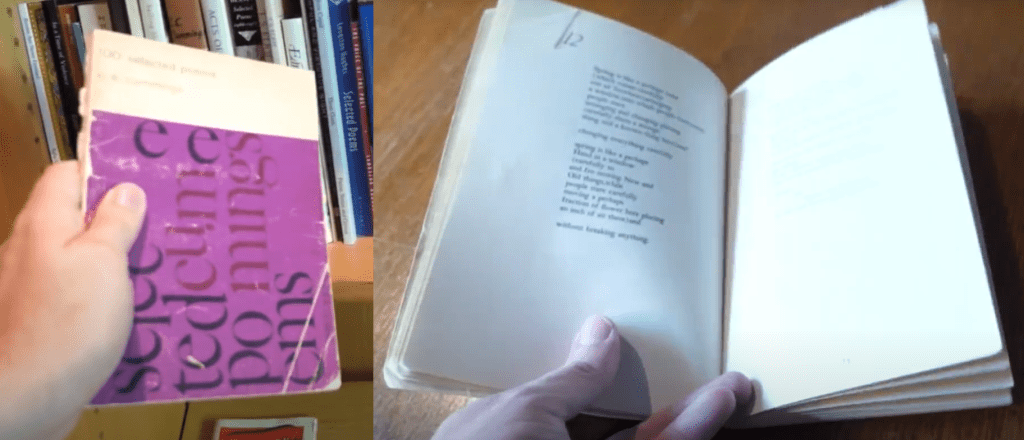
    And I can always find my 9th grade copy of 100 poems by EE Cummings…
    except when it’s March and I want quote that poem about
    Spring being like a “perhaps hand which comes carefully out of Nowhere” etc.

    This is the 1954 edition of 100 Selected Poems: cummings, e. e.: 9780802130723 (Grove Press: Evergreen / Black Cat)

    vlogbrothers | WHERE IS MY NORTON ANTHOLOGY OF POETRY

    Spring is like a perhaps hand
    (which comes carefully
    out of Nowhere)

    Click to read remainder of poem

    arranging
    a window,into which people look(while
    people stare
    arranging and changing placing
    carefully there a strange
    thing and a known thing here)and

    changing everything carefully

    spring is like a perhaps
    Hand in a window
    (carefully to
    and fro moving New and
    Old things,while
    people stare carefully
    moving a perhaps
    fraction of flower here placing
    an inch of air there)and

    without breaking anything.

  • John’s related banter…

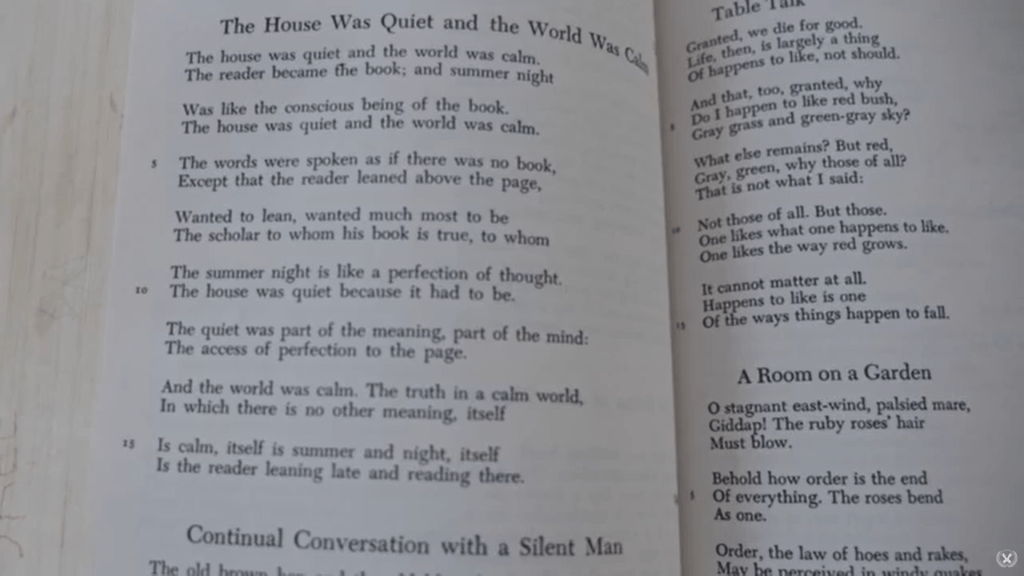
    Good morning Hank, it’s Tuesday, I can’t find my Norton Anthology of Poetry.

    I don’t mean *the* Norton Anthology of Poetry
    which can be purchased from any bookstore, I mean *my* Norton Anthology of Poetry. Or, more specifically, my friend Chip’s Norton Anthology of Poetry that I borrowed from him in 11th grade and then eventually stole.

    The 3rd edition of the Norton Anthology of Poetry is a deeply flawed book. For one thing, it contains almost no poems from the last 40 years on account of having been published 35 years ago, but it is *my* deeply flawed book… or at the very least, Chip’s.

    And I can’t find it. One of the central facts of my life is that no matter how many times I reorganize my home library in any given moment, I will not be able to find the book that I desperately need.

    It’s not with the poetry, It’s not with the Hot Wheels Ultimate track, it’s not in the bookshelf behind our bed
    And it’s not in the background of this video set… 

    WHERE IS MY Norton Anthology of Poetry! I mean this is ridiculous. I’ve been looking for my Norton Anthology of Poetry for an entire day I haven’t been able to write a Vlogbrothers script because I’ve been looking for my Norton Anthology of Poetry, which, ergo, *has* to become the topic of today’s Vlogbrothers video. IT’S A THREE POINT TWO POUND BOOK. Nobody like takes a 3.2 pound book on vacation and leaves it there.

    And yes I know that I could just Google the poem I want to read but I don’t *want* to Google it, I want to read it in my Norton Anthology of Poetry which HAS to be somewhere in this house I mean it’s not like I would have taken it out of the h- … [whispered] wait a second
    Could it be at the office?

    Okay I’m going to drive to the office to look for my Norton Anthology of Poetry and if I don’t find it I *am* going to let it go… Maybe.

    I’m on my way to my office. C’mon, big money, no whammies!

    YES! YES! YES! My Norton Anthology of Poetry!YEEEEAAAASSSSSS

    (reads poem)

    Oh! it’s every bit as good as I remember and just what I needed today. Hank, I will see you on Friday.

    vlogbrothers | WHERE IS MY NORTON ANTHOLOGY OF POETRY

    Click to read poem

    The house was quiet and the world was calm.
    The reader became the book; and summer night

    Was like the conscious being of the book.
    The house was quiet and the world was calm.

    The words were spoken as if there was no book,
    Except that the reader leaned above the page,

    Wanted to lean, wanted much most to be
    The scholar to whom his book is true, to whom

    The summer night is like a perfection of thought.
    The house was quiet because it had to be.

    The quiet was part of the meaning, part of the mind:
    The access of perfection to the page.

    And the world was calm. The truth in a calm world,
    In which there is no other meaning, itself

    Is calm, itself is summer and night, itself
    Is the reader leaning late and reading there.

  • In Counting Descent by Clint Smith (Write Bloody Publishing, 2016)

    John’s related banter…

    While we’re talking about books, and yes, I realize that this video is a little bit scattered, I’ve been reading a lot of poetry lately. I don’t know why; I guess that’s just the way that my brain wants to process text at the moment, and there are two books that I would really like to recommend.

    The first is Counting Descent by Clint Smith. This is a very small book, but it packs a punch. It’s got funny moments, like, there’s a poem called “When They Tell You The Brontosaurus Never Existed”, the first line of which is, “You will wonder what kind of precedent we are setting here.” But in other times, it’s gut-wrenching. It’s sad. It’s just brilliant.

    vlogbrothers | Very Hard to Desclibe

    You will wonder what kind of precedent we are setting here

    (Unquoted remainder)

    the placemats that set under uneaten broccoli
    delineating the Jurassic as a place plentiful
    with baby brontosaurus utter fabrication
    The Land Before Time 1 through 13 all a lie
    The Flintstones’ tale of brontosaurus burgers galore mere fiction
    you will wave goodbye as the dinosaur joins Pluto drifting off into the Purgatory of things that once were a lot of
    you will wonder what it means to have spent your entire life being taught something is real only to be told it was all an accident
    the wrong skull they say
    150 million years of mistake
    how often are we given this message that everything would be fine if you only had a different face a different head on your shoulders what is existence really if its definition is so ephemeral
    if all of that history can be snatched away in a single moment

  • A.k.a. “My mistress’ eyes are nothing like the sun”

    John’s related banter…

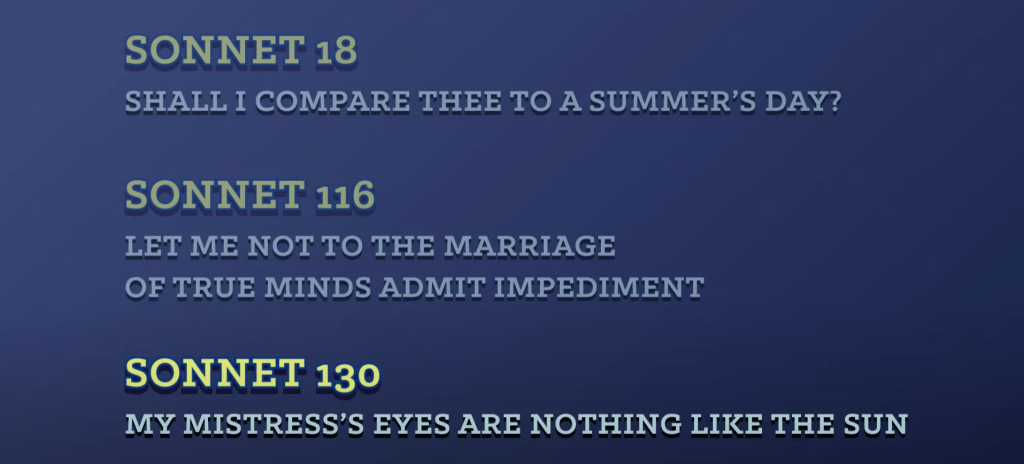
    So today, we’re going to look at the history and the controversy surrounding Shakespeare’s sonnets. And we’ll look at three particular sonnets. They’re often known by their first line, but they’re also known by numbers, so we’re gonna look at sonnet 18 AKA “Shall I Compare Thee to a Summer’s Day?”, Sonnet 116: “Let Me Not to the Marriage of True Minds Admit Impediment”, and sonnet 130: “My Mistress’s Eyes are Nothing Like the Sun.”

    crashcourse | Shakespeare’s Sonnets (Crash Course Literature 304)

    My mistress’ eyes are nothing like the sun;

    (Unquoted remainder)

    Coral is far more red than her lips’ red;
    If snow be white, why then her breasts are dun;
    If hairs be wires, black wires grow on her head.
    I have seen roses damasked, red and white,
    But no such roses see I in her cheeks;
    And in some perfumes is there more delight
    Than in the breath that from my mistress reeks.
    I love to hear her speak, yet well I know
    That music hath a far more pleasing sound;
    I grant I never saw a goddess go;
    My mistress, when she walks, treads on the ground.
    And yet, by heaven, I think my love as rare
    As any she belied with false compare.

  • A.k.a. “Let me not to the marriage of true minds”

    John’s related banter…

    So today, we’re going to look at the history and the controversy surrounding Shakespeare’s sonnets. And we’ll look at three particular sonnets. They’re often known by their first line, but they’re also known by numbers, so we’re gonna look at sonnet 18 AKA “Shall I Compare Thee to a Summer’s Day?”, Sonnet 116: “Let Me Not to the Marriage of True Minds Admit Impediment”, and sonnet 130: “My Mistress’s Eyes are Nothing Like the Sun.”

    crashcourse | Shakespeare’s Sonnets (Crash Course Literature 304)

    Let me not to the marriage of true minds

    (Unquoted remainder)

    Admit impediments; love is not love
    Which alters when it alteration finds,
    Or bends with the remover to remove.
    O no, it is an ever-fixèd mark
    That looks on tempests and is never shaken;
    It is the star to every wand’ring bark
    Whose worth’s unknown, although his height be taken.
    Love’s not time’s fool, though rosy lips and cheeks
    Within his bending sickle’s compass come.
    Love alters not with his brief hours and weeks,
    But bears it out even to the edge of doom:
    If this be error and upon me proved,
    I never writ, nor no man ever loved.

  • A.k.a. “Shall I compare thee to a summer’s day?”

    John’s related banter…

    So today, we’re going to look at the history and the controversy surrounding Shakespeare’s sonnets. And we’ll look at three particular sonnets. They’re often known by their first line, but they’re also known by numbers, so we’re gonna look at sonnet 18 AKA “Shall I Compare Thee to a Summer’s Day?”, Sonnet 116: “Let Me Not to the Marriage of True Minds Admit Impediment”, and sonnet 130: “My Mistress’s Eyes are Nothing Like the Sun.”

    crashcourse | Shakespeare’s Sonnets (Crash Course Literature 304)

    Shall I compare thee to a summer’s day?

    (Unquoted remainder)

    Thou art more lovely and more temperate:
    Rough winds do shake the darling buds of May,
    And summer’s lease hath all too short a date;
    Sometime too hot the eye of heaven shines,
    And often is his gold complexion dimm’d;
    And every fair from fair sometime declines,
    By chance or nature’s changing course untrimm’d;
    But thy eternal summer shall not fade,
    Nor lose possession of that fair thou ow’st;
    Nor shall death brag thou wander’st in his shade,
    When in eternal lines to time thou grow’st:
    So long as men can breathe or eyes can see,
    So long lives this, and this gives life to thee.

  • A.k.a. “Let me not to the marriage of true minds”

    John’s related banter…

    And then there’s sonnet 116 which is the one you’re most likely to hear at somebody’s wedding. This one is also addressed to the young man. This is in some ways the high point of Shakespeare’s love poetry although it’s perhaps a more insecure poem than it seems at first. Here it’s not poetry that is the greatest thing ever, although Shakespeare definitely gives a tip of his hat to his own writing, but love itself.

    Now just as in sonnet 18, there’s worry of the impermanence of human life and beauty. How rosy lips and cheeks will be undone by time and death. But hey, that won’t matter because love will last eternally, or at least until the, quote, edge of doom.
    That’s what Shakespeare hopes anyway, but maybe he’s isn’t certain because he’s playing some games with the language here and he’s showing how easily change and fickleness can happen. Like when you look at or read the poem, notice how easily words change in it. Alter to alteration, remover to remove, maybe he’s worried that love might change too. I mean look at that first line: “Love is not love.” And look at all the ‘no’ an ‘nors’ and ‘nevers’ in the poem.

    But in the end he does come to an empathic conclusion he says that of all the things he’s said about love are in error, quote, ” I never writ, nor no man ever loved.” Obviously he has written and men have loved, so his defense of love is solid right? Well, but then remember the line, “Love is not love.” There are all kinds of explorations in Shakespeare’s work about what real love is. But for me at least, the best line of the poem is when he writes that love is not time’s fool. True love, to Shakespeare, is not beholden to time. It doesn’t answer to time. It somehow transcends time.

    crashcourse | Shakespeare’s Sonnets (Crash Course Literature 304)

    (Unquoted beginning)

    Let me not to the marriage of true minds
    Admit impediments; love is not love
    Which alters when it alteration finds,
    Or bends with the remover to remove.
    O no, it is an ever-fixèd mark
    That looks on tempests and is never shaken;
    It is the star to every wand’ring bark
    Whose worth’s unknown, although his height be taken.

    Love’s not time’s fool,

    (Unquoted remainder)

    though rosy lips and cheeks
    Within his bending sickle’s compass come.
    Love alters not with his brief hours and weeks,
    But bears it out even to the edge of doom:
    If this be error and upon me proved,
    I never writ, nor no man ever loved.

  • A.k.a. “My mistress’ eyes are nothing like the sun”

    John’s related banter…

    And lastly, let’s take a brief look at sonnet 130. One of the one’s addressed to the dark lady. This sonnet is almost a parody, a send up of Petrarch’s sonnets about the lovely Laura, whom he barely knew. That weird renaissance worship of the person you met just one time twenty years ago, and the constant exploration of every facet of their beauty, their mouth, their eyes, their cheeks, their hair—it gets a little overwhelming.

    In sonnet 130 Shakespeare simultaneously does that and refuses to do that. Like if he suggested that a summer’s day wasn’t a good enough descriptor of his beloved, now he’s suggesting that if you compare his mistress to any of the typical stuff: suns roses, rose perfume, she’s going to fall very short. Her breasts are the color of dun, her hair is like black wires, sometimes her breath smells. This strange descriptive aggression characterizes many of the late sonnets, where the poet seems to feel ashamed about being attracted to this women.

    But again, there’s a twist at the end as there is with every good sonnet’s final couplet. “Any yet by heaven I think my love as rare/ as any she belied by false compare.” Shakespeare isn’t saying look my mistress has onion breath. Instead the speaker is saying “All of you other poets have been exaggerating like crazy, including past me. If you were actually going to describe people realistically, his lover would be as beautiful as any other. So take that Coral and perfume and summer days.”

    And for me at least, that humanization of the romantic other is, more romantic and ultimately more loving than any summer’s day. Plus she’s going to get to live forever, well, not actually, because we’re all gonna die. Even the species is going to cease to exist.

    crashcourse | Shakespeare’s Sonnets (Crash Course Literature 304)

    (Unquoted beginning)

    My mistress’ eyes are nothing like the sun;
    Coral is far more red than her lips’ red;
    If snow be white, why then her breasts are dun;
    If hairs be wires, black wires grow on her head.
    I have seen roses damasked, red and white,
    But no such roses see I in her cheeks;
    And in some perfumes is there more delight
    Than in the breath that from my mistress reeks.
    I love to hear her speak, yet well I know
    That music hath a far more pleasing sound;
    I grant I never saw a goddess go;
    My mistress, when she walks, treads on the ground.

    And yet, by heaven, I think my love as rare
    As any she belied with false compare.

  • A.k.a. “Let me not to the marriage of true minds”

    John’s related banter…

    And then there’s sonnet 116 which is the one you’re most likely to hear at somebody’s wedding. This one is also addressed to the young man. This is in some ways the high point of Shakespeare’s love poetry although it’s perhaps a more insecure poem than it seems at first. Here it’s not poetry that is the greatest thing ever, although Shakespeare definitely gives a tip of his hat to his own writing, but love itself.

    Now just as in sonnet 18, there’s worry of the impermanence of human life and beauty. How rosy lips and cheeks will be undone by time and death. But hey, that won’t matter because love will last eternally, or at least until the, quote, edge of doom.
    That’s what Shakespeare hopes anyway, but maybe he’s isn’t certain because he’s playing some games with the language here and he’s showing how easily change and fickleness can happen. Like when you look at or read the poem, notice how easily words change in it. Alter to alteration, remover to remove, maybe he’s worried that love might change too. I mean look at that first line: “Love is not love.” And look at all the ‘no’ an ‘nors’ and ‘nevers’ in the poem.

    But in the end he does come to an empathic conclusion he says that of all the things he’s said about love are in error, quote, ” I never writ, nor no man ever loved.” Obviously he has written and men have loved, so his defense of love is solid right? Well, but then remember the line, “Love is not love.” There are all kinds of explorations in Shakespeare’s work about what real love is. But for me at least, the best line of the poem is when he writes that love is not time’s fool. True love, to Shakespeare, is not beholden to time. It doesn’t answer to time. It somehow transcends time.

    crashcourse | Shakespeare’s Sonnets (Crash Course Literature 304)

    (Unquoted beginning)

    Let me not to the marriage of true minds
    Admit impediments;

    love is not love

    (Unquoted remainder)

    Which alters when it alteration finds,
    Or bends with the remover to remove.
    O no, it is an ever-fixèd mark
    That looks on tempests and is never shaken;
    It is the star to every wand’ring bark
    Whose worth’s unknown, although his height be taken.
    Love’s not time’s fool, though rosy lips and cheeks
    Within his bending sickle’s compass come.
    Love alters not with his brief hours and weeks,
    But bears it out even to the edge of doom:
    If this be error and upon me proved,
    I never writ, nor no man ever loved.

  • A.k.a. “Let me not to the marriage of true minds”

    John’s related banter…

    And then there’s sonnet 116 which is the one you’re most likely to hear at somebody’s wedding. This one is also addressed to the young man. This is in some ways the high point of Shakespeare’s love poetry although it’s perhaps a more insecure poem than it seems at first. Here it’s not poetry that is the greatest thing ever, although Shakespeare definitely gives a tip of his hat to his own writing, but love itself.

    Now just as in sonnet 18, there’s worry of the impermanence of human life and beauty. How rosy lips and cheeks will be undone by time and death. But hey, that won’t matter because love will last eternally, or at least until the, quote, edge of doom.
    That’s what Shakespeare hopes anyway, but maybe he’s isn’t certain because he’s playing some games with the language here and he’s showing how easily change and fickleness can happen. Like when you look at or read the poem, notice how easily words change in it. Alter to alteration, remover to remove, maybe he’s worried that love might change too. I mean look at that first line: “Love is not love.” And look at all the ‘no’ an ‘nors’ and ‘nevers’ in the poem.

    But in the end he does come to an empathic conclusion he says that of all the things he’s said about love are in error, quote, ” I never writ, nor no man ever loved.” Obviously he has written and men have loved, so his defense of love is solid right? Well, but then remember the line, “Love is not love.” There are all kinds of explorations in Shakespeare’s work about what real love is. But for me at least, the best line of the poem is when he writes that love is not time’s fool. True love, to Shakespeare, is not beholden to time. It doesn’t answer to time. It somehow transcends time.

    crashcourse | Shakespeare’s Sonnets (Crash Course Literature 304)

    (Unquoted beginning)

    Let me not to the marriage of true minds
    Admit impediments; love is not love
    Which alters when it alteration finds,
    Or bends with the remover to remove.
    O no, it is an ever-fixèd mark
    That looks on tempests and is never shaken;
    It is the star to every wand’ring bark
    Whose worth’s unknown, although his height be taken.
    Love’s not time’s fool, though

    rosy lips and cheeks

    (Unquoted remainder)

    Within his bending sickle’s compass come.
    Love alters not with his brief hours and weeks,
    But bears it out even to the edge of doom:
    If this be error and upon me proved,
    I never writ, nor no man ever loved.

  • A.k.a. “Let me not to the marriage of true minds”

    John’s related banter…

    And then there’s sonnet 116 which is the one you’re most likely to hear at somebody’s wedding. This one is also addressed to the young man. This is in some ways the high point of Shakespeare’s love poetry although it’s perhaps a more insecure poem than it seems at first. Here it’s not poetry that is the greatest thing ever, although Shakespeare definitely gives a tip of his hat to his own writing, but love itself.

    Now just as in sonnet 18, there’s worry of the impermanence of human life and beauty. How rosy lips and cheeks will be undone by time and death. But hey, that won’t matter because love will last eternally, or at least until the, quote, edge of doom.
    That’s what Shakespeare hopes anyway, but maybe he’s isn’t certain because he’s playing some games with the language here and he’s showing how easily change and fickleness can happen. Like when you look at or read the poem, notice how easily words change in it. Alter to alteration, remover to remove, maybe he’s worried that love might change too. I mean look at that first line: “Love is not love.” And look at all the ‘no’ an ‘nors’ and ‘nevers’ in the poem.

    But in the end he does come to an empathic conclusion he says that of all the things he’s said about love are in error, quote, ” I never writ, nor no man ever loved.” Obviously he has written and men have loved, so his defense of love is solid right? Well, but then remember the line, “Love is not love.” There are all kinds of explorations in Shakespeare’s work about what real love is. But for me at least, the best line of the poem is when he writes that love is not time’s fool. True love, to Shakespeare, is not beholden to time. It doesn’t answer to time. It somehow transcends time.

    crashcourse | Shakespeare’s Sonnets (Crash Course Literature 304)

    (Unquoted beginning)

    Let me not to the marriage of true minds
    Admit impediments; love is not love
    Which alters when it alteration finds,
    Or bends with the remover to remove.
    O no, it is an ever-fixèd mark
    That looks on tempests and is never shaken;
    It is the star to every wand’ring bark
    Whose worth’s unknown, although his height be taken.
    Love’s not time’s fool, though rosy lips and cheeks
    Within his bending sickle’s compass come.
    Love alters not with his brief hours and weeks,
    But bears it out even to the edge of doom:
    If this be error and upon me proved,

    I never writ, nor no man ever loved.

  • A.k.a. “Let me not to the marriage of true minds”

    John’s related banter…

    And then there’s sonnet 116 which is the one you’re most likely to hear at somebody’s wedding. This one is also addressed to the young man. This is in some ways the high point of Shakespeare’s love poetry although it’s perhaps a more insecure poem than it seems at first. Here it’s not poetry that is the greatest thing ever, although Shakespeare definitely gives a tip of his hat to his own writing, but love itself.

    Now just as in sonnet 18, there’s worry of the impermanence of human life and beauty. How rosy lips and cheeks will be undone by time and death. But hey, that won’t matter because love will last eternally, or at least until the, quote, edge of doom.
    That’s what Shakespeare hopes anyway, but maybe he’s isn’t certain because he’s playing some games with the language here and he’s showing how easily change and fickleness can happen. Like when you look at or read the poem, notice how easily words change in it. Alter to alteration, remover to remove, maybe he’s worried that love might change too. I mean look at that first line: “Love is not love.” And look at all the ‘no’ an ‘nors’ and ‘nevers’ in the poem.

    But in the end he does come to an empathic conclusion he says that of all the things he’s said about love are in error, quote, ” I never writ, nor no man ever loved.” Obviously he has written and men have loved, so his defense of love is solid right? Well, but then remember the line, “Love is not love.” There are all kinds of explorations in Shakespeare’s work about what real love is. But for me at least, the best line of the poem is when he writes that love is not time’s fool. True love, to Shakespeare, is not beholden to time. It doesn’t answer to time. It somehow transcends time.

    crashcourse | Shakespeare’s Sonnets (Crash Course Literature 304)

    (Unquoted beginning)

    Let me not to the marriage of true minds
    Admit impediments;

    love is not love

    (Unquoted remainder)

    Which alters when it alteration finds,
    Or bends with the remover to remove.
    O no, it is an ever-fixèd mark
    That looks on tempests and is never shaken;
    It is the star to every wand’ring bark
    Whose worth’s unknown, although his height be taken.
    Love’s not time’s fool, though rosy lips and cheeks
    Within his bending sickle’s compass come.
    Love alters not with his brief hours and weeks,
    But bears it out even to the edge of doom:
    If this be error and upon me proved,
    I never writ, nor no man ever loved.

  • A.k.a. “Shall I compare thee to a summer’s day?”

    John’s related banter…

    So okay, let’s move on to sonnet 18. Now if you’ve seen Shakespeare in love, you know that Shakespeare wrote this for Gwyneth Paltrow. Nope, he didn’t. In “Shall I Compare Thee to a Summer’s Day?” the thee in question is that mysterious young man. Basically sonnet 18 is one big extended metaphor, but the hook is that it’s a metaphor that the poet admits isn’t especially successful. Yes, the poet could compare his beloved to a summer’s day, but it turns out that this comparison isn’t really apt. Like the beloved, is nicer than a summer’s day, the beloved has better weather. Really? Better weather? Well, I guess this was England, so yeah, let’s just go with it. And there’s always something lousy about summer days they’re too hot, or they’re windy, or if they’re perfect they’re over too quickly. But that’s not going to be the case with the beloved. Because just like in sonnet 55 the poet is going to immortalize the beloved in this very poem. Thereby he will make the young man perfect eternally. Like a summer day might end, but the beauty of the beloved is going to go on forever “so long as men can breathe or eyes can see.” And this wasn’t, like, Shakespeare being arrogant, this was a pretty common trope in Elizabethan verse, this idea that human life was temporary but that poetry is forever.

    crashcourse | Shakespeare’s Sonnets (Crash Course Literature 304)

    Shall I compare thee to a summer’s day?

    (Unquoted remainder)

    Thou art more lovely and more temperate:
    Rough winds do shake the darling buds of May,
    And summer’s lease hath all too short a date;
    Sometime too hot the eye of heaven shines,
    And often is his gold complexion dimm’d;
    And every fair from fair sometime declines,
    By chance or nature’s changing course untrimm’d;
    But thy eternal summer shall not fade,
    Nor lose possession of that fair thou ow’st;
    Nor shall death brag thou wander’st in his shade,
    When in eternal lines to time thou grow’st:
    So long as men can breathe or eyes can see,
    So long lives this, and this gives life to thee.

  • A.k.a. “Shall I compare thee to a summer’s day?”

    John’s related banter…

    crashcourse | Shakespeare’s Sonnets (Crash Course Literature 304)

    (Unquoted beginning)

    Shall I compare thee to a summer’s day?
    Thou art more lovely and more temperate:
    Rough winds do shake the darling buds of May,
    And summer’s lease hath all too short a date;
    Sometime too hot the eye of heaven shines,
    And often is his gold complexion dimm’d;
    And every fair from fair sometime declines,
    By chance or nature’s changing course untrimm’d;
    But thy eternal summer shall not fade,
    Nor lose possession of that fair thou ow’st;
    Nor shall death brag thou wander’st in his shade,
    When in eternal lines to time thou grow’st:
    So long as men can breathe or

    eyes can see,

    (Unquoted remainder)

    So long lives this, and this gives life to thee.

  • A.k.a. “My mistress’ eyes are nothing like the sun”

    John’s related banter…

    And lastly, let’s take a brief look at sonnet 130. One of the one’s addressed to the dark lady. This sonnet is almost a parody, a send up of Petrarch’s sonnets about the lovely Laura, whom he barely knew. That weird renaissance worship of the person you met just one time twenty years ago, and the constant exploration of every facet of their beauty, their mouth, their eyes, their cheeks, their hair—it gets a little overwhelming.

    In sonnet 130 Shakespeare simultaneously does that and refuses to do that. Like if he suggested that a summer’s day wasn’t a good enough descriptor of his beloved, now he’s suggesting that if you compare his mistress to any of the typical stuff: suns roses, rose perfume, she’s going to fall very short. Her breasts are the color of dun, her hair is like black wires, sometimes her breath smells. This strange descriptive aggression characterizes many of the late sonnets, where the poet seems to feel ashamed about being attracted to this women.

    But again, there’s a twist at the end as there is with every good sonnet’s final couplet. “Any yet by heaven I think my love as rare/ as any she belied by false compare.” Shakespeare isn’t saying look my mistress has onion breath. Instead the speaker is saying “All of you other poets have been exaggerating like crazy, including past me. If you were actually going to describe people realistically, his lover would be as beautiful as any other. So take that Coral and perfume and summer days.”

    And for me at least, that humanization of the romantic other is, more romantic and ultimately more loving than any summer’s day. Plus she’s going to get to live forever, well, not actually, because we’re all gonna die. Even the species is going to cease to exist.

    crashcourse | Shakespeare’s Sonnets (Crash Course Literature 304)

    (Unquoted beginning)

    My mistress’ eyes are nothing like the sun;
    Coral is far more red than her lips’ red;
    If snow be white, why then

    her breasts are dun;

    (Unquoted remainder)

    If hairs be wires, black wires grow on her head.
    I have seen roses damasked, red and white,
    But no such roses see I in her cheeks;
    And in some perfumes is there more delight
    Than in the breath that from my mistress reeks.
    I love to hear her speak, yet well I know
    That music hath a far more pleasing sound;
    I grant I never saw a goddess go;
    My mistress, when she walks, treads on the ground.
    And yet, by heaven, I think my love as rare
    As any she belied with false compare.

  • A.k.a. “Let me not to the marriage of true minds”

    John’s related banter…

    And then there’s sonnet 116 which is the one you’re most likely to hear at somebody’s wedding. This one is also addressed to the young man. This is in some ways the high point of Shakespeare’s love poetry although it’s perhaps a more insecure poem than it seems at first. Here it’s not poetry that is the greatest thing ever, although Shakespeare definitely gives a tip of his hat to his own writing, but love itself.

    Now just as in sonnet 18, there’s worry of the impermanence of human life and beauty. How rosy lips and cheeks will be undone by time and death. But hey, that won’t matter because love will last eternally, or at least until the, quote, edge of doom.
    That’s what Shakespeare hopes anyway, but maybe he’s isn’t certain because he’s playing some games with the language here and he’s showing how easily change and fickleness can happen. Like when you look at or read the poem, notice how easily words change in it. Alter to alteration, remover to remove, maybe he’s worried that love might change too. I mean look at that first line: “Love is not love.” And look at all the ‘no’ an ‘nors’ and ‘nevers’ in the poem.

    But in the end he does come to an empathic conclusion he says that of all the things he’s said about love are in error, quote, ” I never writ, nor no man ever loved.” Obviously he has written and men have loved, so his defense of love is solid right? Well, but then remember the line, “Love is not love.” There are all kinds of explorations in Shakespeare’s work about what real love is. But for me at least, the best line of the poem is when he writes that love is not time’s fool. True love, to Shakespeare, is not beholden to time. It doesn’t answer to time. It somehow transcends time.

    crashcourse | Shakespeare’s Sonnets (Crash Course Literature 304)

    (Unquoted beginning)

    Let me not to the marriage of true minds
    Admit impediments; love is not love
    Which alters when it alteration finds,
    Or bends with the remover to remove.
    O no, it is an ever-fixèd mark
    That looks on tempests and is never shaken;
    It is the star to every wand’ring bark
    Whose worth’s unknown, although his height be taken.
    Love’s not time’s fool, though rosy lips and cheeks
    Within his bending sickle’s compass come.
    Love alters not with his brief hours and weeks,
    But bears it out even to

    the edge of doom

    (Unquoted remainder)

    If this be error and upon me proved,
    I never writ, nor no man ever loved.

  • A.k.a. “Shall I compare thee to a summer’s day?”

    John’s related banter…

    So okay, let’s move on to sonnet 18. Now if you’ve seen Shakespeare in love, you know that Shakespeare wrote this for Gwyneth Paltrow. Nope, he didn’t. In “Shall I Compare Thee to a Summer’s Day?” the thee in question is that mysterious young man. Basically sonnet 18 is one big extended metaphor, but the hook is that it’s a metaphor that the poet admits isn’t especially successful. Yes, the poet could compare his beloved to a summer’s day, but it turns out that this comparison isn’t really apt. Like the beloved, is nicer than a summer’s day, the beloved has better weather. Really? Better weather? Well, I guess this was England, so yeah, let’s just go with it. And there’s always something lousy about summer days they’re too hot, or they’re windy, or if they’re perfect they’re over too quickly. But that’s not going to be the case with the beloved. Because just like in sonnet 55 the poet is going to immortalize the beloved in this very poem. Thereby he will make the young man perfect eternally. Like a summer day might end, but the beauty of the beloved is going to go on forever “so long as men can breathe or eyes can see.” And this wasn’t, like, Shakespeare being arrogant, this was a pretty common trope in Elizabethan verse, this idea that human life was temporary but that poetry is forever.

    crashcourse | Shakespeare’s Sonnets (Crash Course Literature 304)

    (Unquoted beginning)

    Shall I compare thee to a summer’s day?
    Thou art more lovely and more temperate:
    Rough winds do shake the darling buds of May,
    And summer’s lease hath all too short a date;
    Sometime too hot the eye of heaven shines,
    And often is his gold complexion dimm’d;
    And every fair from fair sometime declines,
    By chance or nature’s changing course untrimm’d;
    But thy eternal summer shall not fade,
    Nor lose possession of that fair thou ow’st;
    Nor shall death brag thou wander’st in his shade,
    When in eternal lines to time thou grow’st:

    So long as men can breathe or eyes can see,

    (Unquoted ending)

    So long lives this, and this gives life to thee.

  • A.k.a. “Not marble nor the gilded monuments”

    John’s related banter…

    I quite like them, like, Shakespeare manages to cram a lot of emotion into his highly structured form. And maybe most importantly, the sonnet’s make Shakespeare’s case for why he thinks poetry is important in the first place: that people die but poetry lives on. Like in sonnet 55, Shakespeare writes:

    And yet, quick side-note, Shakespeare talks about how bright this young man’s memory will shine but we know nothing about him. The poetry may last but people still don’t.

    crashcourse | Shakespeare’s Sonnets (Crash Course Literature 304)

    Not marble nor the gilded monuments
    Of princes shall outlive this powerful rhyme,
    But you shall shine more bright in these contents
    Than unswept stone besmeared with sluttish time.

    (Unquoted remainder)

    When wasteful war shall statues overturn,
    And broils root out the work of masonry,
    Nor Mars his sword nor war’s quick fire shall burn
    The living record of your memory.
    ’Gainst death and all-oblivious enmity
    Shall you pace forth; your praise shall still find room
    Even in the eyes of all posterity
    That wear this world out to the ending doom.
    So, till the Judgement that yourself arise,
    You live in this, and dwell in lovers’ eyes.

  • A.k.a. “Two loves I have of comfort and despair”

    John’s related banter…

    I still think it’s worth noting and understanding that all of the most romantic and loving of the sonnets are those addressed to the young man. Like sonnets 127-154, the ones addressed to the so called “black mistress” are a lot darker and no one’s reading those at weddings. But about the “black mistress” or “dark lady” who appears in those sonnets, we also don’t know who she is. Scholars have suggested royal waiting women, female poets, at least one British-African brothel owner; but we don’t even know if she was black as we use the term today, or just brunette in contrast to the blond young man.
    But the dark lady sonnets are more complicated than the one’s addressed to the young man. The speaker feels tormented and ashamed of his sexual attraction to the woman and even in the sonnets praising her he gets as we’ll see some insults in. Like in sonnet 144 he actually compares the two muses. He talks of having two loves:

    crashcourse | Shakespeare’s Sonnets (Crash Course Literature 304)

    (Unquoted beginning)

    Two loves I have of comfort and despair,

    Which like two spirits do suggest me still

    The better angel is a man right fair,
    The worser spirit a woman coloured ill.

    (Unquoted remainder)

    To win me soon to hell, my female evil
    Tempteth my better angel from my side,
    And would corrupt my saint to be a devil,
    Wooing his purity with her foul pride.
    And, whether that my angel be turn’d fiend,
    Suspect I may, yet not directly tell,
    But being both from me both to each friend,
    I guess one angel in another’s hell.
    Yet this shall I ne’er know, but live in doubt,
    Till my bad angel fire my good one out.

  • See also: John Keats – John Green Reads Poetry

    John’s related banter…

    John from the Past: Mr. Green! Mr. Green! What’s a sonnet?

    John: Good question me from the past. In fact, such a good question that your seventh grade English teacher answered it for you, but apparently, you’ve forgotten. A sonnet is a poetic form consisting of fourteen lines and there are various ways to order the stanzas and the rhyme scheme. But the Shakespearean stanza (named for Will, not because he invented it, but because, you know, he was the best at it) consists of three four line stanzas and a final rhymed couplet. So the rhyme scheme is ABAB CDCD EFEF GG. And the meter in Shakespearean sonnets, as in much of Shakespeare’s plays, is iambic pentameter, which means that every line has 10 syllables consisting of five iambs. Which is just a fancy word for pairs of unstressed and stressed syllables. So a line of a Shakespearean poem goes da-Duh-da-Duh-da-Duh-da-Duh-da-Duh. This turns out to do something to English speaking brains that’s just very catchy. Like, a lot of times pop songs are written in iambs, like a lot of times when we speak we accidentally speak in them. But when I’m trying to remember the sound of iambic pentameter, I just remember John Keats’s last will and testament, which was one line of iambic pentameter:

    crashcourse | Shakespeare’s Sonnets (Crash Course Literature 304)

    Click here to read verse

    My chest of books divide among my friends.

  • A.k.a. “Shall I compare thee to a summer’s day?”

    John’s related banter…

    (Quotes a version of the sonnet’s opening casually)

    That William Shakespeare he knew how to deliver a complement. That’s right, today we’re talking about Shakespeare’s sonnets, collected and published in 1609.

    crashcourse | Shakespeare’s Sonnets (Crash Course Literature 304)

    Shall I compare thee to a summer’s day?
    Thou art more lovely and more temperate:

    (Unquoted remainder)

    Rough winds do shake the darling buds of May,
    And summer’s lease hath all too short a date;
    Sometime too hot the eye of heaven shines,
    And often is his gold complexion dimm’d;
    And every fair from fair sometime declines,
    By chance or nature’s changing course untrimm’d;
    But thy eternal summer shall not fade,
    Nor lose possession of that fair thou ow’st;
    Nor shall death brag thou wander’st in his shade,
    When in eternal lines to time thou grow’st:
    So long as men can breathe or eyes can see,
    So long lives this, and this gives life to thee.

  • Originally written in Polish (Polski), “Spróbuj opiewać okaleczony świat” was translated into English by Clare Cavanagh.

    The brothers’ related banter…

    John: Would you like to hear a short poem for today?

    Hank: Yes!

    John: Uh, this isn’t that sort of a poem, but I think it’s the right poem to read this week. It’s a poem by Adam Zagajewski called Try to Praise The Mutilated World.

    (Reads poem)

    John: Try to Praise The Mutilated World by Adam Zagajewski.

    Hank: Thanks for bringing us up, John.

    John: I like to bring it all the way up, to the energy!

    Hank: It started off on a pretty rough note but you really brought it back.

    John: That’s what I like to do, man. I like to take it from down, to down even lower.

    Hank: (groans) Well that was a beautiful poem. I… want to answer some questions though. I want to move it.

    tumblr

    Dear Hank & John | Ep. 055

    Click to read poem

    Try to praise the mutilated world.
    Remember June’s long days,
    and wild strawberries, drops of rosé wine.
    The nettles that methodically overgrow
    the abandoned homesteads of exiles.
    You must praise the mutilated world.
    You watched the stylish yachts and ships;
    one of them had a long trip ahead of it,
    while salty oblivion awaited others.
    You’ve seen the refugees going nowhere,
    you’ve heard the executioners sing joyfully.
    You should praise the mutilated world.
    Remember the moments when we were together
    in a white room and the curtain fluttered.
    Return in thought to the concert where music flared.
    You gathered acorns in the park in autumn
    and leaves eddied over the earth’s scars.
    Praise the mutilated world
    and the gray feather a thrush lost,
    and the gentle light that strays and vanishes
    and returns.


    For the original Polish (Polski) click here

    Spróbuj opiewać okaleczony świat

    Pamiętaj o długich dniach czerwca
    i o poziomkach, kroplach wina rosé.
    O pokrzywach, które metodycznie zarastały
    opuszczone domostwa wygnanych.

    Musisz opiewać okaleczony świat.

    Patrzyłeś na eleganckie jachty i okręty;
    jeden z nich miał przed sobą długą podróż,
    na inny czekała tylko słona nicość.
    Widziałeś uchodźców, którzy szli donikąd,
    słyszałeś oprawców, którzy radośnie śpiewali.

    Powinieneś opiewać okaleczony świat.

    Pamiętaj o chwilach, kiedy byliście razem
    w białym pokoju i firanka poruszyła się.
    Wróć myślą do koncertu, kiedy wybuchła muzyka.
    Jesienią zbierałeś żołędzie w parku
    a liście wirowały nad bliznami ziemi.

    Opiewaj okaleczony świat

    i szare piórko, zgubione przez drozda,
    i delikatne światło, które błądzi i znika
    i powraca.

  • John quotes part I out of a total five

    The brothers’ related banter…

    John: Would you like a short poem for today?

    Hank: Uh yes I would. Ah but first I want to tell the audience–the listeners of the pod–that I have a bad cough, so I’m gonna do my best but if I sound gross or make bad noises, blame viruses, not me.

    John: Hank I don’t want to say that you don’t seem to be at your best right now, but you don’t. You don’t seem–I don’t–I don’t feel like I’m getting 100% of that Hank Green pod energy that I come to the pod for. 

    Hank: Well you know John, what really gets me going is a short poem. Is short poems.

    John: Well, this one’s about depression, and it’s called “Not so far as the forest” by Edna St. Vincent Millay.  Actually, just part of “Not so far as the forest” so as to keep it short. 

    (Reads poem excerpt)

    John: “Not so far as the forest” by Edna St. Vincent Millay.  Longtime favorite poem of mine, Hank, I even put it in Looking for Alaska, I liked it so much.

    Hank: Uhhh, yeah, that’s–that was good, I liked that, and also appropriate for post-VidCon, when I am often sick but always in a little bit of a cannot-see-the-sunset-because-of-the-clouds funk due, just due to, I think, psychology and coming down off a big high.  It’s always a wonderful moment when VidCon is over, not because I didn’t enjoy it, but because the chances of something going wrong have reached 0 and it does not 0 until it’s over, but then, the weeks afterward, I’m always like, what–what is life for?  I’m no longer having that time.

    tumblr

    Dear Hank & John | Ep. 054

    Click to read Part I

    That chill is in the air
    Which the wise know well, and even have learned to bear.
    This joy, I know,
    Will soon be under snow.

    The sun sets in a cloud
    And is not seen.
    Beauty, that spoke aloud,
    Addresses now only the remembering ear.
    The heart begins here
    To feed on what has been.

    Night falls fast.
    Today is in the past.

    Blown from the dark hill hither to my door
    Three flakes, then four
    Arrive, then many more.


    Click to read the remaining parts (II-V)

    II
    Branch by branch
    This tree has died. Green only
    Is one last bough, moving its leaves in the sun.

    What evil ate its root, what blight,
    What ugly thing,
    Let the mole say, the bird sing;
    Or the white worm behind the shedding bark
    Tick in the dark.

    You and I have only one thing to do:
    Saw the trunk through.

    III
    Distressed mind, forbear
    To tease the hooded Why:
    That shape will not reply.

    From the warm chair
    To the wind’s welter
    Flee, if storm’s your shelter.

    But no, you needs must part,
    Fling him his release–
    On whose ungenerous heart
    Alone you are at peace.

    IV
    Not dead of wounds, not borne
    Home to the village on a litter of branches, torn
    By splendid claws and the talk all night of the villagers,
    But stung to death by gnats
    Lies Love.

    What swamp I sweated through for all these years
    Is at length plain to me.

    V
    Poor passionate thing,
    Even with this clipped wing how well you flew!–though not so far as the forest.

    Unwounded and unspent, serene but for the eye’s bright trouble,
    Was it the lurching flight, the unequal wind under the lopped feathers that brought you down,
    To sit in folded colours on the empty level field,
    Visible as a ship, paling the yellow stubble?

    Rebellious bird, warm body foreign and bright,
    Has no one told you?–Hopeless is your flight
    Towards the high branches. Here is your home,
    Between barnyard strewn with grain and the forest tree.
    Though Time refeather the wing,
    Ankle slip the ring,
    The once-confined thing
    Is never again free.

  • Who is ‘Leon Muss’?

    Ep. 052 is the start of this recurring alter ego of John, a playful rib on Elon Musk:

    J: I’m very excited Hank to find out whether there’s going to be a human on Mars by 2017, and indeed to have our listeners to suggest stakes in this bet. It finally gives me something that I can get excited about: Preventing human beings from going to Mars by 2027.

    H: *laughing* Oh god.

    J: I’ve finally got a mission in life: I’ve got to sabotage Elon Musk’s mission.

    H: No, no… yeah.

    J: I’m gonna become the anti-Elon Musk. I’m gonna start like advocating for decreasing the amount of money we spend on space. Who wants to go to space when we’ve got a great planet right here?

    H: Can we call you like Leon Mush? *John cackles* The anti Elon Musk: Leon Mush.

    J: *still chuckling* Oh man, I’m starting a twitter right now twitter.com/leonmuss where I’m gonna do nothing but destroy Elon Musk’s whole life so I can prevent him from sending people to Mars and win some stupid bet with you.

    The brothers’ related banter…

    John: You know if I could just read one short poem, Hank.

    Hank: Oh, okay. Well that’s usually how you do it.

    John: Do you know- do you mind?

    Hank: Yeah, don’t do two.

    John: I won’t do two. I’m just going to do one short poem for the day. It’s a prose poem.

    Hank: Is it by Leon Muss?

    John: It’s by Leon Muss! (wheezes)

    Hank: (outright laughter)

    John: (high pitched giggling) (wheezing) He writes- (breath) It’s a poem by Leon Muss. It’s on his twitter @LeonMuss4Earth … (giggles) (breath)

    (Reads tweet)

    Hank: (laughs) Good. Great. That’s beautiful.

    John: You’re welcome for the short poem. (burst of laughter) I have already had more fun in this podcast than I usually have ALL WEEK LONG.

    tumblr

    Dear Hank & John | Ep. 053

    Click to read poem

    People often ask me, ‘Leon Muss, should we send humans to Mars?’ And I always tell them, ‘Yes. In 2028 and not a day sooner.’

    A screengrab of the original Tweet
  • Background

    Muhammad Ali famously said, “Float like a butterfly, sting like a bee. The hands can’t hit what the eyes can’t see.” in the lead-up to his 1964 fight against Sonny Liston.

     The phrase was crafted with the help of his cornerman and assistant trainer, Drew “Bundini” Brown, who was known for his poetic flair and motivational rhymes. Brown played a key role in shaping Ali’s public persona and helped coin several of his iconic lines.

    The brothers’ related banter…

    H: Hey John, how are you doing?

    J: Not great, it’s been a terrible week, Hank. As you know, here in the United States, it’s just been a really hard difficult painful week, I think, for everyone.

    H: Yes. And I’m sure that we will talk about that in the midst of our podcast questions, several of which have to do with that. But first, do you have a short poem for us?

    J: I do, among the terrible things that happened since the last time we recorded the podcast is that the great Muhammad Ali died. The greatest boxer of all time, who wrote this poem:

    (Reads poem)

    J: I’m a huge Muhammad Ali fan, Hank. He was a great writer, a great off-the-cuff poet, like the first great freestyler. Just a massive Muhammad Ali fan. The world is poorer without him.

    H: And that’s not making it up. I remember you being a huge Muhammad Ali fan when I was a kid, and not really understanding it.

    J: Well I think I’ve always been attracted to his poetry, but also there’s a certain poetry about the way that he boxed. He was a complicated person, but then again, most of us are. And I was a huge fan of his, and very very sorry his loss.

    tumblr

    Dear Hank & John | Ep. 052

    Click to read poem

    Float like a butterfly, sting like a bee.

    The hands can’t hit what the eyes can’t see.

  • The brothers’ related banter…

    Hank: Maybe we should have a poem before we just start talking about existentialism for the entire episode.

    John: Alright, this is another haiku from Richard Wright. I’m a huge Richard Wright fan, and he has written a lot of good haikus over the years.

    (Reads haiku)

    Hank: Alright. So the real…

    John: You love that one, Hank, because it’s short. …

    tumblr

    Dear Hank & John | Ep. 051

    Click to read poem

    You moths must leave now;
    I’m turning out the light
    And going to sleep

  • Also titled “Let No Charitable Hope”

    The brothers’ related banter…

    H: John, do you have a short poem for us?

    J: I do have a short poem, Hank. It’s Now Let No Charitable Hope by Eleanor Morton Wiley an American poet from the sort of late 19th early 20th century. 

    (Reads poem)

    J: Eleanor Morton Wiley with Now Let No Charitable Hope. I love that idea that no year has quite merited her fear and none has quite escaped her smile. There’s little bit of hoping that poem and I’m just feeling very hopeful right now because I have been reminded that occasionally improbable wonders do befall us.

    H: All right. Well congratulations on having an improbable wonder befall you John. Put that on a t-shirt and it’ll be great.

    H: So here is another question, this one is from Lizzie, who asks “Dear Hank and John, shouldn’t gravy boats be called gravy baths, as the gravy is inside of it?”

    J: I like that we’re really focusing on the hard hitting difficult questions today, Hank.

    H: We’ll get there. We’ll get to some hard questions, John. I think that we’ll get to some harder ones. I have some strong opinions on this if you don’t.

    J: I do have a strong opinion. But I suspect that your strong opinion is that “gravy boat” is the wrong word and that we should start using “gravy bath,” whereas I actually really like “gravy boat.”

    H: I agree with you, I agree with you because gravy boats are– the gravy is the passenger in the gravy boat, and it is sailing in the ocean of Thanksgiving Dinner.

    J: That’s right, so it is a-sail on the ship of your dining room table, and the gravy is the passenger.

    H: Yes. The water in this metaphor is just the ethereal nature of the feast that you are consuming.

    J: That’s beautiful Hank.

    H: Things are like like other things, John.

    J: You missed your calling by not being a poet, “things are like other things” is one of the best poems I’ve ever heard in my entire life. It’s a simile, but it’s also a metaphor, it’s got a lot going for it. I actually think I might get a “things are like other things” tattoo someday.

    H: I have to say that I stole that joke from Twitter, and I don’t know who tweeted it, I just saw it on Tumblr, and the tweet was “yes! we get it, poets, things are like other things!” 

    J: I’m glad you acknowledge having stolen that joke. Which I mean, it would’ve been perfectly plausible to me that two people thought of that same joke, but I appreciate your honesty.

    tumblr

    Dear Hank & John | Ep. 050

    Click to read poem

    Now let no charitable hope
    Confuse my mind with images
    Of eagle and of antelope:
    I am by nature none of these.

    I was, being human, born alone;
    I am, being woman, hard beset;
    I live by squeezing from a stone
    The little nourishment I get.

    In masks outrageous and austere
    The years go by in single file;
    But none has merited my fear,
    And none has quite escaped my smile.

  • A.k.a. “I loved my friend”. It is superscripted: (To F. S.)

    Guest Hank: Sydney Green (the brothers’ mom)

    Their related banter…

    John: Oh wait, Mom, I forgot about the short poem.

    Sydney: You did! I was wondering. I’m very excited about this.

    John: Alright, I do have a short poem. You’ll never guess what it’s about.

    Sydney: Uhh Death?

    John: It’s about death. You’re correct. This is a beautiful short poem by Langston Hughes, one of the all time best short poets in my opinion. Um he wrote–this poem is actually just called “Poem”.

    (Reads poem)

    Sydney: oh

    John: It might not be about death; it might just be about a friend break-up, but it’s very sad, isn’t it?

    Sydney: It is very sad. 

    John: I love “The poem ends, / Soft as it began- ” 

    Sydney: I do too.

    John: Ah he’s good.

    Sydney: Maybe you’ll keep that one for my funeral.

    John: Oh goodness gracious, must I? Must we go there?

    Sydney: Well I don’t know; it’s a podcast about death.

    John: Now people are seeing where I got the obsession from. 

    tumblr

    Dear Hank & John | Ep. 049

    Click to read poem

    I loved my friend. 
    He went away from me. 
    There’s nothing more to say. 
    The poem ends, 
    Soft as it began,—
    I loved my friend. 

  • Note: John later incorporated this almost verbatim* into his fifth solo novel, Turtles All The Way Down (Dutton Books, 2017) as words from the protagonist, Aza Holmes’, perspective

    * Click for the full behind-the-scenes…
    Source: Reddit
    Source: tumblr
    The brothers’ related banter…

    John: Do you want a short poem for the day? Its a very short poem that was sent in by an anonymous listener actually, ready?

    Hank: Oh interesting.

    John: Here it is, ready? It’s just a couplet, two lines of iambic pentameter: 

    (Reads poem)

    Hank: Aaah. Mmmm, interesting.

    John: Not bad right?

    Hank: I like it, I don’t know that I agree.

    John: I don’t know, I think the daffodil knows a lot about spring.

    Hank: I think you may know more about everything than the daffodil knows about anything.

    [John laughing]

    John: Well yes that’s probably literally true, that’s a good point.

    Hank: I apologize. I feel as if I’ve embarrassed my family with that comment. I feel like Neil DeGrasse Tyson tweeting right now.

    [John laughing]

    tumblr

    Dear Hank & John | Ep. 048

    Click to read poem

    The daffodil knows more of spring
    than I will ever know of anything

  • A.k.a. Poem 1286 or 1263 because of differences in how her poems have been cataloged by editors over time.*

    *Click here if you want to learn more about the reasons behind the different numbering…

    The two most commonly cited numbering systems for Dickinson’s poems come from:

    Ralph W. Franklin’s edition (The Poems of Emily Dickinson: Reading Edition, 1998): This is a more recent and widely used edition that re-edited and re-numbered the poems based on manuscript evidence. In Franklin’s edition, the poem is numbered 1286. Franklin used more detailed manuscript analysis, including paper type, handwriting, and other physical evidence, to create a more accurate chronological order.

    Thomas H. Johnson’s edition (The Poems of Emily Dickinson, 1955): This was the first comprehensive scholarly edition and assigned the number 1263 to the poem. Johnson arranged them roughly chronologically based on his interpretation of when they were written.

    The brothers’ related banter…

    John: Uhm, can I read you a poem? 

    Hank: Oh yes, of course! 

    John: Hank, it will surprise and delight you to learn that today’s poem comes from Emily Dickinson. 

    Hank: Oh. 

    (Reads poem)

    Hank: It was a little, a little love song. That was a — that was a short poem John. 

    John: Well, I like them short. 

    Hank: That’s, I apologize for not having anything more intelligent than that to say. Uh, but, but —

    John: That’s fine…

    Dear Hank & John | Ep. 047

    Click to read poem

    There is no Frigate like a Book
    To take us Lands away,
    Nor any Coursers like a Page
    Of prancing Poetry – 
    This Traverse may the poorest take
    Without oppress of Toll – 
    How frugal is the Chariot
    That bears a Human soul.

  • The brothers’ related banter…

    H: I’m doing well as well, and we’re gonna answer some questions, does that–oh, no, you’ve got a poem!  You’ve got a poem!  Poem!  Poem!  Poem!

    J: Hank!  Hank!  Hank!  Usually, we have a poem at this part of the day.

    H: But?

    J: Well, do you want one?

    H: Yeah!  Well, as much as I ever do.  

    J: I thought we’d read another poem from Frances Cornford, Hank, the poet whose husband was named Francis Cornford.  This one is called The Guitarist Tunes Up.  

    (Reads poem)

    J: It’s a little dirty, but you know, I figure we can handle it.  

    H: Yeah.  Alright.

    tumblr

    Dear Hank & John | Ep. 046

    Click to read poem

    With what attentive courtesy he bent
    Over his instrument;
    Not as a lordly conquerer who could
    Command both wire and wood,
    But as a man with a loved woman might,
    Inquiring with delight
    What slight essential things she had to say
    Before they started, he and she, to play.

  • A.k.a. Poem 314

    The brothers’ related banter…

    John: Would you like a short poem for the day?

    Hank: Let’s do it! Is it about, is about pigeons?

    John: It’s not about pigeons, Hank. But, it is about feathers. 

    Hank: Oh, okay. That’s close.

    John: We’ve actually had this poem before on the podcast, Hank. But, I’m in such a good mood and I can’t think of a better situation in which to read this poem, often known as “Hope is the Thing With Feathers” by the brilliant Emily Dickinson. 

    (Reads poem)

    John: “Hope is the Thing With Feathers,” also known as Poem 314 by Emily Dickinson. Hank, have you ever noticed how hope really is the thing with feathers? How, just when you think it’s been extinguished it flies up and l-leaps in front of you?

    Hank: Uh… I mean, that doesn’t feel like so much the case for like, Dag & Red fans right now.

    John: Ha ha ha ha ha. …

    tumblr

    Dear Hank & John | Ep. 045

    Click to read poem

    “Hope” is the thing with feathers –

    That perches in the soul –

    And sings the tune without the words –

    And never stops – at all –

    And sweetest – in the Gale – is heard –

    And sore must be the storm –

    That could abash the little Bird

    That kept so many warm –

    I’ve heard it in the chillest land –

    And on the strangest Sea –

    Yet – never – in Extremity,

    It asked a crumb – of me.

  • From Book 2, Chapter 10. Tender Is The Night was the author’s fourth and final finished novel, published 12 April 1934 by Charles Scribner’s Sons (New York, NY)

    The brothers’ related banter…

    J: …I’m also doing terribly because I just have gotten out of the dentist’s office. Like, I have just risen from the dentist’s chair as I am recording this, and I am in terrible, terrible pain in my lower jaw.

    H: Do they let you cast? Do they let you do the pod from the dentist’s office? That’s nice of them.

    J: No, I mean, I then drove to work, and you know, now I’m here. But yeah, I cannot recommend– this all started, as you know Hank, many many years ago, like 18 years ago, when I was hit by a bike messenger on the streets of Chicago. His shoulder into my jaw and nose. Uh, and here I am, 18 years later, still being– I mean, I was in tears, I am not a brave man when it comes to dentistry. Still suffering, trying to get this problem solved once and for all. But hopefully we’re only one dental visit away. But then again, it’s far too soon to count the chickens. They have not yet hatched. How are you?

    H: Good. I wanna ask you a quick question. Answer one of my questions, John. If you could, had the opportunity to, meet that bike messenger, would you? And if so, what would you say?

    J: I mean, the thing is, I really, I genuinely don’t hold it against the bike messenger because I think that that bike messenger was forced by the nature of his profession to be going the wrong way down a one-way street at great speed, and to be fair to him, I was standing on the curb, and he had to bike, because of where the cars were, very near the curb. And he just didn’t notice me. I was reading a book, he was, you know, biking. His shoulder, my face. The one thing I do kind of wish is that maybe he had stopped. He did stop briefly; I lost consciousness for a little bit, and when I regained consciousness, I did see him, but the moment I started to get up, he biked away.

    H: He was like, “well, I didn’t kill him, let’s move on.”

    J: Yeah. It wasn’t, I mean, I honestly don’t bear him any ill will, it’s just funny– what’s that great Fitzgerald line about “you never know how much space you take up in other people’s lives?” Like, that bike messenger has no idea how central he has become to my personal narrative.

    H: Oh man. Yeah, you never know, you never know.

    Dear Hank & John | Ep. 044

    Click to read quote

    [Well,] you never knew exactly how much space you occupied in people’s lives.

  • The brothers’ related banter…

    J: Hank would you like a short poem for today?

    H: Okay let’s do it.

    J: This poem is by Frances Darwin Cornford, who Hank you’ll be pleased to know was a granddaughter of Charles Darwin himself. This poem is called On Rupert Brooke. Rupert Brooke was a World War I poet who died in World War I.

    (Reads poem)

    J: The long littleness of life, one of the great phrases about human existence I think I’ve ever come across. That poem was recommended by Sam, so thank you Sam. By the way Hank, Frances Cornford’s husband was named… Guess!

    H: Uh, Charles Darwin!

    J: Francis Cornford!

    H: Oh interesting.

    J: It was Frances and Francis.

    H: It would’ve been fun it it’d been Charles Darwin and she just kept her maiden name instead of going back to her old… that’s what I was hoping for, but I was wrong. It maybe would’ve been my next guess, John, if you had asked again. Did you know–

    J: Do you want to know what Frances Cornford’s father’s name was?

    H: Francis Cornford?

    J: No, Francis Darwin of course. Because he was a Darwin.

    H: Oh g-d dangit.

    J: Let’s move on to some question from our listeners.

    H: I want to say first, John. Did you know that the god Apollo was born in a place?

    J: I did not.

    H: I just think that’s very strange, the whole panoply, the whole Greek god stuff, it’s all fascinating to me, and I think we understand it improperly in some ways because we are not of that world. And so we read and think about these things inside of our own frameworks. Only recently, and I don’t know why I learned this, but it was like “this city in Greece… the birthplace of Apollo.” And I was like, Apollo? God’s don’t get born. But of course they do, because it’s a different kind of thing. And that’s all I wanted to say, John. Is it time for other things? Is it time for questions? Is that the thing that we do?

    tumblr

    Dear Hank & John | Ep. 044

    Click to read poem

    A young Apollo, golden-haired,
    Stands dreaming on the verge of strife,
    Magnificently unprepared
    For the long littleness of life.

    John repeats the key refrain:

  • The brothers’ related banter…

    J I just learned that Merle Haggard died Hank. As we are recording this I just found out on Twitter about the death of the great country music legend Merle Haggard. Merle Haggard who performed one of my all time favorite country songs, Mama Tried. Whether you know it or not Hank, you’ve heard that song. Do you know when?

    H: Uh yeah, it was at your wedding.

    J: It was at my wedding, it was my first dance with my mother after my wedding was Mama Tried. In fact Hank if you don’t mind, if I could just jump right into the poem for today. It’s just the chorus of Mama Tried which is a 2 minute long song and this is its brilliant chorus:

    (Quotes chorus)

    J: Mama Tried, the great Merle Haggard song, just a beautiful, beautiful song, and a wonderful song to dance with your mother to at your wedding.

    H: That’s wonderful John, did you have another poem scheduled that you had to bump?

    J: I did, I did, I had a nice Emily Dickinson poem but you know what? There’s world enough and time to quote a different poet.

    H: It’s true, it’s true we’re going to keep making these. …

    Dear Hank & John | Ep. 043

    Had we but world enough and time,*

    Click to read remainder of poem

    This coyness, lady, were no crime.

    We would sit down, and think which way

    To walk, and pass our long love’s day.

    Thou by the Indian Ganges’ side

    Shouldst rubies find; I by the tide

    Of Humber would complain. I would

    Love you ten years before the flood,

    And you should, if you please, refuse

    Till the conversion of the Jews.

    My vegetable love should grow

    Vaster than empires and more slow;

    An hundred years should go to praise

    Thine eyes, and on thy forehead gaze;

    Two hundred to adore each breast,

    But thirty thousand to the rest;

    An age at least to every part,

    And the last age should show your heart.

    For, lady, you deserve this state,

    Nor would I love at lower rate.

           But at my back I always hear

    Time’s wingèd chariot hurrying near;

    And yonder all before us lie

    Deserts of vast eternity.

    Thy beauty shall no more be found;

    Nor, in thy marble vault, shall sound

    My echoing song; then worms shall try

    That long-preserved virginity,

    And your quaint honour turn to dust,

    And into ashes all my lust;

    The grave’s a fine and private place,

    But none, I think, do there embrace.

           Now therefore, while the youthful hue

    Sits on thy skin like morning dew,

    And while thy willing soul transpires

    At every pore with instant fires,

    Now let us sport us while we may,

    And now, like amorous birds of prey,

    Rather at once our time devour

    Than languish in his slow-chapped power.

    Let us roll all our strength and all

    Our sweetness up into one ball,

    And tear our pleasures with rough strife

    Through the iron gates of life:

    Thus, though we cannot make our sun

    Stand still, yet we will make him run.

    *John says: “There’s world enough and time”

  • From the album of the same name, released 22 July 1968 (Capitol). The song was recorded 9 May 1968.

    The brothers’ related banter…

    J I just learned that Merle Haggard died Hank. As we are recording this I just found out on Twitter about the death of the great country music legend Merle Haggard. Merle Haggard who performed one of my all time favorite country songs, Mama Tried. Whether you know it or not Hank, you’ve heard that song. Do you know when?

    H: Uh yeah, it was at your wedding.

    J: It was at my wedding, it was my first dance with my mother after my wedding was Mama Tried. In fact Hank if you don’t mind, if I could just jump right into the poem for today. It’s just the chorus of Mama Tried which is a 2 minute long song and this is its brilliant chorus:

    (Quotes chorus)

    J: Mama Tried, the great Merle Haggard song, just a beautiful, beautiful song, and a wonderful song to dance with your mother to at your wedding.

    H: That’s wonderful John, did you have another poem scheduled that you had to bump?

    J: I did, I did, I had a nice Emily Dickinson poem but you know what? There’s world enough and time to quote a different poet.

    H: It’s true, it’s true we’re going to keep making these. …

    tumblr

    Dear Hank & John | Ep. 043

    And I turned twenty-one in prison doin’ life without parole
    No one could steer me right but Mama tried, Mama tried
    Mama tried to raise me better, but her pleading, I denied
    That leaves only me to blame ’cause Mama tried

    Click to read remaining lyrics

    The first thing I remember knowin’
    Was a lonesome whistle blowin’
    And a young un’s dream of growin’ up to ride
    On a freight train leavin’ town
    Not knowin’ where I’m bound
    And no one could change my mind but Mama tried
    One and only rebel child
    From a family, meek and mild
    My Mama seemed to know what lay in store
    Despite all my Sunday learnin’
    Towards the bad, I kept on turnin’
    ‘Til Mama couldn’t hold me anymore

    (Chorus)

    Dear old Daddy, rest his soul
    Left my Mom a heavy load
    She tried so very hard to fill his shoes
    Workin’ hours without rest
    Wanted me to have the best
    She tried to raise me right but I refused

    (Chorus)

  • From Haiku: This Other World (1998)

    The brothers’ related banter…

    J: Would you like a short poem for the day?  

    H: Yeah, tell me all about it.  

    J: I thought I’d read you another haiku by Richard Wright. I liked the last Richard Wright haiku so much and I like this one so much. Written right at the end of his life, when he was living in exile in Paris, he wrote:

    (Reads haiku)

    H: Oh yes, yeah. I liked it.

    J: Just one little beautiful haiku at the end of life. 

    H: That was great. High quality.

    J: I know, that Richard Wright, he could do a lot of different things. Great non-fiction writer. Great novelist and turns out, a pretty darn good haiku writer.  

    H: I know nothing about this person.  

    J: What do you mean you don’t know anything about Richard Wright? Of course you know something about Richard Wright.  

    H: What do I know about him?  

    J: I mean….  

    H: I’m Googling right now.  

    J: I’m fairly certain that you read a Richard Wright novel in high school like Native Sun or his memoir Black Boy. I’m pretty positive that every American high school student has to read at least one Richard Wright book.  

    H: Well I will say that despite what I may have been required to read in high school, I didn’t read all those books. 

    tumblr

    Dear Hank & John | Ep. 042

    Click to read haiku

    Burning out its time
    and timing its own burning
    one lonely candle.

  • The brothers’ related banter…

    J: Hank, I almost feel like we should move on to the short poem for the day because it’s been so so dark.

    H: Sure, I mean is it gonna be less dark?

    J: It is, it is. Now Hank, as you know, Richard Wright is one of my favorite writers, great American novelist, but he was also an author of haiku. In fact, he wrote more than 4,000 haikus in his life. If we wanted to, we could have a short poem every podcast for the next what, I don’t know, 40 years with nothing but Richard Wright poems. But I’m just gonna read you one instead of reading you all 4,000 of them. It’s a nice early spring poem. “An apple blossom, trembling on a sunlit branch, from the weight of bees” It’s haiku number 78 by Richard Wright.

    H: Well John, we could have a Richard Wright– If we do a Dear Hank & John every week for the next 76 years, we will still have Richard Wright haikus.

    J: I’ll tell you my biggest concern about that, is that one or both of us is almost certain to be deceased in 76 years. Don’t you think so?

    H: You think?

    J: Oh yeah.

    H: You think we’re gonna die?

    J: No no no, I think– I know we’re gonna die. I think we’re gonna die within the next 76 years.

    H: No I’m gonna say both of us are gonna be dead in 76 years.

    J: I would only be 115.

    H: Uhh huh.

    J: That is on the far end…

    H: That is on the far end… that is on the outside of the bell curve.

    J: … that’s on the far edge of the likely curve (laughs).

    H: The far outside of that wave. And you know at 115 you’re riding that down the nether regions of the bell curve there, thinking things are okay. Like that woman who did that dance with President Obama. Nobody was happier than her ever in the world.

    J: That’s true, but I think she was only 104 so she’s 11 years short of being able to get through all of Richard Wright’s haikus.

    H: You forget how much time, like, you get to be 70 and you’re like “well, at any moment now” really, and then 90 is like 20 years from that. Imagine all the stuff you get done between when you’re 0 and 20. You just get to do all that over again.

    J: Right, but in reverse order. So instead of, you know, getting potty trained, you find yourself… yeah.

    H: And suddenly you have to have caregivers again.

    J: Oh boy. We’ve gone all the way into the darkness, and what I wanted to do was read a nice little spring haiku about bees so that I could start off with a question from a listener about bees.

    H: Okay, let’s talk about bees.

    tumblr

    Dear Hank & John | Ep. 041

    Click to read haiku

    An apple blossom
    Trembling on a sunlit branch
    From the weight of bees.

  • The brothers’ related banter…

    H: But, no, you have to a short poem John.

    J: I forgot to do the short poem, I even had a short poem Hank.

    H: Oh good.

    J: This short poem was actually sent to me by twitter from Julie who wrote “Have you read There Will Come Soft Rains by Sara Teasdale on the podcast? If not, I recommend you do, it’s about death if that helps.” It does help, it does. There Will Come Soft Rains by Sara Teasdale, and I guess this is written about, or in war time.

    (Reads poem)

    J: There Will Come Soft Rains by Sara Teasdale. A nice poem about the apocalypse.

    [Hank laughs]

    tumblr

    Dear Hank & John | Ep. 040

    Click to read poem

    There will come soft rains and the smell of the ground,
    And swallows circling with their shimmering sound;

    And frogs in the pools, singing at night,
    And wild plum trees in tremulous white,

    Robins will wear their feathery fire,
    Whistling their whims on a low fence-wire; 

    And not one will know of the war, not one
    Will care at last when it is done 

    Not one would mind, neither bird nor tree,
    If mankind perished utterly 

    And Spring herself, when she woke at dawn,
    Would scarcely know that we were gone.

  • From More Pansies (1932).

    The couple’s related banter…

    H: Do you have a short poem for us Katherine?

    K: I do have one prepared, it is the shortest one I could find.

    H: Good for you! Thank you for doing that, I appreciate that very much.

    K: *laughs* And we don’t have to talk about it afterwards, it’s by D H Lawrence, who was a writer.

    H: Is he no longer?

    K: And apparently a poet. Oh, he is no longer, correct.

    H: Okay.

    K: Yes, he is a former. It’s called Tourists.

    H: Okay.

    (Reads poem)

    H: *laughs* Great! Great Dear Hank and John poem Katherine!

    K: Thanks.

    H: I – you look really proud of yourself right now.

    K: We were – I am, I feel proud. *laughs* As a person who knows nothing about poetry and has minimal interest in it.

    H: *laughs* That’s not true, you like poetry.

    K: Eh.

    H: More than I do.

    K: I suppose. I mean, I can appreciate it but I don’t seek it out, that’s for sure.

    H: Yeah, I’m – I mostly have a, I feel like I, uh, my brain has very structured ways of understanding the world –

    K: It’s challenging to absorb, yes.

    H: It’s taken a long time for me to develop these structures and they work, they function well and then like – poetry is kinda designed to disrupt those structures.

    K: Yes.

    H: And then I’m just like ‘I can’t work’ [laughing] Everything breaks! I don’t have those other ways of understanding the world, they’re just not there.

    K: It is very challenging for you to understand.

    tumblr

    Dear Hank & John | Ep. 039

    Click to read poem

    There is nothing to look at any more,

    everything has been seen to death.

  • Syria’s National Poet نزار توفيق قباني (French: Nizar Kabbani) lived 21 March 1923 – 30 April 1998. In Arabic the poem is titled “الضوء أهم من المصباح”.

    The brothers’ related banter…

    J: I’m doing well. I’m just back from northern Jordan where I spent the last few days visiting refugee camps and Syrian refugees who are living in cities in Jordan. Most of the over six hundred thousand refugees from the Syrian war living in Jordan are living not in camps but in cities.

    J: It was a fascinating trip, very emotionally exhausting. At times very difficult, but also I feel really really lucky to have been able to go and to have been able to hear some of the stories of refugees, their families and also stories from people living in Jordan about, you know, how the refugee crisis has reshaped their country since ten percent of all people living in Jordan right now are Syrian refugees. More than a quarter of people living in Lebanon right now are Syrian refugees. The scope of the problem is truly overwhelming, and I think it was really important to me to be able to go there to get a human sense of it, you know. To be able to see it not in terms of hundreds of thousands and millions, and big statistics, but instead in terms of actual people. 

    J: Hank, would you like a short poem for the day?

    H: Sure.

    J: All right. I picked a short poem today from a Syrian poet, Nizar Qabbani. This is called “Light is More Important Than the Lantern”. It’s translated by B. Frangieh and C. Brown. I don’t know who those people are. But, “Light is More Important Than the Lantern”, by Nizar Qabbani:

    (Reads translated poem)

    J: “Light is More Important Than the Lantern,” by Nizar Qabbani.

    H: That was lovely.

    tumblr

    Dear Hank & John | Ep. 038

    Click to read translated poem

    Light is more important than the lantern,
    The poem more important than the notebook,
    And the kiss more important than the lips.

    My letters to you
    Are greater and more important than both of us.
    They are the only documents
    Where people will discover
    Your beauty
    And my madness.


    Original version in Arabic

    يمكنك قراءة قصيدة “الضوء أهم من الفانوس” لنزار قباني بالنص العربي الكامل من خلال الرابط التالي على موقعه الرسمي
    :

  • This appears as a verse at the beginning of Chapter 14 of her book, and is part of the fictional Earthseed scripture created by the protagonist, Lauren Olamina, and aligns with the central Earthseed tenet: “God is Change.”

    This was also quoted by John on the vlogbrothers episode “Kindness”

    The brothers’ related banter…

    J: Alright, should we talk about Florida, or should we move on to, uh, the poem?

    J: Alright, let’s move on to a poem.

    H: Okay.

    J: I wanted to read you this poem last week. It’s from- it was in a recent Vlogbrothers video. Have you read Octavia Butler?

    H: Yeah.

    J: Have you read The Parable of a Sower?

    H: No.

    J: You’ve gotta read that one.

    H: Alright.

    J: It’s the best. I’ve gone on to read like 6 Octavia Butler books in the last two weeks, but, um, this one was- this one was maybe my favorite. So it’s, uh, from Parable of the Sower, um, and it’s a very short poem today. The shortest of the short poems. Not the shortest we’ve ever done, but near!

    (Reads verse)

    J: It’s good, right?

    H: Mhm.

    J: Octavia Butler, man. One of America’s great novelists. And one I hadn’t even ever read until, like six months ago. Yeah.

    H: Yeah. Uh, phoenix. Burned. I never know what to say after poems. Just think about it in silence, everyone, together.

    J: I just think it’s- it’s not even really a poem, it’s just an observation. It’s just a fact about phoenixes. You know what AFC Wimbledon’s badge is?

    H: Is it a phoenix?

    J: It is.

    H: That makes sense.

    J: It makes sense.

    H: Yeah.

    J: Because they had to- they had to- they had to burn.

    H: Yeah.

    J: Before they could rise from their own ashes

    tumblr

    Dear Hank & John | Ep. 037

    Click to read poem

    In order to rise from its own ashes, a phoenix first must burn.

  • Harper Lee (28 April 1926 – 19 February 2016) originally published her classic novel on 11 July 1960 (J. B. Lippincott & Co.)

    The brothers’ related banter…

    John: So, we just have to pause briefly to commemorate the life of Harper Lee, author of “To Kill a Mockingbird”. Harper Lee, who wrote, “There are just some kind of men who– who’re so busy worrying about the next world, they’ve never learned to live in this one…” And who wrote, “Mockingbirds don’t do one thing but make music for us to enjoy. They don’t eat up people’s gardens, don’t nest in corncribs, they don’t do one thing but sing their hearts out for us. That’s why it’s a sin to kill a mockingbird.” And Harper Lee who also wrote the single greatest line of dialogue in American literature, “Miss Jean Louise, stand up. Your father’s passin’.”
     
    John: Hank, she was one of my favorite writers, especially when I was a young person. And when my son was born, we gave him the middle name Atticus, partly because of the historical Atticus, but partly because of Atticus Finch the great hero in the novel ‘To Kill a Mockingbird’. And, uh, my publisher, Julie Strauss-Gabel, after Henry was born, sent Harper Lee, uh, some copies of my books, and uh Ms. Lee very kindly sent one of them back: a first printing of “Looking for Alaska,” that she signed on the title page, “Welcome to the world Henry Atticus, Harper Lee.” 
     
    Hank: I feel like that was our short poem already. I hope you don’t have another one, because –
     
    John: But I have a short poem about dog death. …

    Dear Hank & John | Ep. 036

    Click to read the first quote

    “There are just some kind of men who– who’re so busy worrying about the next world, they’ve never learned to live in this one…”

    — Miss Maudie Atkinson (Chapter 5)

    Click to read the second quote

    “Mockingbirds don’t do one thing but make music for us to enjoy. They don’t eat up people’s gardens, don’t nest in corncribs, they don’t do one thing but sing their hearts out for us. That’s why it’s a sin to kill a mockingbird.”

    — Miss Maudie Atkinson (Chapter 10)

    Click to read the third quote

    “Miss Jean Louise, stand up. Your father’s passin’.”

    — Reverend Sykes to Jean Louise “Scout” Finch (Chapter 21)

    And just for good measure…

  • From her book, Dog Songs (NY: Penguin, 2013)

    The brothers’ related banter…

    John: So, we just have to pause briefly to commemorate the life of Harper Lee, author of “To Kill a Mockingbird”. Harper Lee, who wrote, “There are just some kind of men who– who’re so busy worrying about the next world, they’ve never learned to live in this one…” And who wrote, “Mockingbirds don’t do one thing but make music for us to enjoy. They don’t eat up people’s gardens, don’t nest in corncribs, they don’t do one thing but sing their hearts out for us. That’s why it’s a sin to kill a mockingbird.” And Harper Lee who also wrote the single greatest line of dialogue in American literature, “Miss Jean Louise, stand up. Your father’s passin’.”
     
    John: Hank, she was one of my favorite writers, especially when I was a young person. And when my son was born, we gave him the middle name Atticus, partly because of the historical Atticus, but partly because of Atticus Finch the great hero in the novel ‘To Kill a Mockingbird’. And, uh, my publisher, Julie Strauss-Gabel, after Henry was born, sent Harper Lee, uh, some copies of my books, and uh Ms. Lee very kindly sent one of them back: a first printing of “Looking for Alaska,” that she signed on the title page, “Welcome to the world Henry Atticus, Harper Lee.” 
     
    Hank: I feel like that was our short poem already. I hope you don’t have another one, because –
     
    John: But I have a short poem about dog death.
     
    Hank: Oh really? You found a short poem about dog death?
     
    John: Of course I did, Hank.
     
    Hank: [Laughing] Oh my goodness. Alright I’m going to take my headphones out. You do it and I’ll be back. Just sort of yell when you’re done.
     
    John: Okay. Uh, today’s short poem  is by Mary Oliver, a great uh lover of dogs and also a wonderful poet. This is from her book, “Dog Songs” and the title of the poem is “If You Are Holding This Book.”

    (Reads poem)

    Hank: [Laughing]
     
    John: “If You Are Holding This Book” from Mary Oliver’s book, “Dog Songs.”
     
    Hank: I could handle that one.
     
    John: Alright, I tried – There are some sadder ones but I didn’t want to make you cry in our comedy podcast.
     
    Hank: [Laughing] It’s so, so funny! It’s such a funny podcast, John!
     
    John: Oh, man.
     
    Hank: I’ll tell you what, uh, It’s weird, It’s very – My emotions make no sense and they continue to surprise me, and I’m learning about myself through this process. Uh. and what I’m learning is, I ain’t no rational being.
     
    John: [Laughing]
     
    Hank: That’s not what humans are, so uh it’s something else and it sucks.
     
    John: Yeah, I’m really sorry uh she was a great dog and… it is, I mean it’s a grieving process and I think no matter what kind of grief you experience, the main… one of my conclusions from grief is that grief is super weird.
     
    Hank: Mhmm. Mhmm.
     
    John: Uh, and that if you try to judge yourself within the process of grief you’re only going to complicate matters because it’s complex and weird and I would argue that there aren’t a lot of wrong ways to do it you just kind of gotta let yourself be yourself.
     
    Hank: Alright, well I will take that advice, John.

    tumblr

    Dear Hank & John | Ep. 036

    Click to read poem

    You may not agree, you may not care, but if you are holding this book you should know, that of all the sights I love in this world, and there are plenty, very near the top of the list is this one: dogs without leashes.

  • The poem (first quote) is also quoted by John on Dear Hank & John episode 37

    John’s thoughts…

    Good morning Hank, it’s Tuesday.

    I’m at the beach and it’s very pretty here, but my vacation has been completely consumed by this book – The Parable of the Sower by Octavia Butler – which is the best book I’ve read in, I don’t know, in years.

    Like, every now and again I’ll read a book and literally feel like a spell has been cast upon me that allows me to escape the prison of my self. And for a little while I will not feel stuck inside my own consciousness, but instead I’ll feel like I have magical access to worlds outside of me. And I find that feeling to be a tremendous consolation.

    And then when the book ends I’m left with this weird wobby-sobby feeling, like I’m overwhelmed with the mysterium tremendum of having seen and having been seen. And I also feel this big sadness in my chest, maybe partly because I know I’ll never get to read that book again for the first time. But also partly because I don’t know how long it’ll be until I come across a novel again that properly turns me inside out.

    Now of course Hank the books that leave me floored aren’t always gonna be the ones that leave you floored, but I do think you would love this particular book if you haven’t read it already. The Parable of the Sower is a hard book to summarize: it’s a coming of age story; it’s also a dystopian novel about the collapse of the United States; it’s about race and class and gender and wealth. It’s also about how religions form, and even though it’s more than twenty years old, Hank, it’s terrifyingly contemporary. 

    Right but anyway, throughout this very page-turny roaring adventure-y novel, the narrator writes short poems about her understanding of God, which she defines as change. I usually dislike that kind of novelistic device, but Butler is such a beautiful writer that it succeeds brilliantly. Like, consider this magnificent short poem, Hank:

    (Reads poem)

    I wanna share just two more lines with you. First, like The Great GatsbyThe Parable of the Sower begins with a fictional epigraph, which concludes, “Without positive obsession, there is nothing at all.” Hank, one of my favorite things about you is your positive obsession, a.k.a. your nerdiness. Like, you have this ability to be unironically enthusiastic and to find stuff that you can be strongly in favor of. And you aren’t the kind of person that tears down without building up. Like, when we were in high school, I felt like in order to survive I had to create ironic distance between myself and the world. You know, like if you told me you liked a band, I’d be like, “Yeah, their old stuff was good but now they’ve sold out,” or if you told me you liked an author, I would tell you what was wrong with their work, etc. But Hank, you’ve encouraged me to let go of that and throughout my entire adult life, you’ve really been a model for positive obsession – kind of even a guiding star at times – so thank you.

    The second line is a simple one: as the narrator’s line is falling apart, she writes, “Kindness eases change.” Hank, I’m really sorry that Lemon is dying. I know that she’s just a dog, but she’s a great dog. And in the comments of your video on Friday I saw so many people whose kindness is easing this awful change. It made me think about Lemon’s life – like, she was a racing greyhound, which often isn’t the best dog life, but then when she retired she came into your life. And just as you’ve made Lemon’s life better, she’s made your life better.

    We often imagine the world as a zero sum game, as a place where good news for someone is necessarily bad news for someone else. But I believe that kindness can change that arithmetic, and as evidence I would point to the love that Lemon’s life has brought to you and to many. The internet can be a hard place to find kindness – maybe especially right now – but I believe it’s worth fighting for, because I believe it makes the world bigger and that it eases the hard but inevitable changes that define life.

    Nerdfighters, thank you for your kindness. Hank, I love you; I love Lemon. I’ll see you on Friday.

    Vlogbrothers | “Kindness”

    Click to read poem

    In order to rise from its own ashes, a phoenix first must burn.

    Click here to read the second quote

    Without positive obsession, there is nothing at all.

    Click here to read the third quote

    Kindness eases change.

  • See also: “If We Must Die” (excerpts) by Claude McKay – John Green Reads Poetry

    The brothers’ related banter…

    John: But, uh, I don’t know. The point is, you can’t download a pizza or a sandwich for that matter. Uh, I feel that we should move on to the, uh, the short poem for the day.

    Hank: If you want to.

    John: Alright. This is a poem by Claude McKay. Hank, I don’t know if you’re familiar with his work- one of the major poets of the Harlem Renaissance, but for some reason much less famous than, uh, Langston Hughes, and some of the other, uh, Harlem Renaissance writers, but I… I don’t know, I really like Claude McKay. But I- I don’t know. I really like Claude McKay. This poem’s called “If We Must Die” and it is a great American poem about the African American struggle for civil rights. 

    (Reads poem)

    “If We Must Die” by Claude McKay. 

    Hank: Wonderful. Thanks, John. 

    John: I mean, I feel like that’s- That was a poem about death that wasn’t that depressing. Or, it is depressing but it’s- it’s- there’s something defiant about it that I like. I like poems that are defiant toward death and toward systemic injustice. I think that defiance is probably the right- the right response. 

    John: So yeah, I love that poem.

    Hank: Well, thank you for sharing it with us.

    tumblr

    Dear Hank & John | Ep. 035

    Click to read poem

    If we must die, let it not be like hogs

    Hunted and penned in an inglorious spot,

    While round us bark the mad and hungry dogs,

    Making their mock at our accursèd lot.

    If we must die, O let us nobly die,

    So that our precious blood may not be shed

    In vain; then even the monsters we defy

    Shall be constrained to honor us though dead!

    O kinsmen! we must meet the common foe!

    Though far outnumbered let us show us brave,

    And for their thousand blows deal one death-blow!

    What though before us lies the open grave?

    Like men we’ll face the murderous, cowardly pack,

    Pressed to the wall, dying, but fighting back!

  • A.k.a. “Stop All The Clocks”

    The brothers’ related banter…

    John: Hank, would you like me to read you a poem about death?

    Hank: That sounds like the kind of thing that you do. 

    John: This poem is by WH Auden. I’ve been thinking a lot about memoriam poems, like, poems that have been written in memorial to other people, because there’s been so much death. It’s January, still. Actually, it’s not, it’s February. I guess now it’s the least deadly month. January is the deadliest month for humans. February, the least deadly month, but only because it has so few days. Anyway, this is a great poem by WH Auden, and I apologize in advance for it not being shorter. But it’s still fairly short.

    (Reads poem)

    WH Auden, the poem often known as “Stop All the Clocks, Cut off the Telephone.”

    Hank: Thanks for bringing us up, here, John! Glad to start the podcast off on the upbeat note!

    John: Yeah, I was wrong about the title. It’s actually called “Funeral Blues.” I really like that poem, though. It is a little dark. As I was reading it I realized that it’s a little bit sad [laughs].

    Hank: [laughs] I did. I felt the sadness. It was in me. It’s still there! Indeed.

    John: You know what I like about that poem, though, Hank. Just real briefly, what I love about it is that when people die – when people you love die, one of the things that I’m always struck by is that the world goes on?

    Hank: Hmm.

    John: Uh, so, I remember when we were burying our grandfather – our father’s father – I remember looking down at the street and just seeing all of the cars moving and thinking “Well, that’s very strange, that the world is going on as if nothing has happened.” And that WH Auden poem is for me, that clarion call of “This is what death should be”. But of course, it can never be because it’s something that people do everyday. Uh, anyway, sorry to start on a dark note. Let’s move on to questions from our listeners. …

    tumblr

    Dear Hank & John | Ep. 034

    Click to read poem

    Stop all the clocks, cut off the telephone,
    Prevent the dog from barking with a juicy bone,
    Silence the pianos and with muffled drum
    Bring out the coffin, let the mourners come.

    Let aeroplanes circle moaning overhead
    Scribbling on the sky the message ‘He is Dead’.
    Put crepe bows round the white necks of the public doves,
    Let the traffic policemen wear black cotton gloves.

    He was my North, my South, my East and West,
    My working week and my Sunday rest,
    My noon, my midnight, my talk, my song;
    I thought that love would last forever: I was wrong.

    The stars are not wanted now; put out every one,
    Pack up the moon and dismantle the sun,
    Pour away the ocean and sweep up the wood;
    For nothing now can ever come to any good.

  • Also called “Epitaph on my own Friend”

    The brothers’ related banter…

    Hank: Oh, ugh jeez, wow, we’re bad at this! You also have to do the poem, don’t forget about the poem!

    John: … I also forgot that generally, here in the beginning of the podcast, uh, I read you a short poem.

    Hank: Do that! 

    John: … Uh, I was thinking recently, Hank, you know, we had, uh, two unexpected weeks of grieving David Bowie, uh, and then in the interim, lots of other people died. I don’t want to say that 2016 is the year of celebrity death, but, um, I don’t know. It seems like an unusual number of people are dying, but then again, January is the number one month for death in the world. Um, anyway–

    Hank: Huh!

    John: Alan Rickman died, uh, and of course, uh, just earlier, uh, yesterday as we’re recording this we heard about the death of the great character actor Abe Vigoda, um, who was ninety-four years old. Lived a great, uh, long and complicated, uh, interesting life. It reminded me of this poem by Robert Burnes, the eighteenth century Scottish! Very important, to, uh identify him as Scottish, uh, poet, who was not English. OK, this uh, poem is called Epitaph On A Friend, by Robert Burnes.

    (Reads poem)

    John: Epitaph On A Friend, by Robert Burnes.

    Hank: Lovely! Uh, John, do you know that interestingly, January is the number one month for–for death? Apparently, I didn’t know that, but you did. But February is-is the last month for death. It is also last place in the amount of beer drinking per month and last place in the amount of money spent per month because… it has fewer days

    John: I was gonna say, that’s the least interesting statistic possible. The shortest month is also the least deadly month.

    Hank: [laughs]

    John: But yes no, January, partly because it has thirty one days, but partly because there just seems to be something about winter that kills us. January indeed is the deadliest month. also there’s some thought that people really like to get through the holidays… at the end of their lives. Anyway, let’s move on to- away from the darkness toward the questions from our beautiful listeners.

    Hank: There’s also I think a-uh there may be a tax advantage to having people die die in January rather than in December and so occasionally doctors who see their patients die on the thirty-first, on the last day of December will just say that they died on January first because it’s just like, it’s a good thing for the taxes of the family of the person so that is an interesting thing as well.

    tumblr

    Dear Hank & John | Ep. 033

    An honest man here lies at rest,

    (not included line)

    As e’er God with His image blest:

    The friend of man, the friend of truth;
    The friend of age, and guide of youth:
    Few hearts like his, with virtue warm’d,
    Few heads with knowledge so inform’d:
    If there’s another world, he lives in bliss;
    If there is none, he made the best of this.

  • Produced in collaboration with Ken Scott, this song was originally recorded by Bowie (8 January 1947 – 10 January 2016) in the summer of 1971 and released on 17 December of that year as part of his Hunky Dory album (Trident / RCA).

    The brothers’ related banter…

    John: Can I read you a short poem?
     
    Hank: Yeah. OK, do that.
     
    John: Hank, in honor– last week we talked about David Bowie’s death, it’s now been like six weeks since David Bowie died, but I’ve just now gotten the poem together. This is actually lyrics from David Bowie’s song Eight Line Poem, I thought I’d read today in honor of the great David Bowie.

    (Reads song)

    John: Eight Line Poem, by David Bowie
     
    Hank: It’s like David Bowie knew that we were gonna need a short poem for today and so he was like. “You know, well, it’s the 70’s. In about 40 years, somebody’s gonna need an eight line poem, and so I’ll write you one, boom.”
     
    John: Well we appreciate it, David Bowie, and all of your other gifts to our broken and only humanity as well.

    tumblr

    Dear Hank & John | Ep. 032

    Click to read poem

    The tactful cactus by your window
    Surveys the prairie of your room
    The mobile spins to its collision
    Clara puts her head between her paws
    They’ve opened shops down West side
    Will all the cacti find a home
    But the key to the city
    Is in the sun that pins
    the branches to the sky

  • The brothers’ related banter…

    John: How are you? 

    Hank: Well, uh, the day that we are recording this podcast, uh, i-it-it is a week ago, as you people listening to it, or maybe more than that, but, is the day we found out that David Bowie died. And, I’m very sad, and having, uh, I’m dealing with that.

    John: Indeed, we must, we must pause to give thanks for the life of David Bowie, who was, uh, such a, uh, astonishing revelation in so many worlds, uh, not just music, but, uh, in the way that he presented himself, in the way the way that he shifted between identities. Truly, um, a man ahead of his time. 

    Hank: Yes. Yes, very helpful for me, um, to have David Bowie as a sort of ro-role model, uh, not in all things, of course, but in many. And, uh, I am sad. So, the local radio station is, is playing only David Bowie on vinyl this day. And I was just sitting in my car, uh, very very hard to leave that. But, here I am for Dear Hank and John! A comedy podcast about death. So appropriate today.

    John: It couldn’t-couldn’t be a better day to do a comedy podcast about death (Hank laughs in the background). Uh, would you like a short poem for the day. I should’ve done something David Bowie-centric, but I didn’t. Hank I wasn’t properly prepared.

    Hank: That’s fine. I accept your apology.

    John: Instead I’ve got a Sonia Sanchez poem for you today. Do you know Sonia Sanchez? She was born in Birmingham, Alabama (my hometown, not yours, even though we’re brothers) and great– just a brilliant poet and one of the best love poets we have in the world today, I think, although she also writes blisteringly and beautifully about race and sex and feminism and lots of other things. But this is a very short poem called “Black Magic” by Sonia Sanchez.

    (Reads poem)

    John: “Black Magic” by Sonia Sanchez.

    Hank: Short poem!

    John: Very short poem for the day, Hank. I thought, uh, I feel like I’ve been lengthening the definition of short poems lately–

    Hank: Yes.

    John: –on Dear John and Hank and I feel like I might be losing some listeners in the process, so go check out Sonia Sanchez if you’re not familiar with her work. It is full of richness and she’s just a wonderful wonderful poet. Yeah, I don’t know. Next week, Hank, I’ll have a poem for you about grief. How’s that? We’ll remember David Bowie a week after his death, which as listeners are listening will be like 6 months after his death.

    tumblr

    Dear Hank & John | Ep. 031

    Click to read poem

    magic my man is you turning my body into a thousand smiles.

    black magic is your touch making me breathe.

  • A.k.a. Poem 314

    The brothers’ related banter…

    J: It’s been a good 2016, so far. I’ve been sick the entire time. At first, I thought I was just hungover, but it turns out I think I’m ill because I’m more like five or six days into 2016 (John, it kinda worries me you don’t know what day it is). Sooo, I think I’m just sick. 
    H: Yeah, a five or six day hangover is definitely something to be concerned about.
    J: Yeah, I think it would be unusual. I did overindulge on New Year’s Eve, though. We had a lovely time with friends, but, we do this annual champagne taste test, where we have a blind champagne taste test. We taste like twenty different champagnes, and we try to rank them. 
    H: Uh huh.
    J: And Dom Perignon, the nicest champagne, this year finished dead last. Dead last- 
    H: (laughs) Let me guess.
    J: Yeah. 
    H: In first, was uh, was just sprite mixed with vodka. 
    J: (laughs) no, that’s actually- there’s a name for that champagne, it’s called Andre, and it finished second to last just behind Don Perignon. The winner was Madame Liberte, an American sparkling wine, so there you go. Can I read you a short poem? 
    H: OK. Is it about getting drunk?
    J: No. It’s about hope. 
    H: OK. Same thing.
    J: This is by Emily Dickinson.

    tumblr

    Dear Hank & John | Ep. 030

    Click to read poem

    “Hope” is the thing with feathers –

    That perches in the soul –

    And sings the tune without the words –

    And never stops – at all –

    And sweetest – in the Gale – is heard –

    And sore must be the storm –

    That could abash the little Bird

    That kept so many warm –

    I’ve heard it in the chillest land –

    And on the strangest Sea –

    Yet – never – in Extremity,

    It asked a crumb – of me.

  • The brothers’ related banter…

    J: Is there any way we could move on to the short poem of the day?

    H: That’s fine with me.

    J: I mean, there’s a bunch of short poems today that I’m thinking about, Hank, but I think I’m gonna go with He Tells Her by Wendy Cope. Are you familiar with this poem?

    H: I don’t think so.

    J: It’s the world’s best poem about mansplaining. Are you familiar with mansplaining?

    H: I sure am.

    J: OK. This is called He Tells Her by Wendy Cope.

    (Reads poem)

    H: Boom! Drop the mic. 

    J: It is indeed a boom worthy poem, Hank. I think boom is the only response to that great poem, “He Tells Her” by Wendy Cope. 

    H: Aw yeah!

    tumblr

    Dear Hank & John | Ep. 029

    Click to read poem

    He tells her that the Earth is flat —
    He knows the facts, and that is that.
    In altercations fierce and long
    She tries her best to prove him wrong.
    But he has learned to argue well.
    He calls her arguments unsound
    And often asks her not to yell.
    She cannot win. He stands his ground.

    The planet goes on being round.

  • A.k.a. “Faith is a fine invention”

    The brothers’ related banter…

    J: Can I read you a short poem?

    H: Yeah, OK.

    J: It’s by Emily Dickinson. I really think you’re going to like this poem, Hank. I have…

    H: OK, I’ll try to listen.

    J: I have organized it for you.

    H: OK.

    J: This is a Hank Green Emily Dickinson poem of which there are not many, it must be noted. It’s Poem 202, that’s how it’s usually known.

    (Reads poem)

    H: I liked it.

    J: I thought you might. (Hank laughs) I thought you might.

    H: Yeah, it’s good.

    J: It’s one of Emily Dickinson’s shortest poems but also, in my opinion, one of my favorites.

    H: Yeah, it feels, it feels like one of those one-liners from that guy who wrote one-liners.

    J: Sure. It’s also, you know, an interesting thing about this poem is that it’s, it’s sort of like translated differently.

    H: Oh yeah?

    J: Like sometimes it’s written as: “Faith” is a fine invention For Gentlemen who see!” and then other times it’s written as “Faith” is a fine invention When Gentlemen can see!”

    H: Huh. Well how is it… First, I have to say I’m talking about the guy who wrote the “Candy is dandy, but liquor is quicker” one, it felt like one of those.

    J: Yeah, that’s Ogden Nash.

    H: Yeah.  But second, how is Emily Dickinson’s work translated when she wrote in English?

    J: The answer is that I don’t know.  But the probable answer is that because Emily Dickinson’s poems were written in drafts and many were never published or they were only–or when they were published, they were published in highly edited form, it’s probable that one of those is the highly edited, non-ideal, non-Emily Dickinson herself form.

    H: Yeah, she had–she had her editor who was like, I don’t really understand why people like this person, but I guess we’ll keep publishing them and we’ll–but we’ll make it more appropriate, we’ll make it better.

    J: Right.  

    H: It’s the most insulting thing of all time.

    J: Yeah, right, like, we’re gonna improve on Emily Dickinson’s–like, her language choices.

    H: Oh man.

    J: Oh man.  Editors are great, though.  My editor makes my books better, but I am not Emily Dickinson.

    H: No, you are not.  Hey, John.

    J: Yes?

    H: Wanna answer some questions?  

    J: Do I?  

    H: I felt like we got to the questions really fast this time.  

    J: Well, it was an exceptionally short poem.

    H: Yes.  This podcast is coming out on Monday, next Monday.

    J: Yeah.  Yeah.

    H: Will the Project for Awesome still be going on then?

    J: Uh, you can still get perks.  

    H: Yeah, you’ll still be able to get perks.

    J: So, the 48 hour livestream will probably have just ended, but if you go to your web browser and you search Project for Awesome 2015, you can still get perks, that’s why I’m stressed out, by the way, it’s ’cause I’m working on my Project for Awesome video, but yeah, so you can go to your browser, search for Project for Awesome 2015, and you can go to the IndieGoGo and there are amazing, amazing perks.

    H: Including an exclusive episode of Dear Hank and John that will be released no other way.

    J: That’s right.

    H: And I understand that most people will be listening to this not on Monday, and I apologize to them, but for those of you who really keep up and listen right when it comes out, that’s for you.

    J: Check out that exclusive episode of Dear Hank and John. You can also get things like Hank and Katherine watching Star Wars together and then you can kind of play along by listening along, or Sarah and I watching the movie Paper Towns together, which we did a couple nights ago, Hank, and um, we had like a bottle of wine when we started the commentary and then we did not have a bottle of wine when we finished the commentary and you can really follow along as things devolve.  

    H: Oh man, that sounds good.  

    J: But there are lots of other perks, from socks to hats.

    H: You forgot about your poetry podcast.

    J: Oh yeah, and there’s also a digital perk where you can get me reading you some poems.  In fact, I read you the poem that I just read you, but the other version of it.

    H: Oh!

    J: Also, I read lots of longer poems, but there are lots of–there are amazing perks.  You can get socks, you can get a hat, you can get Nerdfighter Art, it’s just uh, it’s–you can get me calling you on Christmas Day.

    H: Oh wow!  I didn’t know about that.  That’s cool.

    J: So anyway, there’s lots of great perks, check it out at Project for Awesome.com and all the money goes to benefit charities chosen by the Nerdfighter or else Save the Children and the UNHC, which are great organizations, so um, yeah.


    H: You forgot about your poetry podcast.

    J: Oh yeah, and there’s also a digital perk where you can get me reading you some poems.  In fact, I read you the poem that I just read you, but the other version of it.

    H: Oh!

    J: Also, I read lots of longer poems, but there are lots of–there are amazing perks.  You can get socks, you can get a hat, you can get Nerdfighter Art, it’s just uh, it’s–you can get me calling you on Christmas Day.

    H: Oh wow!  I didn’t know about that.  That’s cool.

    J: So anyway, there’s lots of great perks, check it out at Project for Awesome.com and all the money goes to benefit charities chosen by the Nerdfighter or else Save the Children and the UNHC, which are great organizations, so um, yeah.

    tumblr

    Dear Hank & John | Ep. 028

    Click to read poem

    “Faith” is a fine invention
    For Gentlemen who see!
    But Microscopes are prudent
    In an Emergency!

  • The brothers’ related banter…

    John: So overall you’re in a good mood?

    Hank: I would say I’m in a good mood, yes.

    John: Great, because I have a short poem about death for you today.

    Hank: Awesome.

    John: This was recommended by Kimmie, it’s called Virtue by George Herbert (ehr-BAIR)?  Herbert (her-BEHR)?  Herbert.  We’ll say Herbert. 

    (Reads poem)

    John:   Virtue, by George hair bear herb heir Herbert.  I’m so good at last names.  That was a poem from the uhhhhh 17th century, Hank, I feel like we don’t have enough 17th century poems about death on this podcast.

    Hank: Uh, that poem was also about life, and it was also not short.  

    John: I thought it was pretty short, but anyway, I’m trying to keep my consecutive streak of number of podcasts that I’ve talked more than you alive.  

    Hank: Ah, I see, I see, you gotta–yeah, I do–I am looking forward to hearing the analysis of last week’s podcast, I have not yet heard who talked more after my attempt to be more verbose.

    tumblr

    Dear Hank & John | Ep. 027

    Click to read poem

    Sweet day, so cool, so calm, so bright,

    The bridal of the earth and sky;

    The dew shall weep thy fall to-night,

    For thou must die.

    Sweet rose, whose hue angry and brave

    Bids the rash gazer wipe his eye;

    Thy root is ever in its grave,

    And thou must die.

    Sweet spring, full of sweet days and roses,

    A box where sweets compacted lie;

    My music shows ye have your closes,

    And all must die.

    Only a sweet and virtuous soul,

    Like season’d timber, never gives;

    But though the whole world turn to coal,

    Then chiefly lives.

  • The brothers’ related banter…

    H: John, how’re you doing?

    J: I’m doing well. It’s cold here, so I thought I would read a poem about spring when it comes time for me to read my poem, but I don’t want to talk too much today. How are you doing?

    H: I’m good. I’m afraid if you don’t want to talk too much because that means I’ll have to talk more which is scary for me and I don’t really know how to do it. I know how to talk the amount that I currently talk and not more than that. I feel like not talking is easier than talking more, I could be wrong. Other than that, I’m doing well. My life is good. I’ve got friends staying in my house and I just got back from the East Coast which was a very weird and fun trip.

    J: Well, Hank, I mentioned how much we talk because we’ve just received an email from Peter Dressel who, with his sister Maggie, have put together a public report, a scientific article on the question of who talks more in episodes of Dear Hank and John. I’ll just read you the abstract, it contains most of the relevant information.

    “Since Hank and John have had several arguments about who talks more in the podcast, we figured we would relisten to the episodes and keep track. The results show that John indisputably talks more.”

    H: Yeah, uhhuh.

    J: I’m a little surprised. I always thought that I was the, you know, the quiet, but surprisingly intelligent one. It turns out that I’m the talkative stupid one.

    H: What were the numbers? How does it break down?

    J: Basically for every one minute that I am talking, you talk for 47 seconds. I’m gonna put the whole thing online. You can look at the Twitter, Twitter John Green. I don’t think that’s actually… If you type in Twitter John Green into Google I bet it’ll find me. And you can see the results for yourself. It’s an extremely complicated and compelling piece of work that Peter and Maggie put together in their spare time, so thanks very much to these two students at the University of Iowa, both of whom are clearly geniuses.

    H: Well that it — seems like it’s a fair amount of work to do and I appreciate them doing it so that I can feel validated and under-appreciated. I’m sure that everyone out there wishes they got just as much Hank as they got John if not a little more. 

    J: Well Hank speaking of which, would you like a short poem for today?

    H: Let’s do that. I guess, you know, you’re gonna talk more because you do the short poem. 

    J: Oh yeah, no they accounted for that they said I still talk more even without the short poem.

    H: Oh okay.

    J: So don’t you worry. I’m the talkative one. I’m gonna read you an E.E. Cummings poem that if I can find it in my E.E. Cummings poem book that I’ve had since high school and it’s got — it’s essentially got all of the poems dog-eared because, you know, at different times in my life I’ve liked different poems, but this– given the weather I thought this one would be perfect.

    (Reads poem)

    J: The E.E. Cummings poem often known as “oh sweet spontaneous” as that is its first line, but yeah, sweet spontaneous… life… that only gives us spring. We want more, but spring is what we get in this world, Hank. Not however for several months if the weather outside in Indianapolis is any indication.

    H: I would imagine not, also if just the way that the months work is any indication. I mean it’s gonna be a while. I take a little bit of issue with the fact that science has prodded the earth with its thumb and E.E. Cummings thinks that we have only found spring when in fact, we have found a great deal many useful things.

    J: Oh you’ve gotta give E.E. Cummings a little bit of poetic license, Hank, that’s all I can say.

    H: Well what is– yeah what does he mean?

    J: I think he means that, you know, scientists prod Earth and, you know, they may discover many things but the beau… they don’t the beau… I don’t know. I don’t know. I don’t know that I agree with that part of the poem, actually. Can we move on to questions from our listeners?

    H: Maybe the true gift that the earth gives– we’re just finding things out about the earth– but the thing that it will give us is the spring.

    J: Whether we like it or not, spring is coming. But first! Winter is coming.

    H: That’s the sequel to The Song of Ice and Fire– Spring is Coming.

    J: Yes, the last book will be called, “Spring is Coming!” –exclamation point, and it will just be full of happiness and joy, and the mother of dragons will live happily with King Joffrey and everything will work out wonderfully.

    H: (laughs) Oh gosh, they should just be kids and make out… in cars.

    J: Like in my books. No we tried to make those movies, they aren’t quite as popular. Let’s answer some questions from listeners.

    tumblr

    Dear Hank & John | Ep. 026

    Click to read poem

    O sweet spontaneous
    earth how often have
    the
    doting

    fingers of
    prurient philosophers pinched
    and
    poked

    thee
    , has the naughty thumb
    of science prodded
    thy

    beauty, how
    often have religions taken
    thee upon their scraggy knees
    squeezing and

    buffeting thee that thou mightest conceive
    gods
    (but
    true

    to the incomparable
    couch of death thy
    rhythmic
    lover

    thou answer-est

    them only with

    spring)

  • The brothers’ related banter…

    J: So Hank, let me ask you real quickly how are you doing?

    H: I’m good. I’m a little bit stressed ’cause it’s Pizzamas.

    J: Yes.

    H: And I need to make a podcast today.

    J: Yes.

    H: And also a video.

    J: Yes.

    H: And also go to a gala (gay-la), gala (ga-la), gala (gar-la).

    J: Should we move directly into the short poem of the day in that case?

    H: Yeah, Sure!

    J: Hank, I would like to tell you something that is deeply true: I do not have a short poem for today.

    H: Hahaha, ok, well that was a really beautiful poem, John.

    J: Thank You, let’s move on to the next portion. I’m going to find a poem, Hank, while we are talking. Um, I really–I’ve already read that Margaret Atwood poem that I use in times of crisis–Ah ok, we will use this Dorothy Parker poem, “Unfortunate Coincidence”.

    H: You’ve had too many times of crisis.

    J: I have a list of short poems on my phone; in case of emergency and we are in one. So we are going to use this Dorothy Parker poem, “Unfortunate Coincidence”.

    (Reads poem)

    H: Oh Dang.

    J: Dorothy Parker, “Unfortunate Coincidence”.

    tumblr

    Dear Hank & John | Ep. 025

    Click to read poem

    By the time you swear you’re his,

    Shivering and sighing,

    And he vows his passion is

    Infinite, undying —

    Lady, make a note of this:

    One of you is lying. 

  • Didn’t I hear John read this poem elsewhere?

    Yes! Good memory:

    The brothers’ related banter…

    H: Do you have a short poem for us?

    J: I do, it’s called “Poetry”, it’s a special poem just for you, Hank, by Marianne Moore. Again, the title is “Poetry”. You must bear in mind the title, “Poetry,” as I read you the poem.

    (Reads poem)

    Poetry, by Marianne Moore. Published in The Complete Poems of Marianne Moore, published in 1967.

    tumblr

    Dear Hank & John | Ep. 024

    I, too, dislike it.
    Reading it, however, with a perfect contempt for it, one discovers in
    it, after all, a place for the genuine.

    (The unquoted remainder of the poem)

             Hands that can grasp, eyes
             that can dilate, hair that can rise
                 if it must, these things are important not because a

    high-sounding interpretation can be put upon them but because
             they are
         useful; when they become so derivative as to become
             unintelligible, the
         same thing may be said for all of us—that we
             do not admire what
             we cannot understand. The bat,
                 holding on upside down or in quest of something to

    eat, elephants pushing, a wild horse taking a roll, a tireless
             wolf under
         a tree, the immovable critic twinkling his skin like a horse
             that feels a flea, the base-
         ball fan, the statistician—case after case
             could be cited did
             one wish it; nor is it valid
                 to discriminate against “business documents and

    school-books”; all these phenomena are important. One must
             make a distinction
         however: when dragged into prominence by half poets,
             the result is not poetry,
         nor till the autocrats among us can be
             “literalists of
             the imagination”—above
                 insolence and triviality and can present

    for inspection, imaginary gardens with real toads in them,
             shall we have
         it. In the meantime, if you demand on the one hand, in defiance
             of their opinion—
         the raw material of poetry in
             all its rawness, and
             that which is on the other hand,
                 genuine, then you are interested in poetry.

  • The brothers’ related banter…

    J: Hank, would you like a short poem for today?

    H: Oh thanks, yeah, give me a short poem John.

    J: I’ve been holding on to this one, Hank. It’s a single line of perfect iambic pentameter, the last will and testament of John Keats, the great British Romantic poet.

    (Reads poem)

    H: Are we done? Was that that?

    J: That’s the poem. That is his entire last will and testament. “My chest of books divide among my friends.”

    H: Yeah. Well, at least we got to the death quick.

    J: Yes, he knew he was dying when he wrote that. Another great line of iambic pentameter that Keats wrote in his diaries, he’d been taking care of his brother who had tuberculosis and Keats began coughing and he coughed up some blood and near the drop of blood in his diary he wrote, “This drop of blood, it spells my death.”

    H: Wow. 

    J: I guess that’s actually a line of iambic quadrameter, but you know.

    H: (laughs) Oh, man.

    J: Still pretty dark.

    H: Yeah, I’m glad that we don’t have so much tuberculosis in the world but you know, much at all here in America. That’s actually, I guess there is–

    J: But we still have way too much tuberculosis. It’s ridiculous how much tuberculosis we have.

    H: True. But now we have the tuberculosis that is very difficult to treat as well.

    J: Yeah, there’s multi-drug resistant tuberculosis but also just the treatment regiments– When I was in Ethiopia, I spent a lot of time or at least, you know, few hours not a lot of time, with some tuberculosis patients who, you know have to come into these primary health care centers pretty much every week to get the right medication and to get their lobes checked to find out how much tuberculosis they have and everything. What was really interesting to me was that before those primary health care centers they just… there was no way to get the medication that you needed, which is part of the reason that we have so much drug-resistant tuberculosis because we had very poorly controlled ways of dispensing antibiotics and often the wrong ones would get dispensed because it would be, you know, an unlicensed or untrained person or a family member trying to buy medicine for someone. And it was really interesting and like an illustration of how badly we need this relatively inexpensive but sort of difficult to maintain, difficult to invest in primary healthcare systems in the developing world. Like once we have those places, once you build that infrastructure, it completely transforms those communities.

    What were we talking about? What is this podcast devoted to? Is it about John Keats, death, and global health? Or is it about answering viewers’ questions?

    tumblr

    Dear Hank & John | Ep. 023

    Click to read poem

    My chest of books divide among my friends.

    And, given its brevity, we include the following as well…

  • The brothers’ related banter…

    H: It’s a comedy podcast about death where my brother and I answer questions, give you dubious advice, and bring you all the week’s news from both Mars and AFC Wimbledon. Hey John, how you doing?

    J: Uh, good. Actually not. Not good. Couple things, first off I’ve had a bad week, just like a difficult personal week health-wise. As you know, Hank, this is personal, but I have a brain illness called Obsessive Compulsive Disorder and I’ve been in the process of switching medications which has not been fun. Also, in possibly even worse news, the Taylor Swift summer that we were blessed with here in Indianapolis has officially ended. There was 48 straight hours of rain and now it is cold. (Hank laughs) So the darkness has descended, the sky here in Indianapolis is so close to the ground that I feel like I could reach up and touch it, and Taylor Swift is well and truly gone. How are you?

    H: I’m so sorry to here that. It is also quite gloomy here. If I looked out the window and didn’t know anything about what time it actually was I would guess that it was about seven o’clock at night.

    J: Yeah.

    H: It is in fact noon. It’s just really dark and overcast and, in personal health news, as long as we’re going there, I take a medicine that makes my life much, much better but also makes everything taste bad. It’s awful.

    J: Yeah. I also am feeling very frustrated with medication side effects at the moment.

    H: Yeah. It doesn’t do it all the time. I’ll have, I’ll go weeks and I’ll be like “Ah, it went away. Yay.” And then I’ll wake up one morning and I’ll be like “Wow, my mouth tastes really bad” and then I’ll brush my teeth and I’ll be like “Wow, my toothpaste tastes really bad.” And then I’ll go have breakfast and I’ll be like “This is, there’s something wrong with this banana” and it turns out that that’s just my life for the next few weeks.

    J: Hmm. A comedy podcast about two middle-aged men and their chronic health problems.

    H: (chuckles) Well, you gotta know that, uh, life isn’t always gonna be… milkshakes.

    J: Ah, I was just talking to my psychiatrist about this very thing, which was that when I was in college, and I first became aware that I was, uh, mentally ill, I — I believed somehow that this was something, that this was a problem of one’s teens and early twenties. But it turns out that you — that you are stuck inside of the same brain for your entire life. So, anyway, I am doing OK. I am doing much better today than I was on Monday, when we were first supposed to record this podcast and I just had to cancel. Can I read you a short poem that will hopefully cheer us both up?

    H: Let’s do it!

    J: Alright. It’s by E. E. Cummings. It’s called “I Thank You God For Most This Amazing”.

    (Reads poem)

    E. E. Cummings. A poem from, uh, I think the 1940s, but I’m not positive.

    H: That was nice. Thanks for that poem, John.

    J: Yeah. It’s a good one. E. E. Cummings, you know, specializes in the poetry of, uh, surprisingly optimistic. That would be my description of E. E. Cummings’ poetry.

    tumblr

    Dear Hank & John | Ep. 022

    Click to read poem

    I thank You God for most this amazing
    day: for the leaping greenly spirits of trees
    and a blue true dream of sky; and for everything
    which is natural, which is infinite, which is yes.

    I who have died am alive again today,
    and this is the sun’s birthday; this is the birthday

    of life, and of love, and wings: and of the gay
    great happening illimitably earth.

    How should tasting, touching, hearing, seeing,
    breathing, any lifted from the no
    of all thing human merely being
    doubt unimaginable You?

    Now the ears of my ears awake and
    now the eyes of my eyes are opened.

  • The brothers’ related banter…

    J: Okay Hank, here’s our poem for today it’s called The Skylight by Seamus Heaney. It’s actually a recommendation by Jeremy.

    (Reads poem)

    J: The Skylight by Seamus Heaney, a funny poem to start our comedy podcast.

    H: (Laughs) I was just thinking the other day about how I like enclosed spaces, and how my house is, my bedroom is very large, it has a large, it has a high ceiling, it’s not a very large bedroom, but it has very high ceilings and I sometimes am like, “I just want to be in the closet.”

    J: (Laughs) I love glass and steel homes. I believe, like, my favorite house is Phillip Johnson’s glass house and I would be very happy in a house with no walls at all, just so long as I had extreme privacy.

    H: (Laughs) Nope, that’s not how I feel. I used to, when I was a kid just make little nests in the closet and pack myself in there and spend time there and my parents thought it was super weird. Our parents.

    J: Yeah, they were my parents as well. Henry does that now so maybe he got that from his Uncle Hank.

    tumblr

    Dear Hank & John | Ep. 021

    Click to read poem

    You were the one for skylights. I opposed
    Cutting into the seasoned tongue-and-groove
    Of pitch pine. I liked it low and closed,
    Its claustrophobic, nest-up-in-the-roof
    Effect. I liked the snuff-dry feeling,
    The perfect, trunk-lid fit of the old ceiling.
    Under there, it was all hutch and hatch.
    The blue slates kept the heat like midnight thatch.

    But when the slates came off, extravagant
    Sky entered and held surprise wide open.
    For days I felt like an inhabitant
    Of that house where the man sick of the palsy
    Was lowered through the roof, had his sins forgiven,
    Was healed, took up his bed and walked away.

  • The brothers’ related banter…

    H: Do you have a short poem for us?

    J: I do, it’s Philip Larkin. It was requested, it is request actually today. William requested the poem Home is so Sad By Philip Larkin. It’s a bit of depressing poem, I apologize for that, Hank. I know that you prefer the funny stuff. But this is Home is so sad By Philip Larkin.

    (Reads poem)

    J: Home is so Sad by Philip Larkin. Oh Home.

    H: Oh.

    J: It is so sad.

    H: Well I guess when you take out all of the people because everything is impermanent.

    J: Yeah. I guess that’s the sadness, Hank. The underlying sadness of most stories is that everything is impermanent. I was thinking today as I was writing that in a way, like, all stories are about a… Not just all stories but also all of life, but every story in one way or another is about a plucky, young hero desperately trying to escape her fate.

    H: Yep.

    J: And each of us is a plucky, is a is a plucky young person desperately trying to escape our fate until we become middle aged.

    H: (Laughs) That’s not true, there are lots of plucky middle aged people trying to escape their fate.

    J: Right I know, but the only choice is between being a plucky middle-aged person trying to escape your fate and just accepting it. (Hank laughs) Not that, not that I’m frustrated by how the writing’s going at the moment or anything.

    tumblr

    Dear Hank & John | Ep. 020

    Click to read poem

    Home is so sad. It stays as it was left,
    Shaped to the comfort of the last to go
    As if to win them back. Instead, bereft
    Of anyone to please, it withers so,
    Having no heart to put aside the theft

    And turn again to what it started as,
    A joyous shot at how things ought to be,
    Long fallen wide. You can see how it was:
    Look at the pictures and the cutlery.
    The music in the piano stool. That vase.

  • From To a Blossoming Pear Tree (1977)

    The brothers’ related banter…

    J: Discoveries in Arizona, by James Wright. Bit of a longer short poem for today, Hank, but I thought you might like it because it’s got some nature in it, I know that you’re pro-nature.

    H: You’re right, I did like it. It gave me goosebumps.

    J: Ahohohoho! Wow! That’s a massive victory!

    tumblr

    Dear Hank & John | Ep. 019

    Click to read poem

    All my life so far
    I have been afraid
    Of cactus,
    Spiders
    Rattlesnakes.

    The tall fourteen year old boy who led me through the desert whispered, “Come over this way.” Picking my steps carefully over an earth strangely familiar, I found four small holes, large enough for a root that might have been torn out or a black snake hole in Ohio, that I hated.

    “What is it?” I said. “Some cute prairie dog or an abandoned post hole maybe?”

    “No,” he said. “She’s down there with her children. She doesn’t hate you, she’s not afraid. She’s probably asleep, she’s probably keeping warm with something I don’t know about. And all I know is sometimes in sunlight, two brown legs reach out. It is hard to get a look at her face, even in the museum she turns away. I don’t know where she’s looking.”

    “I have lived all my life in terror of a tarantula, and yet I have never even seen a tarantula turn her face away from me.”

    “That’s alright,” said the boy. “Maybe she’s never seen you either.”

  • Context…

    J: I can tell that you prefer the funny poems.

    H: (Laughs) I was a little bit unable to keep the train of thought on that one. My dog was being cute.

    J: Can I tell you a poem that I think is quite funny, that’s two lines long by Ogden Nash?

    H: Okay, sure.

    J: I think it’s actually four lines long. 

    (Reads poem)

    H: That is, those are some short lines if that’s a four-line poem.

    J: Yeah, I thought you would like that one, ’cause it’s funny, but maybe you’re just paying attention to your dog instead of listening to me.

    H: I did, I… No, I did, I did. I liked it, I’ve heard it before. In fact, I didn’t ever consider it so much a poem (John laughs) as something people say.

    tumblr

    Dear Hank & John | Ep. 018

    Click to read poem

    Candy
    is dandy,
    but liquor
    is quicker

  • The brothers’ related banter…

    J: Hank, would you like a short poem for today?

    H: Is your short poem about 2D glasses?

    J: It is not. It is about grief.

    H: Okay, sure.

    J: Sorry to ruin your day. It’s by Raymond Carver. It’s called Grief.

    (Reads poem)

    Grief by Raymond Carver. I love that poem, really gets me, gets me, like, just below the solar plexus.

    H: Hmm. That’s a soft spot.

    J: I can tell that you prefer the funny poems.

    H: (Laughs) I was a little bit unable to keep the train of thought on that one. My dog was being cute.

    J: Can I tell you a poem that I think is quite funny, that’s two lines long by Ogden Nash?

    H: Okay, sure.

    J: I think it’s actually four lines long. 

    (Reads poem)

    H: That is, those are some short lines if that’s a four-line poem.

    J: Yeah, I thought you would like that one, ’cause it’s funny, but maybe you’re just paying attention to your dog instead of listening to me.

    H: I did, I… No, I did, I did. I liked it, I’ve heard it before. In fact, I didn’t ever consider it so much a poem (John laughs) as something people say.

    tumblr

    Dear Hank & John | Ep. 018

    Click to read poem

    Woke up early this morning and from my bed
    looked far across the Strait to see
    a small boat moving through the choppy water,
    a single running light on. Remembered
    my friend who used to shout
    his dead wife’s name from hilltops
    around Perugia. Who set a plate
    for her at his simple table long after
    she was gone. And opened the windows
    so she could have fresh air. Such display
    I found embarrassing. So did his other
    friends. I couldn’t see it.
    Not until this morning.

  • The brothers’ related banter…

    John: Can I read, can I read a poem to you?

    Hank: Read me a poem John!

    John; Hank, today’s poem comes to you from George Bilgere. You liked the funny poem last week so much that I thought I would read you this one. You’ve heard it before, but boy do I like it. It’s called The Return Of Odysseus. You’re familiar with The Odyssey, right Hank?

    Hank: Mmm yeah, I’ve heard of it. Did they make it into a movie? Was it a movie?

    John: The Too Long; Didn’t Read version of The Odyssey is that after a number of years at war, Odysseus goes home, but it takes him, like, 20 years to go home, hence it being an Odyssey. Alright Hank so here is The Return Of Odysseus by George Bilgere.

    (Reads poem)

    John: The Return Of Odysseus by George Bilgere. One of my favorite poems largely because of it’s last word, “In the great halls and courtyards of my house.” Not my home, not my palace, my house. The least pretentious word he could have chosen in that moment. Beautifully, beautifully written poem. Just couldn’t be better start to finish, and I thought that you’d like it Hank, because you like a good funny.

    Hank: I do! I find that maybe funny poetry is the right entrance for most people. It seems to be for me.

    John: Alright well don’t worry, I’m gonna get very sad and serious next week.

    Hank: OK. Make me feel things, John!

    tumblr

    Dear Hank & John | Ep. 017

    Click to read poem

    When Odysseus finally does get home
    he is understandably upset about the suitors,
    who have been mooching off his wife for twenty years,
    drinking his wine, eating his mutton, etc.

    In a similar situation today he would seek legal counsel.
    But those were different times. With the help
    of his son Telemachus he slaughters roughly
    one hundred and ten suitors
    and quite a number of young ladies,
    although in view of their behavior
    I use the term loosely. Rivers of blood
    course across the palace floor.

    I too have come home in a bad mood.
    Yesterday, for instance, after the department meeting,
    when I ended up losing my choice parking spot
    behind the library to the new provost.

    I slammed the door. I threw down my book bag
    in this particular way I have perfected over the years
    that lets my wife understand
    the contempt I have for my enemies,
    which is prodigious. And then with great skill
    she built a gin and tonic
    that would have pleased the very gods,
    and with epic patience she listened
    as I told her of my wrath, and of what I intended to do
    to so-and-so, and also to what’s-his-name.

    And then there was another gin and tonic
    and presently my wrath abated and was forgotten,
    and peace came to reign once more
    in the great halls and courtyards of my house.

  • The brothers’ related banter…

    J: …Hank should we answer some people’s questions? 

    H: No, but John, wait! Don’t you have to read us a poem? 

    J: So Hank you’ll recall last week’s short poem was by William Carlos Williams who was a physician, often wrote very short poems on the back of prescription pads, This Is Just To Say “I have eaten the plums that were in the ice box” et cetera? Well this is a slightly longer poem that I really enjoy, it’s by Kenneth Koch often associated with the Beat movement, somewhat unfairly I think, but anyway, moving on, it’s called Variations on a Theme by William Carlos Williams.

    (Reads poem)

    H: (Laughs) That’s nice, John, I liked it. 

    J: I knew I could find a poem you would like if I tried hard enough! 

    H: I’m coming around, I’m coming around. I don’t know that you’re gonna sway me into becoming a hardcore AFC Wimbledon fan but you may yet make me enjoy poetry.

    tumblr

    Dear Hank & John | Ep. 016

    Click to read poem

    I chopped down the house that you had been saving to live in next summer.
    I am sorry, but it was morning, and I had nothing to do
    And its wooden beams were so inviting.

    We laughed at the hollyhocks together
    And then I sprayed them with lye.
    Forgive me. I simply do no know what I am doing.

    I gave away the money that you had been saving to live on for the next ten years.
    The man who asked for it was shabby
    And the firm March wind on the porch was so juicy and cold.

    Last evening we went dancing and I broke your leg.
    Forgive me. I was clumsy and
    I wanted you here in the wards, where I am the doctor!

  • See also: “This is Just to Say” by William Carlos Williams – John Green Reads Poetry

    The brothers’ related banter…

    J: Would you like a poem?

    H: Give me a poem, John. 

    J: Alright so this is, you’ve been complaining a lot about the poem’s lately, especially that they sound-

    H: It’s not complaint!

    J: -poemy.

    H: It’s just, I’m just commentary. 

    J: So I’m going to try, what I’m going to try to do today is I’m going to read a very famous, very short William Carlos Williams poem. I’m going to try to read it in a way that isn’t so poemy. And then next week I’m going to read an even less poemy poem. But Hank please, please take careful note of this poem. I want you to listen to it closely, not just for this week but also for next week. Okay?

    H: Okay.

    (Reads poem)

    (Hank laughs) 

    J: That’s the poem This is Just to Say by William Carlos Williams. I didn’t do that too poemy did I?

    H: I like it. I’m down. It still sounds like a poem. I don’t know, there’s something about it. Like when you’re just reading a book it sounds like you’re reading a book and when you’re reading a poem it sounds like you’re reading a poem. I’m not sure what the thing is. 

    J: I mean I can read that one much more poemy. “I have eaten the plums that were in the icebox and which you were probably saving for breakfast.” Anyway I love that poem, despite the fact that I don’t really know for sure what an icebox is. Is that a refrigerator? I suppose that’s where I would put my plums. But I think we’ve all been in that situation, both literally and metaphorically in our lives with those we love where we must seek their forgiveness because, despite the fact that they were saving something and we should’ve, we should’ve honored that, we are overcome by our own need, by our own personal hunger, and that’s human, but it’s also very sad. […]

    tumblr

    Dear Hank & John | Ep. 015

    Click to read poem

    I have eaten
    the plums
    that were in
    the icebox

    and which
    you were probably
    saving
    for breakfast

    Forgive me
    they were delicious
    so sweet
    and so cold

  • The brothers’ related, lengthy banter…

     J: Would you like a poem for today? It’s kind of on the topic, now that I think about it.

    H: Oh, it’s a pesto related poem?

    J: It’s a poem related to consumer goods, and pesto would have been, you know, pesto-

    H: Alright. 

    J: -is essentially a consumer good. It’s… Today’s poem is actually a request, Hank.

    H: Oh. Oh my goodness.

    J: Luis, long time listener to Dear John and Hank, requested this poem, by…

    H: Well, not that long time.

    J: Yeah, long time. No, he’s listened to all eleven episodes. He requested this poem, The World Is Too Much With Us by William Wordsworth. Great, British, romantic poet, William Wordsworth, and this is a great example of his poetry.

    (Reads poem)

    William Wordsworth, expressing concern about our relationship with nature, and our obsession with consumer goods, way back in, like, 1808.

    H: I guess, I guess we have less to concern ourselves with. If it’s been a concern so long, then it must not be a real concern. Right?

    J: I don’t think that’s how concerns work, but I do think that Wordsworth would be alarmed by the proliferation of inside culture. But sadly, I have to say that as much as I enjoy a good William Wordsworth poem, inside culture is my favorite kind of culture.

    H: John, I have a question for you on the subject of poetry. Why do poems sound like poems? We don’t talk like that in any other situation, except when poeming. You know what I mean. There’s a way that you talk when you’re, when you’re reading a poem out loud. Not you, but a person. All people talk this way when poems are being read.

    J: Yeah.

    H: You sort of have to, like, you have to emphasize the syllables more and make the, make the things sound the way that they should. It’s like, it’s kind of, like, performing a musical piece except that there’s a lot more room for improvisation.

    J: Well, I think you’ve… Well, there’s lots of room for improvisation with some music pieces, but I think you’ve hit upon precisely what it is which is that poetry is rhythmic. Poetry is musical, you know. And so, not all poetry, but lots of it is, and so I try to reflect, when I’m reading, you know, what I think the meter of the poem is. And the most common meter in English is iambic, right. Where it’s doo doo, doo doo, doo doo, doo doo, doo doo. That’s iambic pentameter. “The world is too much with us; late and soon“. That’s the first line of that Wordsworth poem. And I don’t know exactly why we use iambic pentameter in English poetry, except that it sounds good. That doo doo, doo doo, doo doo, doo doo, doo doo. Something about it just fills our little heads with delight, in the same way that, you know, I think certain kinds of music do. So that’s my theory about it, but, when I’m reading a poetry that isn’t in iambic pentameter, like if I’m reading, you know, a little bit of Walt Whitman Song of Myself, for instance, I would go in a totally different direction. Like, let me, let me give you the first stanza of Song of Myself, OK.

    (Reads portion)

    So, I feel like that’s a very different poetry reading voice than you have when you’re reading, you know, someone like Wordsworth. No?

    H: Ah… I disagree. It sounds the same to me. It sounds, it sounds in the same way that it sounds different from normal human speech. It sounds the same.

    J: Well, I think it’s supposed to be elevated. I think it’s supposed to be elevated human speech.

    H: Yeah, yeah. And it has, like, yeah. It has, and I think the question is could you read that in a way that doesn’t sound like reading a poem or is it the poem itself that sounds like a poem?

    J: I mean, I think a lot of, I think a lot of poetry, you know, does want to sound like heightened language. I think some doesn’t, you know, like Frank O’Hara’s, Having a Coke with You. You know that poem?

    H: Right. Mmm, no, but, but I can feel it already.

    J: (Laughs) You’re just trying to get me to avoid reading you some Frank O’Hara, and I don’t blame you. Or, you know, what about, what about some light verse, like, you know, Dorothy Parker? You know, like her poems, they still sound like…

    H: Right, right.

    J: They still, you know… Dorothy Parker poems still sound like poetry, but, you know, they’re making fun of the way that poetry sounds, if that makes sense. So I think sometimes there’s a self-consciousness about it.

    H: Right. Well, what if, what if you just take Song of Myself and you just say it like words. Like, “I celebrate myself, and I sing myself, and what I assume, you shall assume, for every atom belonging to me is as good belongs to you.”

    J: Nope, you still sound like you’re reading poetry to me. I don’t think there’s anyway to avoid it because the language is precise and the language is chosen and it has a rhythm to it, right. I mean, you could, sort of, like, tap out good poems, and like I don’t think that’s a bad thing, I think that’s a great thing. Like you can tap out any great sentence in literature, right. Like, the first sentence of Great Gatsby. “In my young…”

    H: Is there, maybe, a better reading of Song of Myself, of most poems, that isn’t the way that we read them because we sort of get caught up in the way of reading poems that sounds like poem reading. 

    J: No, because, I think you have to acknowledge the heightenedness of the language in this-

    H: You do!

    J: -the specificity of the language.

    H: But you just said, like, the..

    J: But I don’t, I think your underlying concern is maybe that people when they’re reading poetry get too obsessed with line breaks and I think that’s absolutely true. Like you should try, in so far as possible, to read a poem, I think anyway, as if you were reading. Like, you know, as if you were reading aloud. But, you know, and the line breaks are only there to give you, like, the briefest of an eye pause, rather than the pause of, like, a comma or something. But I don’t know. I’m not an expert in poetry, Hank, I am just a guy who read you a great Wordsworth poem, that you should have enjoyed more than you did.

    H: I did, no. But here’s the thing that’s happening, I think, with Dear Hank and John and my being forced to listen to a poem every week, is that I’m starting to think more about poetry and about what it is about poetry that sort of rubs me the wrong way. And now, and, like, there are lots of poems that I enjoy, like, you know, more modern stuff is always more enjoyable to me, I think because it’s made for, you know, like, me and people who are alive right now, and so it requires a little less to, like… There’s a little bit lower of a barrier to entry. Like, I like Watsky’s poetry, for example. But I think that a lot, like, a lot of it is the pretension, and the way that we perform poetry sort of does elevate it in a way where I’m just like, “Ah, I can’t”. Like, it’s like people talking about how, like, about, like, the notes of raspberry and twists of lemon in a glass of wine when I’m like, “You know what this tastes like is freaking grapes! It’s grape flavored alcohol. Let’s get over it.” And I, and I just…

    J: Yeah, but I think that’s, I think you’re maybe not giving enough credit to, like, the validity of other people’s passions and interests. So as a counterexample I would say that, like, a lot of people find the language of science or the language of mathematics to be very off-putting and to be very alienating. However, that language exists for the purpose of specificity and for the purpose of accuracy and so if someone’s trying to, you know, accurately map something from inside of human experience or accurately map a relationship between, you know, contemporary human consciousness and the natural world, like, you know, you need specific language to do that. And so I don’t… Just as I think that there’s nothing inherently wrong with someone saying that certain wine tastes better than others, or trying to find out what it is about that wine that tastes better than others, I don’t think there’s anything inherently wrong with the sort of heightened language of poetry. But I will try, next week, to find a poem that you will enjoy that is unpretentious and is read in a way that does not sound like poetry. Deal?

    H: Deal. And I don’t want you to think that I’m criticizing you, and I don’t want poetry to think that I’m criticizing it, I just… Just in the same way that when I’m talking about science I like to do it in a way that will be interesting to the maximum number of people and lower those barriers to entry and make it less alienating.

    J: Yeah.

    H: I think that there’s ways to do that with poetry and that people who are into poetry should think about that.

    J: Yeah, that’s why I picked a very accessible Wordsworth poem instead of one of the more difficult ones.

    H: (Laughs) Sorry about that. Oh. Well, let’s do some questions, John, does that sound good to you?

    J: It sounds fine. I think increasingly that the way that I wanted you to feel about AFC Wimbledon is instead the way that you’re starting to feel about poetry, which is extremely unfortunate because I just wanted to read a poem to sort of, like, set the mood and now I have to read a poem and then defend it every week for twenty minutes.

    tumblr

    Dear Hank & John | Ep. 014

    Note: This was also read by John Green’s wife, Sarah Urist Green, for Ours Poetica

    Click to read poem

    The world is too much with us; late and soon,
    Getting and spending, we lay waste our powers;—
    Little we see in Nature that is ours;
    We have given our hearts away, a sordid boon!
    This Sea that bares her bosom to the moon;
    The winds that will be howling at all hours,
    And are up-gathered now like sleeping flowers;
    For this, for everything, we are out of tune;
    It moves us not. Great God! I’d rather be
    A Pagan suckled in a creed outworn;
    So might I, standing on this pleasant lea,
    Have glimpses that would make me less forlorn;
    Have sight of Proteus rising from the sea;
    Or hear old Triton blow his wreathèd horn.

  • The brothers’ related, lengthy banter…

     J: Would you like a poem for today? It’s kind of on the topic, now that I think about it.

    H: Oh, it’s a pesto related poem?

    J: It’s a poem related to consumer goods, and pesto would have been, you know, pesto-

    H: Alright. 

    J: -is essentially a consumer good. It’s… Today’s poem is actually a request, Hank.

    H: Oh. Oh my goodness.

    J: Luis, long time listener to Dear John and Hank, requested this poem, by…

    H: Well, not that long time.

    J: Yeah, long time. No, he’s listened to all eleven episodes. He requested this poem, The World Is Too Much With Us by William Wordsworth. Great, British, romantic poet, William Wordsworth, and this is a great example of his poetry.

    (Reads poem)

    William Wordsworth, expressing concern about our relationship with nature, and our obsession with consumer goods, way back in, like, 1808.

    H: I guess, I guess we have less to concern ourselves with. If it’s been a concern so long, then it must not be a real concern. Right?

    J: I don’t think that’s how concerns work, but I do think that Wordsworth would be alarmed by the proliferation of inside culture. But sadly, I have to say that as much as I enjoy a good William Wordsworth poem, inside culture is my favorite kind of culture.

    H: John, I have a question for you on the subject of poetry. Why do poems sound like poems? We don’t talk like that in any other situation, except when poeming. You know what I mean. There’s a way that you talk when you’re, when you’re reading a poem out loud. Not you, but a person. All people talk this way when poems are being read.

    J: Yeah.

    H: You sort of have to, like, you have to emphasize the syllables more and make the, make the things sound the way that they should. It’s like, it’s kind of, like, performing a musical piece except that there’s a lot more room for improvisation.

    J: Well, I think you’ve… Well, there’s lots of room for improvisation with some music pieces, but I think you’ve hit upon precisely what it is which is that poetry is rhythmic. Poetry is musical, you know. And so, not all poetry, but lots of it is, and so I try to reflect, when I’m reading, you know, what I think the meter of the poem is. And the most common meter in English is iambic, right. Where it’s doo doo, doo doo, doo doo, doo doo, doo doo. That’s iambic pentameter. “The world is too much with us; late and soon“. That’s the first line of that Wordsworth poem. And I don’t know exactly why we use iambic pentameter in English poetry, except that it sounds good. That doo doo, doo doo, doo doo, doo doo, doo doo. Something about it just fills our little heads with delight, in the same way that, you know, I think certain kinds of music do. So that’s my theory about it, but, when I’m reading a poetry that isn’t in iambic pentameter, like if I’m reading, you know, a little bit of Walt Whitman Song of Myself, for instance, I would go in a totally different direction. Like, let me, let me give you the first stanza of Song of Myself, OK.

    “I celebrate myself, and sing myself,
    And what I assume you shall assume,
    For every atom belonging to me as good belongs to you.”

    So, I feel like that’s a very different poetry reading voice than you have when you’re reading, you know, someone like Wordsworth. No?

    H: Ah… I disagree. It sounds the same to me. It sounds, it sounds in the same way that it sounds different from normal human speech. It sounds the same.

    J: Well, I think it’s supposed to be elevated. I think it’s supposed to be elevated human speech.

    H: Yeah, yeah. And it has, like, yeah. It has, and I think the question is could you read that in a way that doesn’t sound like reading a poem or is it the poem itself that sounds like a poem?

    J: I mean, I think a lot of, I think a lot of poetry, you know, does want to sound like heightened language. I think some doesn’t, you know, like Frank O’Hara’s, Having a Coke with You. You know that poem?

    H: Right. Mmm, no, but, but I can feel it already.

    J: (Laughs) You’re just trying to get me to avoid reading you some Frank O’Hara, and I don’t blame you. Or, you know, what about, what about some light verse, like, you know, Dorothy Parker? You know, like her poems, they still sound like…

    H: Right, right.

    J: They still, you know… Dorothy Parker poems still sound like poetry, but, you know, they’re making fun of the way that poetry sounds, if that makes sense. So I think sometimes there’s a self-consciousness about it.

    H: Right. Well, what if, what if you just take Song of Myself and you just say it like words. Like, “I celebrate myself, and I sing myself, and what I assume, you shall assume, for every atom belonging to me is as good belongs to you.”

    J: Nope, you still sound like you’re reading poetry to me. I don’t think there’s anyway to avoid it because the language is precise and the language is chosen and it has a rhythm to it, right. I mean, you could, sort of, like, tap out good poems, and like I don’t think that’s a bad thing, I think that’s a great thing. Like you can tap out any great sentence in literature, right. Like, the first sentence of Great Gatsby. “In my young…”

    H: Is there, maybe, a better reading of Song of Myself, of most poems, that isn’t the way that we read them because we sort of get caught up in the way of reading poems that sounds like poem reading. 

    J: No, because, I think you have to acknowledge the heightenedness of the language in this-

    H: You do!

    J: -the specificity of the language.

    H: But you just said, like, the..

    J: But I don’t, I think your underlying concern is maybe that people when they’re reading poetry get too obsessed with line breaks and I think that’s absolutely true. Like you should try, in so far as possible, to read a poem, I think anyway, as if you were reading. Like, you know, as if you were reading aloud. But, you know, and the line breaks are only there to give you, like, the briefest of an eye pause, rather than the pause of, like, a comma or something. But I don’t know. I’m not an expert in poetry, Hank, I am just a guy who read you a great Wordsworth poem, that you should have enjoyed more than you did.

    H: I did, no. But here’s the thing that’s happening, I think, with Dear Hank and John and my being forced to listen to a poem every week, is that I’m starting to think more about poetry and about what it is about poetry that sort of rubs me the wrong way. And now, and, like, there are lots of poems that I enjoy, like, you know, more modern stuff is always more enjoyable to me, I think because it’s made for, you know, like, me and people who are alive right now, and so it requires a little less to, like… There’s a little bit lower of a barrier to entry. Like, I like Watsky’s poetry, for example. But I think that a lot, like, a lot of it is the pretension, and the way that we perform poetry sort of does elevate it in a way where I’m just like, “Ah, I can’t”. Like, it’s like people talking about how, like, about, like, the notes of raspberry and twists of lemon in a glass of wine when I’m like, “You know what this tastes like is freaking grapes! It’s grape flavored alcohol. Let’s get over it.” And I, and I just…

    J: Yeah, but I think that’s, I think you’re maybe not giving enough credit to, like, the validity of other people’s passions and interests. So as a counterexample I would say that, like, a lot of people find the language of science or the language of mathematics to be very off-putting and to be very alienating. However, that language exists for the purpose of specificity and for the purpose of accuracy and so if someone’s trying to, you know, accurately map something from inside of human experience or accurately map a relationship between, you know, contemporary human consciousness and the natural world, like, you know, you need specific language to do that. And so I don’t… Just as I think that there’s nothing inherently wrong with someone saying that certain wine tastes better than others, or trying to find out what it is about that wine that tastes better than others, I don’t think there’s anything inherently wrong with the sort of heightened language of poetry. But I will try, next week, to find a poem that you will enjoy that is unpretentious and is read in a way that does not sound like poetry. Deal?

    H: Deal. And I don’t want you to think that I’m criticizing you, and I don’t want poetry to think that I’m criticizing it, I just… Just in the same way that when I’m talking about science I like to do it in a way that will be interesting to the maximum number of people and lower those barriers to entry and make it less alienating.

    J: Yeah.

    H: I think that there’s ways to do that with poetry and that people who are into poetry should think about that.

    J: Yeah, that’s why I picked a very accessible Wordsworth poem instead of one of the more difficult ones.

    H: (Laughs) Sorry about that. Oh. Well, let’s do some questions, John, does that sound good to you?

    J: It sounds fine. I think increasingly that the way that I wanted you to feel about AFC Wimbledon is instead the way that you’re starting to feel about poetry, which is extremely unfortunate because I just wanted to read a poem to sort of, like, set the mood and now I have to read a poem and then defend it every week for twenty minutes.

    Dear Hank & John | Ep. 014

    John’s version:

    Hank’s version:

    The quoted portion…

    I celebrate myself, and sing myself,
    And what I assume you shall assume,
    For every atom belonging to me as good belongs to you.

    Remainder can be found at: Song of Myself (1892 version) | The Poetry Foundation

  • John’s thoughts…

    Good morning Hank, it’s Tuesday. So earlier this morning, I was kayaking on the White River and I came to an island that only exists when the water is low and so I had to choose which stream to follow down and I thought, as I always do in these situations, of Robert Frost’s poem, The Road Not Taken.

    You know, the one that ends in, “Two roads diverged in a wood, and I— I took the one less traveled by, And that has made all the difference.” So I followed the road that seemed the less obvious choice. It turns out that it was the less obvious for a reason. 

    So Hank, The Road Not Taken is an interesting poem because 1) it’s kind of responsible for the death of the person it was written for and 2) what most people conclude from the poem is the exact opposite of what Robert Frost intended to conclude. And also, 3) this dissonance points at something terrible about poetry I think Hank. 

    But let’s start with 1 – that dead guy. So Robert Frost was inspired to write this poem by the many walks he took with his friend, the English poet, Edward Thomas. Thomas was a very obsessive and indecisive person, and every time they’d come to a fork in the road, he wouldn’t know which one to take.

    You know, like how if you’re in the English countryside and if you choose the wrong path, you might get eaten by a lion. But you can’t know that until after you’ve made the choice. I assume that there are lions in England, at least dandy lions.

    And in Frost’s mind, the poem was, like, gently mocking people who obsess over the importance of tiny, little decisions, right? But as often happens with people who are mocked too gently, Edward Thomas didn’t get the joke and took the poem very, very seriously. And so even though Edward Thomas was too old to be expected to enlist, he went ahead and took the road less traveled, joining the British army to fight in World War I, where upon he was promptly shot through the chest and killed. 

    Since then Hank, pretty much everyone, including me, has adopted Edward Thomas’ interpretation of the poem despite the fact that it, you know, it killed him. I think there’s just something alluring about the idea that choosing the road less traveled is always a good idea. It would be very helpful if there was some overarching guideline, like “follow the path that others don’t.” Also, following the road less taken has the added advantage of making everyone feel like a non-conformist, which is nice. 

    But of course, there are a bunch of problems. For one thing, if everyone followed the road less traveled, it quickly becomes the road more traveled. Furthermore, there are many times when the road more traveled is more traveled for a reason, because for instance, the road less traveled leads to a kayak unfriendly marsh. Or because it turns out that there’s something kind of nice about having a spouse and two kids and a mini-van.

    Anyways Hank, I’ve been thinking about this a lot because over at our podcast, Dear Hank and John, we’ve been getting a lot of questions from listeners who are making huge life decisions, you know, should I go into the military? Which college should I attend? Should I attend college at all?

    As humans, we constantly have to make all of these big, big decisions, with very limited information. Like Hank, we’re both incredibly blessed to have great marriages and great spouses, but I had no idea what I was agreeing to on my wedding day. I thought I was saying, “I want to be in a romantic relationship with you for the rest of my life.” I did not realize that I was also saying, like, “I want to be co-CEOs of a company that raises children and mows lawns and stuff.”

    Anyways Hank, the other thing about Dear Hank and John is that I insist on beginning each episode with a short poem. And so in the last few weeks, we’ve had a bunch of discussions about poetry – whether poetry matters, what poetry does, etc. And I think, Hank, we have at The Road Not Taken one answer about what poetry can do. Because poetry is so often musical and rhythmic, it has a way of sticking in our heads, like I’ve memorized it almost by accident. 

    Frost thought the poem was exploring how people experience choice-making rather than offering advice, but precisely because it sounds good Hank, it seems like good advice. And even though I know that it isn’t good advice, at least not consistently, I suspect that the next time I am facing a fork in the road or a fork in the river, those iambic feet will wander back into my mind. And I will once again be biased, however minutely, toward the road less traveled. 

    I guess that’s one example of how I think poetry can really matter in the real lives of real people, Hank, and why I think that poets and readers alike need to be very careful with language. After all, Hank, we don’t want to end up like Edward Thomas, but we also don’t want to end up like the poet, who at least in a roundabout way, killed him. 

    Hank, I’ll see you on Friday.

    Vlogbrothers | YouTube

    Two roads diverged in a yellow wood,

    (Unquoted section of the poem)

    And sorry I could not travel both
    And be one traveler, long I stood
    And looked down one as far as I could
    To where it bent in the undergrowth;

    Then took the other, as just as fair,
    And having perhaps the better claim,
    Because it was grassy and wanted wear;
    Though as for that the passing there
    Had worn them really about the same,

    And both that morning equally lay
    In leaves no step had trodden black.
    Oh, I kept the first for another day!
    Yet knowing how way leads on to way,
    I doubted if I should ever come back.

    I shall be telling this with a sigh
    Somewhere ages and ages hence:
    Two roads diverged in a wood, […]

    and I—
    I took the one less traveled by,
    And that has made all the difference.

  • The brothers’ related (in-person!) banter…

    John: Hank, would you like a short poem for today?

    Hank: I, it doesn’t matter.

    John: ‘Cause you’re gonna get one. This is a very short poem, to make up for the longest short poem I read a couple weeks ago. This is called You Fit Into Me by Margaret Atwood. Are you familiar with this poem?

    Hank: No.

    John: Oh it’s a good one, are you ready?

    (Reads poem)

    Hank: That was a short poem.

    John: Very short.

    Hank: I like Margaret Atwood. That’s my kinda poem.

    John: Yeah well, Margaret Atwood’s your kinda, your kinda writer for sure. She’s great and I, I’ve always liked that poem because there’s so much “You complete me” and “You fit into me” and “We complement each other” poetry out there that she sets your expectations up pretty carefully and you’re just picturing this, you know, this needle and this thread and then, and then you’re not.

    Hank: Yep.

    tumblr

    Dear Hank & John | Ep. 013

    Click to read poem

    You fit into me
    Like a hook into an eye
    A fish hook
    An open eye

  • A.k.a. Poem 1263

    The brothers’ discussion around this poem…

    John: I love this poem but I also don’t know what it means. And, I’ve loved it for a long time and I’ve felt torn in two directions about it for the longest time, because… One of the things that’s interesting about Dickinson’s poetry is the sort of waxing and waning relationship that she has with religious faith and with the idea of the soul and I feel in this poem there is both the waxing and the waning, and I can handle one poem waxing and another waning but I’m not sure that I can handle waxing and waning within the same poem. But I love that line “Tell all the truth but tell it slant”. I think it is a really, really good piece of advice when it comes to telling stories and also when it comes to writing. So that’s today’s poem.

    Hank: Mmm. I very rarely know what to think about poems, John. (John laughs) Emily Dickinson in particular is something that, that was forced upon me in high school and I was like “This is clearly just somebody who put a bunch of words down in an order that, to them and to us, is completely arbitrary”. And I need, I need you to give, to teach me how to feel things about these words that are clearly meant to say something but are so afraid of actually saying it.

    John: Well the problem with saying things directly, I mean, that’s, you know, that’s a reasonable criticism of many poems and many works of literature, but the problem with saying something directly is that you end up saying it less effectively, right. Like, let me submit that if you just say there is a certain tension between innocence and experience in adolescence that leads to a simultaneous, like, thrill of the new and feeling of loss about one’s childhood that one can never get back, like that isn’t, that doesn’t hit you in the middle, you can’t identify with that. It doesn’t feel as transformative as, like, reading about Holden Caulfield experiencing those emotions. So I think that there is something about language that can be, like, transformative and helpful in a way that just “saying something” isn’t. But, uh, yeah. So I mean, that’s, that’s what Emily Dickinson is saying, I think, when she says “Tell all the truth but tell it slant.” You know, we can’t… If we just say the thing directly, a lot of times, it isn’t as impactful, it isn’t as moving and important to us. Should we move on to questions or do you want to continue?

    Hank: Well, I wanna talk about poetry. Is that OK?

    John: OK. OK, yeah, absolutely.

    Hank: Just for a little bit. I, I will also submit that you know, there is both a problem and a solution in the way that I feel like poetry operates. The solution is that it’s giving us an opportunity to think, it’s kind of a… It’s a prompt wherein, like, it’s not saying “Here’s the thing to think” it’s saying, “Here is something that will make you think”. And I appreciate that, I appreciate, I love things that make me think, and I think, you know, by not being all up front and being, you know, 100% this is the thing that I’m trying to say, it gives you the opportunity to fill it in. The problem that that solution also causes is that it doesn’t truly function unless… It sort of relies on the reader and the writer to have come from a similar place, in that, you know, these… Well, not necessarily. I think that, it relies on them having come from a similar place if the reader is going to get what the writer intended for them to get.

    John: Well, yes and no. I mean, look, a reader and a writer have to work in collaboration and a reader has to do their job just as the writer has to do their job, but, like, let me give you the example of The Adventures of Huckleberry Finn, the great American novel written by Mark Twain. You know, like, there is a right way and a wrong way to read that novel. It’s not just, it doesn’t just exist to make you think, it exists to make you understand some of the reasons that, that slavery is so unjust and that sort of like a demented moral conscience across a social order can lead to people believing that virtue is sin and sin is virtue. Like that’s not trying to, like, make you think, it’s trying to make an argument that will, you know, will change your belief system or affirm your understanding of humanity or challenge it. And I think, like, that, the idea that, like, you know, all readings of a story or a poem are equally valuable or there are no wrong answers in literature like there are in science, like I just dismiss that completely. I think that, you know, I think that authorial intent isn’t particularly important, but meaning is and there are better and worse readings of a text, and it’s just like science in the sense that our responsibility as readers is to try, to try to get to whatever truth might be inside a work of art.

    Hank: Yeah. I feel you. In the case of a novel, I would understand it much more of, like, the, you know, the amount of information there allows for a more solid interpretation, but I think the economy of words in poetry, and also the, you know, the intent of it being a little bit, you know, like leaving room there for the reader to be a part of the work, it, in a way, it… I feel like without, without, you know, participation in Emily Dickinson’s culture I would have a very difficult time understanding what Emily Dickinson’s work meant.

    John: No! I mean, it’s right there in the text, like, you know “As Lightning to the Children eased with explanation kind” like, you know, we don’t tell young children, like, you know, lightning is this terrifying bolt of electricity from the sky that will kill you. We’re like, “Oh listen to the, you know, look at the beautiful lightning and then hear the big thunder” you know? And her argument here is right in the last two lines of the poem “The Truth must dazzle gradually or every man be blind”. Like, if somehow, you know, the secrets of the universe and of God and the soul were revealed to us all at once, that like this, that truth would be blinding. Now, I don’t agree with the argument of the poem necessarily but, like, I think there is a reading of it. Like, I don’t think that it’s, like, that hard, like I don’t think that’s it’s a matter of like, you know, needing to understand, you know, what kind of house Emily Dickinson grew up in or, like, what color clothing she wore. I think it was usually white, for the record. (Hank laughs) But I think, you know, I think, like, the poem can stand on its own. Now not all poems can stand on their own but I think that one can.

    tumblr

    Dear Hank & John | Ep. 012

    Click to read poem

    Tell all the truth but tell it slant —

    Success in Circuit lies

    Too bright for our infirm Delight

    The Truth’s superb surprise

    As Lightning to the Children eased

    With explanation kind

    The Truth must dazzle gradually

    Or every man be blind —

  • The brothers’ related banter…

    Hank: I’m pretty good, I’ve had a bit of an annoying day, I’ll be honest. We can talk about that later, but first, can you have a short poem for us?

    John: Sure, this is a poem to remind you that as annoying as your day might have been, it’s better than World War I was. […]

    (Reads poem)

    Hank: Oof. 

    John: A. E. Housman’s poem on death and war, and also I think the centrality of the body. This is something I’ve been thinking a lot about, Hank. It was really in the first World War that poets in Europe started to grapple with the question of the seriousness of destroying or endangering or acting violently upon a human body, because, you know, for most of European history for the last thousand years, the destruction of the body was secondary to the destruction or endangering of the soul, like, you know, the soul was gonna survive in a way that the body wasn’t, and it was really in World War I when poets began to grapple with, you know, that in a world where maybe there aren’t human souls or maybe the human soul doesn’t survive the human body, that… began to grapple with kind of the seriousness of bodily destruction, and Housman did that very interestingly throughout his career, but I think also in that poem.

    Hank: Well, my refrigerator isn’t working.

    John: Yeah.

    Hank: Which is super annoying.

    John: That is tough. You know what it reminds me of a little bit is that 20 million actual human beings died in World War I, but I’m sorry about your fridge.

    Hank: I’ve been shuffling materials around and knocking on neighbors’ doors so that I can put my frozen vegetables in their freezers and boy, what a… You’ve ruined all of my complaint, John, I can no longer complain about the thing I wanted to complain about.

    tumblr

    Dear Hank & John | Ep. 011

    Click to read poem

    Here dead lie we
    Because we did not choose
    To live and shame the land
    From which we sprung.
    Life, to be sure,
    Is nothing much to lose,
    But young men think it is,
    And we were young.

  • The brothers’ related banter…

    John: Hank, I apologize in advance, this isn’t the shortest short poem you’ve ever heard in your life, but I think it’s a good one, OK? […]

    John: That’s a poem by James Tate, Never Again The Same. More or less the way that I’ve felt coming home after the last two months of crazy travel and the calm that has returned to me does not even feel my own. Sorry for the long short poem, Hank, but it’s a good one right?

    Hank: Yeah, it was wonderful. It was definitely not the lyrics to an Elton John song.

    John: Yeah, I mean I’ve noticed that in my absence the short poems have been pretty terrible. Nothing against the many wonderful guest hosts you’ve had, but they don’t have a gift for short poetry.

    Hank: Yeah. That’s something that you, you know, that you in particular are very good at.

    tumblr

    Dear Hank & John | Ep. 010

    Click to read poem

    Speaking of sunsets,
    last night’s was shocking.
    I mean, sunsets aren’t supposed to frighten you, are they?
    Well, this one was terrifying.
    People were screaming in the streets.
    Sure, it was beautiful, but far too beautiful.
    It wasn’t natural.
    One climax followed another and then another
    until your knees went weak
    and you couldn’t breathe.
    The colors were definitely not of this world,
    peaches dripping opium,
    pandemonium of tangerines,
    inferno of irises,
    Plutonian emeralds,
    all swirling and churning, swabbing,
    like it was playing with us,
    like we were nothing,
    as if our whole lives were a preparation for this,
    this for which nothing could have prepared us
    and for which we could not have been less prepared.
    The mockery of it all stung us bitterly.
    And when it was finally over
    we whimpered and cried and howled.
    And then the streetlights came on as always
    and we looked into one another’s eyes-
    ancient caves with still pools
    and those little transparent fish
    who have never seen even one ray of light.
    And the calm that returned to us
    was not even our own.

  • Guest John: Felicia Day

    The related banter…

    Hank: …But first, Felicia, do you have a poem for us?

    Felicia: Mmm yeah, I do in fact have a prepared statement.

    (Reads lyrics)

    Felicia: Thank you.

    Hank: Thank you for that lovely poem, written by Bernie Taupin, the man who wrote almost all of the lyrics to Elton John’s songs.

    Felicia: Tiny Dancer.

    Hank: This is the final… This is the final Elton John lyric of Dear Hank and John because John’s hiatus will be ending next week, so he will be back but this week, even better than John we have Felicia.

    tumblr

    Dear Hank & John | Ep. 009

    Click to read opening lyrics

    It’s getting late, have you seen my mates?
    Ma, tell me when the boys get here
    It’s seven o’clock and I wanna rock
    Wanna get a belly full of beer
    My old man’s drunker than a barrel full of monkeys
    And my old lady, she don’t care
    My sister looks cute in her braces and boots
    A handful of grease in her hair

    Oh, don’t give us none of your aggravation
    We had it with your discipline
    Oh, Saturday night’s alright for fighting
    Get a little action in
    Get about as oiled as a diesel train
    Gonna set this dance alight
    ‘Cause Saturday night’s the night I like
    Saturday night’s alright, alright, alright, ooh

    Well, they’re packed pretty tight in here tonight
    I’m looking for a dolly who’ll see me right
    I may use a little muscle to get what I need
    I may sink a little drink and shout out, “She’s with me!”

    A couple of the sounds that I really like
    Are the sounds of a switchblade and a motorbike
    I’m a juvenile product of the working class
    Whose best friend floats in the bottom of a glass

    Click to read remaining song lyrics

    Oh, don’t give us none of your aggravation
    We had it with your discipline
    Saturday night’s alright for fighting
    Get a little action in
    Get about as oiled as a diesel train
    Gonna set this dance alight
    ‘Cause Saturday night’s the night I like
    Saturday night’s alright, alright, alright, ooh

    Oh, don’t give us none of your aggravation
    We had it with your discipline
    ‘Cause Saturday night’s alright for fighting
    Get a little action in
    Get about as oiled as a diesel train
    Gonna set this dance alight
    ‘Cause Saturday night’s the night I like
    Saturday night’s alright, alright, alright, ooh

    Saturday! Saturday! Saturday!
    Saturday! Saturday! Saturday!
    Saturday! Saturday! Saturday night’s alright
    Saturday! Saturday! Saturday!
    Saturday! Saturday! Saturday!
    Saturday! Saturday! Saturday night’s alright
    Saturday! Saturday! Saturday!
    Saturday! Saturday! Saturday!
    Saturday! Saturday! Saturday night’s alright, whoo

  • Guest John: Grace Helbig

    Song background

    The song was recorded on 27 February 1971, and was released on Elton John’s album Madman Across the Water (DJM and Uni Records).

    The related banter…

    Hank: But first, Grace, do you have a poem for us?

    Grace: Yes I do! Here we go. Ready? It’s an original.

    (Reads her poem)

    Grace: So. There’s a lot of symbolism. It’s, um, uh, I wrote this in, like, third grade. This is actually, yeah. So this is an excerpt from my diary. I had a crush on this kid named Levon and I really, he didn’t like me back so I wished that he would die. 

    Hank: And then something about balloons, you liked balloons then too.

    Grace: Yeah, I was at a kid’s birthday party, it was, it got complicated. Levon just didn’t want any of this.

    Hank: It would be, it would actually… How wonderful would it have been if you could’ve actually found… should have people do that! Bring on your childhood poetry.

    Grace: Oh my G-d! Can you imagine.

    Hank: Do you have any nearby?

    Grace: No. I have this that you can’t see in this audio podcast but it’s a papoose hanging on my wall that I made in fourth grade when we were studying Native Americans in social studies. Well, I take that back, my dad made on my behalf for a project in fourth grade, in which my teacher instantly knew that I didn’t make it.

    Hank: Yeah, no I would not have said that that was something a fourth-grader did. 

    Grace: No, not at all, but it has lasted till now. I’m 29 years old and I think I was 8?

    Hank: And you got that just in case you have, a baby shows up?

    Grace: Yeah, that’s my Baby Bjorn. It’s just a pile of sticks on the wall with some burlap strung to it.

    Hank: And a yellowed piece of paper with type-written text on it that I’m sure says something very sentimental.

    Grace: Absolutely. And there’s so many spelling mistakes in that thing, but it was at the time when you wrote everything on typewriters so you didn’t want to go back.

    Hank: Yeah you can’t fix it.

    Grace: Yep. This stays. This is just how… Tribe is spelled without an “e” on the end.

    Hank: Trib.

    Grace: Trib. It’s a great trib.

    tumblr

    Dear Hank & John | Ep. 008

    (Unquoted opening portion)

    Levon bears his war wound like a crown
    He calls his child Jesus
    ‘Cause he likes the name
    And he sends him to the finest school in town.

    Levon, Levon likes his money
    He makes a lot they say
    Spends his days countin’
    In a garage by the motorway.

    He was born a pauper to a pawn on a Christmas Day
    When the New York Times said God is dead
    And the war’s begun
    Oh Alvin Tostig has a son today
    And he shall be Levon
    And he shall be a good man
    And he shall be Levon
    In tradition with the family plan
    And he shall be Levon
    And he shall be a good man
    He shall be Levon.

    Levon sells cartoon balloons in town
    His family business thrives
    Jesus, blows up balloons all day
    Sits on the porch swing watching them fly
    And Jesus, he wants to go to Venus
    Leave Levon far behind
    Take a balloon and go sailing
    While Levon, Levon slowly dies.

    (Unquoted remaining lyrics)

    He was born a pauper to a pawn on a Christmas Day
    When the New York Times said God is dead
    And the war’s begun
    Oh Alvin Tostig has a son today
    And he shall be Levon
    And he shall be a good man
    And he shall be Levon
    In tradition with the family plan, woo
    And he shall be Levon
    And he shall be a good man
    He shall be Levon.

    And he shall be Levon
    And he shall be a good man
    And he shall be Levon
    In tradition with the family plan, woo
    And he shall be Levon
    And he shall be a good man
    He shall be Levon.

  • Guest Jonh(s): Charlie McDonnell and Jimmy Hill

    The related banter…

    Hank: But first, does Jimmy have a poem for us?

    Jimmy: Oh yeah, Hank, I’ve got a poem alright. Well, we’re going to split it.

    Charlie: Yeah, we’re gonna do a line each.

    Hank: Oh.

    Jimmy: We’re gonna read it together.

    Charlie: Do you wanna start, Jimmy?

    Jimmy: “Mars ain’t the kind of place to raise your kids
    Charlie: In fact it’s cold as hell
    Jimmy: And there’s no one there to raise them if you did
    Charlie: And all this science I don’t understand
    Jimmy: It’s just my job five days a week
    Charlie: A rocket man, a rocket man
    Jimmy: And I think it’s gonna be a long, long time”

    Hank: Thanks for that, that lovely poem.

    Jimmy: The beautiful lyrics of Bernie Taupin there.

    Hank: He is very prolific.

    Jimmy: What is this guy building rockets saying he doesn’t know anything about science for? Surely that’s kind of a fundamental thing on your CV if your job is to create spacecrafts.

    Hank: Well I don’t think his job is to create spacecraft. I think his job is just to sit in the spacecraft but it has always seemed kind of odd to me that it’s just his job five days a week and now they’re sending him to Mars, question mark? Because that’s gonna take a lot… You can’t, like, come home on the weekends.

    Charlie: You stole my joke, that’s what I was gonna say.

    Jimmy: Oh you… Sorry Charlie.

    Charlie: I had that one ready, Hank.

    Jimmy: You paused for so long. I thought somebody needs to say something. I resorted to stealing a joke for the sake of an awkward silence.

    Hank: Oh, well there’s nothing quite as hilarious as an awkward silence so let’s just have one of those.

    Charlie: Oh dear. No, I was like “That’s the awkward silence that we’ll edit out, there it is. Can’t wait to see that go.” (All laugh)

    tumblr

    Dear Hank & John | Ep. 007

    Click to read opening lyrics

    She packed my bags last night, pre-flight
    Zero hour, 9 a.m.
    And I’m gonna be high as a kite by then

    I miss the Earth so much, I miss my wife
    It’s lonely out in Space
    On such a timeless flight

    And I think it’s gonna be a long, long time
    ‘Til touchdown brings me ’round again to find
    I’m not the man they think I am at home
    Oh, no, no, no, I’m a rocket man
    Rocket man, burning out his fuse up here alone

    And I think it’s gonna be a long, long time
    ‘Til touchdown brings me ’round again to find
    I’m not the man they think I am at home
    Oh, no, no, no, I’m a rocket man
    Rocket man, burning out his fuse up here alone

    Mars ain’t the kind of place to raise your kids
    In fact, it’s cold as hell
    And there’s no one there to raise them if you did

    And all this science, I don’t understand
    It’s just my job, five days a week
    A rocket man, a rocket man

    And I think it’s gonna be a long, long time

    Click to read remaining song lyrics

    ‘Til touchdown brings me ’round again to find
    I’m not the man they think I am at home
    Oh, no, no, no, I’m a rocket man
    Rocket man, burning out his fuse up here alone

    And I think it’s gonna be a long, long time
    ‘Til touchdown brings me ’round again to find
    I’m not the man they think I am at home
    Oh, no, no, no, I’m a rocket man
    Rocket man, burning out his fuse up here alone

    And I think it’s gonna be a long, long time
    And I think it’s gonna be a long, long time
    And I think it’s gonna be a long, long time
    And I think it’s gonna be a long, long time
    And I think it’s gonna be a long, long time
    And I think it’s gonna be a long, long time
    And I think it’s gonna be a long, long time
    And I think it’s gonna be a long, long time

  • Guest John: Emma Blackery

    The related banter…

    H: … But first, Emma!

    Emma: Yes.

    H: You have a poem for us?

    E: I do! I decided I would fill in for John and give a nice romantic sort of poem and I’m going to dedicate it to John. I think he’ll enjoy this one. OK, are you ready?

    H: Yes.

    E: OK.

    (Reads lyrics)

    H: Thank you Emma. (Emma laughs) I’m glad this is becoming a tradition. As long as John is gone, all of the poems will be Bernie Taupin lyrics, the man who wrote almost all of Elton John’s songs. Thanks to Maureen Johnson for starting off that tradition and thank you, Emma, for continuing it.

    E: You’re welcome. It’s a legacy now.

    tumblr

    Dear Hank & John | Ep. 006

    Daniel my brother you are older than me
    Do you still feel the pain of the scars that won’t heal?
    Your eyes have died but you see more than I
    Daniel you’re a star in the face of the sky

    Click to read remaining song lyrics

    [Verse 1]
    Daniel is travelin’ tonight on a plane
    I can see the red taillights headin’ for Spain
    Oh, and I can see Daniel wavin’ goodbye
    God, it looks like Daniel
    Must be the clouds in my eyes

    [Verse 2]
    They say Spain is pretty, though I’ve never been
    And Daniel says it’s the best place he’s ever seen
    Oh, and he should know, he’s been there enough
    Lord, I miss Daniel
    Oh, I miss him so much

    [Chorus 2x]
    Oh, Daniel, my brother, you are older than me
    Do you still feel the pain of the scars that won’t heal?
    Your eyes have died, but you see more than I
    Daniel, you’re a star in the face of the sky

  • Guest John: Maureen Johnson

    The related banter…

    H: Do you have a poem for us?

    M: I do.

    H: Oh, that’s good. So you don’t have any AFC Wimbledon news but you will fulfill John’s role of a short poem.

    M: I certainly will. Here is a short poem for you.

    (Reads lyrics)

    And that was, of course, part of Tiny Dancer written by Bernie Taupin, the man who wrote lyrics to nearly all… It’s an extraordinarily high percentage of Elton John’s songs.

    H: That was beautiful. That was a beautiful, uh, poem and a some what unexpected direction to go in which I’m excited that, yes. Because who knows a bunch of short poems and is pretentious enough to talk about them on podcasts besides John Green?

    M: No-one.

    H: No-one. Yeah.

    M: Zero people.

    H: Zero people.

    M: Really.

    tumblr

    Dear Hank & John | Ep. 005

    Blue-jean baby, LA lady
    Seamstress for the band
    Pretty-eyed, pirate smile
    You’ll marry a music man

    Ballerina, you must’ve seen her
    Dancing in the sand
    And now she’s in me, always with me
    Tiny dancer in my hand

    Click to read remaining song lyrics

    Jesus freaks, out in the street
    Handing tickets out for God
    Turning back, she just laughs
    The boulevard is not that bad

    Piano man, he makes his stand
    In the auditorium
    Looking on, she sings the songs
    The words she knows, the tune she hums

    But, oh, how it feels so real
    Lying here, with no one near
    Only you, and you can hear me
    When I say softly, slowly

    Hold me closer, tiny dancer
    Count the headlights on the highway
    Lay me down in sheets of linen
    You had a busy day today

    Hold me closer, tiny dancer
    Count the headlights on the highway
    Lay me down in sheets of linen
    You had a busy day today

    Blue-jean baby, LA lady
    Seamstress for the band
    Pretty-eyed, pirate smile
    You’ll marry a music man

    Ballerina, you must’ve seen her
    Dancing in the sand
    And now she’s in me, always with me
    Tiny dancer in my hand

    But, oh, how it feels so real
    Lying here, with no one near
    Only you, and you can hear me
    When I say softly, slowly

    Hold me closer, tiny dancer
    Count the headlights on the highway
    Lay me down in sheets of linen
    You had a busy day today

    Hold me closer, tiny dancer
    Count the headlights on the highway
    Lay me down in sheets of linen
    You had a busy day today

  • The brothers’ banter related to this poem…

    John: This is a poem by Walt Whitman. It’s designed to make Hank angry and it’s called When I Heard the Learn’d Astronomer.

    Hank: Ehhh, you know. That didn’t make me angry. I just think that Walt Whitman could enjoy both of those things in different ways. Those are both wonderful things. I like listening to learned astronomers myself and looking at the stars in the mystical mists or whatever he said it was.

    John: Well, I think it’s the–I think it’s the debate between whether there’s value to mystical experiences and whether science can damage that value. I–this is a poem where I disagree with Walt Whitman, he has a few of those, because I do believe that science only improves our, sort of, like mystical relationship with the stars. I mean, the more I know about the stars, the more kind of beautiful and massive and overwhelming they become, and that’s very close to the feeling of the mysterium tremendum, you know, that fear and awe and overwhelmedness that accompanies, kind of, experiences with the divine or with the radically other or whatever, um, but I still love the poem. It’s a funny thing–funny thing about poems, Hank, sometimes I disagree with the argument of the poem, but I find its language and rhythm so compelling that I can’t–I can’t help but like it, you know?

    Hank: Yeah! Oh, absolutely. Except for the part–except for the part where I don’t really get poetry because it–well, I–actually, I like it a lot more when you’re reading it to me. I have a hard time reading poetry because it doesn’t have the normal line breaks and it’s taken me long enough to be able to read words the way that they’re normally presented that when they’re presented differently I have a very hard time with reading comprehension and I just completely lose track of what’s going on. So, I think that all poetry should be read to me by someone, but preferably John Green, if that’s an option.

    tumblr

    Dear Hank & John | Ep. 004

    Click to read poem

    When I heard the learn’d astronomer;
    When the proofs, the figures, were ranged in columns before me;
    When I was shown the charts and the diagrams, to add, divide, and measure them;
    When I, sitting, heard the astronomer, where he lectured with much applause in the lecture-room,
    How soon, unaccountable, I became tired and sick;
    Till rising and gliding out, I wander’d off by myself,
    In the mystical moist night-air, and from time to time,
    Look’d up in perfect silence at the stars.

  • From her book A Thousand Mornings

    tumblr

    Dear Hank & John | Ep. 003

    Click to read poem

    I go down to the shore in the morning
    and depending on the hour the waves
    are rolling in or moving out,
    and I say, oh, I am miserable,
    what shall—
    what should I do? And the sea says
    in its lovely voice:
    Excuse me, I have work to do.

  • John’s thoughts…

    A poem, Hank, that reminds us that the news exhausted and outraged us even before the men and women of cable began yelling at us and at each other.

    tumblr

    Dear Hank & John | Ep. 002

    Click to read poem

    I find it very difficult to enthuse
    Over the current news.
    Just when you think that at least the outlook is so black that it can grow no blacker, it worsens,
    And this is why I do not like the news, because there has never been an era when so many things were going so right for so many of the wrong persons.

  • John also quotes it here.

    Dear Hank & John | Ep. 001

    tumblr
    Click to read poem

    Folks, I’m telling you,
    birthing is hard
    and dying is mean-
    so get yourself
    a little loving
    in between.

  • In Raise High the Roof Beam, Carpenters & Seymour: An Introduction (1955)

    John’s related banter…

    Speaking of uh beauty being truth and truth beauty uh being all you know and all you need to know. I also like John Keats a lot. Um and then um anytime I talk about John Keats, I got to talk about uh the poem that Salinger uh attributed to uh one of the glasses. Um I think in Seymour introduction uh John Keats. John Keats put your coat on. Um John Keats’s last will and testament one perfect line of amic pentameter. My chest of books divide among my friends.

    hankgames | Poetry: AFC Wimbly Womblys #56

    Click to read poem

    John Keats
    John Keats
    John
    Please put your scarf on

  • Also quoted on the first episode of Dear Hank & John

    John’s related banter…

    Today I’m going to talk about poets and poetry. Some of my favorite poets, some of my favorite uh lines from poetry. I guess I don’t I’m not a great uh memorizer of poems. Although I love I love reading poetry aloud. … that’s what poetry is.
    You want to know what poetry is? Um, one of my favorite poets is uh Langston Hughes. I probably should have just dribbled there. Um, I also when I quote poetry, I often get it wrong, so just as a heads up. Um, I I love I love um I love Langston Hughes. I love his like I love his really really short um poems like uh uh dying is hard and birthing is mean. So get yourself some loving in between. Um but I also love like the big epics like uh a dream deferred. I love that that line um from montage of a dream deferred. Good morning daddy ain’t your heard the boogie woogie rumble of a dream deferred. So good man. That’s so good. Get a tiny tiny little golden boy.

    hankgames | Poetry: AFC Wimbly Womblys #56

    (Unquoted portion)

    Folks, I’m telling you,

    birthing is hard
    and dying is mean-
    so get yourself
    a little loving
    in between.

  • John’s related banter…

    Speaking of uh beauty being truth and truth beauty uh being all you know and all you need to know. I also like John Keats a lot. Um and then um anytime I talk about John Keats, I got to talk about uh the poem that Salinger uh attributed to uh one of the glasses. Um I think in Seymour introduction uh John Keats. John Keats put your coat on. Um John Keats’s last will and testament one perfect line of amic pentameter. My chest of books divide among my friends.
    For those of you who don’t know what iambic pentameter is, by the way, I can teach you really quickly. So then you will have actually learned something from the wimblelywamblies.

    …Um I’m talking about some of my favorite poets. Do you have any of my f Who do you think are my favorite poets?
    I I was just talking about Keats as it happens. I’m also a big Walt Whitman fan. He’s Keats died when he was 27. Oh, do do you want me to tell that story?
    Yeah. So, um my the first one of the very first times I I met Sarah or you know in our adulthood, we went to high school together. We didn’t know each other in high school. One of the very first times that we met, um, she came to my apartment for my birthday party. It was my 27th birthday party and it was, uh, it had a Keats theme because of course Keats, what the f Oh, now I’m angry. Keats died when he was uh, what’s the point? It was the I’d lived a year long. I’d lived longer than Keats and I still hadn’t accomplished anything in my life. My first book wasn’t out yet and it was a party about how, you know, look at what Keat’s accomplished in his life and I’ve done nothing.
    Sorry. It wasn’t that dark in real life, but now I’m in a dark, dark place because we’re down 2-1 despite being, it must be said, the far better side. It’s no justice in football, ladies and gentlemen.

    Um, I love I love Walt Whitman’s uh Leaves of Grass. Um, I love Shakespeare, of course. Um, although I make fun of him a lot in the fault in our stars. Um, I love uh I love I love the sonnetss.
    Uh, I love his I I mean, I love I love the iambic pentameter in his plays. Oh, right. I was going to teach you what iambic pentameter is really quickly in case you don’t know. It’s um it’s got it’s 10 syllables, one line, 10 syllables. Da d d d d d d d d d d d d d d d d d d d d d d d d d d d d d d d d d d d d d d d d d d d d d d d d d d d d d d d d d d d d d d d d d d d d d d d d d d d d d d d d d d d d d d d d d d d d d d d d d d d d d d d d d d d d d d d d d d d d d d d d d d d d d d d d d d d d d d d d d d d d d d d d d d d d d d d d d d d d d d d d d that’s how it sounds you can if you can say it du dut dut dut du it’s pentameter um so you emphasize the second syllable of each uh what’s called foot each leg two

    Um yeah, so my chest of books divide among my friends. Um for some reason I can’t think of a single other line of pentameter in the in the whole of the literature. But anyway, most most well lots of English poetry is a pentameter because it sounds so good.

    hankgames | Poetry: AFC Wimbly Womblys #56

    Prose reading
    Iambic pentameter
    Click to read poem

    My chest of books divide among my friends

  • See also: “This is Just to Say” by William Carlos Williams – John Green Reads Poetry

    John’s related banter…

    Um I don’t know who what what kind of poetry should I quote. I don’t I’m not feeling poet poetic right now. I’m feeling sad.

    Oh. This is when I turn to poetry for comfort.
    I have taken the plums that were in the ice box in which you were probably saving for breakfast. Forgive me. They were delicious, so sweet, and so cold.
    This is when you need William Carlos Williams in your life.

    hankgames | Poetry: AFC Wimbly Womblys #56

    Click to read poem

    I have eaten
    the plums
    that were in
    the icebox

    and which
    you were probably
    saving
    for breakfast

    Forgive me
    they were delicious
    so sweet
    and so cold

  • The opening piece in his extended work Montage of a Dream Deferred (1951)

    John’s related banter…

    Today I’m going to talk about poets and poetry. Some of my favorite poets, some of my favorite uh lines from poetry. I guess I don’t I’m not a great uh memorizer of poems. Although I love I love reading poetry aloud. … that’s what poetry is.
    You want to know what poetry is? Um, one of my favorite poets is uh Langston Hughes. I probably should have just dribbled there. Um, I also when I quote poetry, I often get it wrong, so just as a heads up. Um, I I love I love um I love Langston Hughes. I love his like I love his really really short um poems like uh uh dying is hard and birthing is mean. So get yourself some loving in between. Um but I also love like the big epics like uh a dream deferred. I love that that line um from montage of a dream deferred. Good morning daddy ain’t your heard the boogie woogie rumble of a dream deferred. So good man. That’s so good. Get a tiny tiny little golden boy.

    … Um, also like uh um also of course love the poetry of Emily Dickinson, as anyone who’s read any of my books would know. … That is that’s poetry in motion right there.

    hankgames | Poetry: AFC Wimbly Womblys #56

    Good morning, daddy!
    Ain’t you heard
    The boogie-woogie rumble
    Of a dream deferred?

    (Unquoted remainder)

    Listen closely:
    You’ll hear their feet
    Beating out and beating out a –
    You think
    It’s a happy beat?
    Listen to it closely:
    Ain’t you heard
    something underneath
    like a –
    What did I say?
    Sure,
    I’m happy!
    Take it away!
    Hey, pop!
    Re-bop!
    Mop!
    Y-e-a-h!

  • John’s related banter…

    In fact, there’s a line from the uh there’s a line from the translation of the Bible.
    I have to I’m giving a sermon. I don’t know how I got talked into this at my church on Sunday. And uh it’s the Samaritan woman at the well uh bit. And there’s a great line of iambic pentameter in this particular English translation.
    Um, uh, you have no bucket. You have no bucket and the well is deep. You have no bucket and the well is deep. All right, maybe I should stop talking about poetry

    hankgames | Poetry: AFC Wimbly Womblys #56

    Plain reading
    In iambic pentameter
    Click to read the iambic pentameter phrase

    You have no bucket and the well is deep.

    (NRSV)

  • See also: “If We Must Die” by Claude McKay – John Green Reads Poetry

    John’s related banter…

     And, speaking of migration, let us now migrate to the chair for the Mystery Document.

    The rules here are simple. I guess the author of the Mystery Document, I’m either right or I get shocked with the shock pen. Alright, let’s see what we got here. (reads poem)

    (Screengrab)

    Stan, thank you for the poetry, I appreciate that it’s not some obscure document from 18th century blah blah blah. It’s Claude McKay, Harlem Renaissance poet, the poem is called If We Must Die. Ah, it’s the only thing in the world I’m actually good at!

    Now I know this from the imagery alone, especially the line about mad and hungry dogs that would figuratively and literally make up the mobs of the lynchings but the giveaway here is the ultimate sentiment that we will fight back. This was part of the spirit of the Harlem Renaissance, which rejected stereotypes and prejudice and sought to celebrate African-American experience.

    crashcourse | The Roaring 20’s (Crash Course US History #32)

    If we must die, let it not be like hogs
    Hunted and penned in an inglorious spot,
    While round us bark the mad and hungry dogs,
    Making their mock at our accursèd lot.

    (unquoted section)

    If we must die, O let us nobly die,
    So that our precious blood may not be shed
    In vain; then even the monsters we defy
    Shall be constrained to honor us though dead!
    O kinsmen! we must meet the common foe!
    Though far outnumbered let us show us brave,
    And for their thousand blows deal one death-blow!
    What though before us lies the open grave?

    Like men we’ll face the murderous, cowardly pack,
    Pressed to the wall, dying, but fighting back!

  • John’s related banter…

    “Poetry makes nothing happen,” W. H. Auden once famously wrote. “It is a way of happening, a mouth.” Straightening this rebar didn’t bring back those children or hold the shoddy contractors accountable. It made nothing happen. But the way of happening threatens the Chinese government enough that they detain and threaten Ai Weiwei because, in a world supersaturated with tragic statistics where even photographs and videos can lose their punch, Ai found a way to bring form to love, and anger, and grief. That’s why good art matters so much, Hank, and why it has always mattered, even if it does make nothing happen. I’ll see you on Friday. (Names of dead children read aloud at the exhibit)

    vlogbrothers | Poetry Makes Nothing Happen: Thoughts on Ai Weiwei from the Indianapolis Museum of Art

    (Unquoted opening)

    ( d. Jan. 1.93.9)

    I

    He disappeared in the dead of winter:
    The brooks were frozen, the airports almost deserted,
    And snow disfigured the public statues;
    The mercury sank in the mouth of the dying day.
    What instruments we have agree
    The day of his death was a dark cold day.

    Far from his illness
    The wolves ran on through the evergreen forests,
    The peasant river was untempted by the fashionable quays;
    By mourning tongues
    The death of the poet was kept from his poems.

    But for him it was his last afternoon as himself,
    An afternoon of nurses and rumours;
    The provinces of his body revolted,
    The squares of his mind were empty,
    Silence invaded the suburbs,
    The current of his feeling failed; he became his admirers.

    Now he is scattered among a hundred cities
    And wholly given over to unfamiliar affections,
    To find his happiness in another kind of wood
    And be punished under a foreign code of conscience.
    The words of a dead man
    Are modified in the guts of the living.

    But in the importance and noise of to-morrow
    When the brokers are roaring like beasts on the floor of the Bourse,
    And the poor have the sufferings to which they are fairly accustomed,
    And each in the cell of himself is almost convinced of his freedom,
    A few thousand will think of this day
    As one thinks of a day when one did something slightly unusual.

    What instruments we have agree
    The day of his death was a dark cold day.

    II

    You were silly like us; your gift survived it all:
    The parish of rich women, physical decay.
    Yourself. Mad Ireland hurt you into poetry.
    Now Ireland has her madness and her weather still.

    For poetry makes nothing happen:

    (Unquoted section)

    In the valley of its making where executives
    Would never want to tamper, flows on south
    From ranches of isolation and the busy griefs,
    Raw towns that we believe and die in; it survives,

    A way of happening, a mouth.

    (Unquoted remainder)

                                            III

                                           Earth, receive an honoured guest:
                                           William Yeats is laid to rest.
                                           Let the Irish vessel lie
                                           Emptied of its poetry.

                                           In the nightmare of the dark
                                           All the dogs of Europe bark,
                                           And the living nations wait,
                                           Each sequestered in its hate;

                                           Intellectual disgrace
                                           Stares from every human face,
                                           And the seas of pity lie
                                           Locked and frozen in each eye.

                                           Follow, poet, follow right
                                           To the bottom of the night,
                                           With your unconstraining voice
                                           Still persuade us to rejoice;

                                           With the farming of a verse
                                           Make a vineyard of the curse,
                                           Sing of human unsuccess
                                           In a rapture of distress;

                                           In the deserts of the heart
                                           Let the healing fountain start,
                                           In the prison of his days
                                           Teach the free man how to praise.

    February 1939

  • A.k.a. Thomas H. Johnson edition (1955): Poem #812; R. W. Franklin edition (1998): Poem #891

    John’s related banter…

    Good morning, Hank.

    It’s Tuesday, March 26th, 2013, also known as spring. You know, spring…(quotes William Shakespeare, from Love’s Labour’s Lost)

    Spring, (quotes William Blake, To Spring)

    Spring, which is like a woman who says, (quotes Carl Sandburg, Three Spring Notations on Bipeds)

    Spring, when (quotes A. E. Housman, Spring Morning)

    (Quotes Emily Dickinson, A Light exists in Spring) Where is this light, Emily Dickinson? Is it down there with the snow? Is it up there in the grey sky of doom? Because that looks exactly like the winter light!

    Hank, when the Yeti [John’s in-video nickname for his wife, Sarah Urist Green] and I first moved to Indianapolis, we dropped off the moving van at the U-Haul place, and the guy was like, “Welcome to Indianapolis!”

    And I said, “How long have you lived here?” And he said, “Oh, about 30 years.” And I said, “Well, what do you think of it?” And after a second, he said, “Well, you gotta live somewhere.” I think that’s probably how a lot of people feel about their hometowns, but I’ve really come to love Indianapolis, even in… the spring snow.

    It’s an unpretentious city of hidden beauty, which is by far my favorite kind of beauty, and it’s lovely, even in winter. But I am ready, Hank, I am ready for spring. Hank, the calendar has made me a promise that outside has failed to keep, stupid outside, always ruining everything.

    So Hank, I don’t actually believe that magical thinking works or anything, but I thought for today’s video I would share my favorite poem about spring in the hopes that like spring will like happen.

    I also love this poem because it reminds us that poetry is partly in the business of getting us to try to pay attention. It’s by e. e. cummings.

    (reads poem)

    You gotta live somewhere, Hank, but you also get to live to somewhere. So brace yourself, my friends, spring is coming.

    Hank, I’ll you on Friday.

    vlogbrothers | A Poem for Spring

    A Light exists in Spring
    Not present on the Year
    At any other period —

    (Unquoted remainder)

    When March is scarcely here

    A Color stands abroad
    On Solitary Fields
    That Science cannot overtake
    But Human Nature feels.

    It waits upon the Lawn,
    It shows the furthest Tree
    Upon the furthest Slope you know
    It almost speaks to you.

    Then as Horizons step
    Or Noons report away
    Without the Formula of sound
    It passes and we stay —

    A quality of loss
    Affecting our Content
    As Trade had suddenly encroached
    Upon a Sacrament.

  • John’s related banter…

    Good morning, Hank.

    It’s Tuesday, March 26th, 2013, also known as spring. You know, spring…(quotes William Shakespeare, from Love’s Labour’s Lost)

    Spring, (quotes William Blake, To Spring)

    Spring, which is like a woman who says, (quotes Carl Sandburg, Three Spring Notations on Bipeds)

    Spring, when (quotes A. E. Housman, Spring Morning)

    (Quotes Emily Dickinson, A Light exists in Spring) Where is this light, Emily Dickinson? Is it down there with the snow? Is it up there in the grey sky of doom? Because that looks exactly like the winter light!

    Hank, when the Yeti [John’s in-video nickname for his wife, Sarah Urist Green] and I first moved to Indianapolis, we dropped off the moving van at the U-Haul place, and the guy was like, “Welcome to Indianapolis!”

    And I said, “How long have you lived here?” And he said, “Oh, about 30 years.” And I said, “Well, what do you think of it?” And after a second, he said, “Well, you gotta live somewhere.” I think that’s probably how a lot of people feel about their hometowns, but I’ve really come to love Indianapolis, even in… the spring snow.

    It’s an unpretentious city of hidden beauty, which is by far my favorite kind of beauty, and it’s lovely, even in winter. But I am ready, Hank, I am ready for spring. Hank, the calendar has made me a promise that outside has failed to keep, stupid outside, always ruining everything.

    So Hank, I don’t actually believe that magical thinking works or anything, but I thought for today’s video I would share my favorite poem about spring in the hopes that like spring will like happen.

    I also love this poem because it reminds us that poetry is partly in the business of getting us to try to pay attention. It’s by e. e. cummings.

    (reads poem)

    You gotta live somewhere, Hank, but you also get to live to somewhere. So brace yourself, my friends, spring is coming.

    Hank, I’ll you on Friday.

    vlogbrothers | A Poem for Spring

    (Unquoted opening)

    Star and coronal and bell
    April underfoot renews,
    And the

    hope of man as well
    Flowers among the morning dews.

    (Unquoted remainder)

    Now the old come out to look,
    Winter past and winter’s pains,
    How the sky in pool and brook
    Glitters on the grassy plains.

    Easily the gentle air
    Wafts the turning season on;
    Things to comfort them are there,
    Though ’tis true the best are gone.

    Now the scorned unlucky lad
    Rousing from his pillow gnawn
    Mans his heart and deep and glad
    Drinks the valiant air of dawn.

    Half the night he longed to die,
    Now are sown on hill and plain
    Pleasures worth his while to try
    Ere he longs to die again.

    Blue the sky from east to west
    Arches, and the world is wide,
    Though the girl he loves the best
    Rouses from another’s side.

  • John’s related banter…

    Good morning, Hank.

    It’s Tuesday, March 26th, 2013, also known as spring. You know, spring…(quotes William Shakespeare, from Love’s Labour’s Lost)

    Spring, (quotes William Blake, To Spring)

    Spring, which is like a woman who says, (quotes Carl Sandburg, Three Spring Notations on Bipeds)

    Spring, when (quotes A. E. Housman, Spring Morning)

    (Quotes Emily Dickinson, A Light exists in Spring) Where is this light, Emily Dickinson? Is it down there with the snow? Is it up there in the grey sky of doom? Because that looks exactly like the winter light!

    Hank, when the Yeti [John’s in-video nickname for his wife, Sarah Urist Green] and I first moved to Indianapolis, we dropped off the moving van at the U-Haul place, and the guy was like, “Welcome to Indianapolis!”

    And I said, “How long have you lived here?” And he said, “Oh, about 30 years.” And I said, “Well, what do you think of it?” And after a second, he said, “Well, you gotta live somewhere.” I think that’s probably how a lot of people feel about their hometowns, but I’ve really come to love Indianapolis, even in… the spring snow.

    It’s an unpretentious city of hidden beauty, which is by far my favorite kind of beauty, and it’s lovely, even in winter. But I am ready, Hank, I am ready for spring. Hank, the calendar has made me a promise that outside has failed to keep, stupid outside, always ruining everything.

    So Hank, I don’t actually believe that magical thinking works or anything, but I thought for today’s video I would share my favorite poem about spring in the hopes that like spring will like happen.

    I also love this poem because it reminds us that poetry is partly in the business of getting us to try to pay attention. It’s by e. e. cummings.

    (reads poem)

    You gotta live somewhere, Hank, but you also get to live to somewhere. So brace yourself, my friends, spring is coming.

    Hank, I’ll you on Friday.

    vlogbrothers | A Poem for Spring

    (Unquoted opening)

    THE DOWN drop of the blackbird,
    The wing catch of arrested flight,
    The stop midway and then off: off for triangles, circles, loops of new hieroglyphs-
    This is April’s way:

    a woman:
    ‘O yes, I’m here again and your heart
    knows I was coming.’

    (Unquoted remainder)

    White pigeons rush at the sun,
    A marathon of wing feats is on:
    ‘Who most loves danger? Who most loves wings? Who somersaults for God’s sake in the name of wing power in the sun and blue on an April Thursday.’
    So ten winged heads, ten winged feet, race their white forms over Elmhurst.
    They go fast: once the ten together were a feather of foam bubble, a chrysanthemum whirl speaking to silver and azure.

    The child is on my shoulders.
    In the prairie moonlight the child’s legs hang over my shoulders.
    She sits on my neck and I hear her calling me a good horse.
    She slides down-and into the moon silver of a prairie stream
    She throws a stone and laughs at the clug-clug.

  • John’s related banter…

    Good morning, Hank.

    It’s Tuesday, March 26th, 2013, also known as spring. You know, spring…(quotes William Shakespeare, from Love’s Labour’s Lost)

    Spring, (quotes William Blake, To Spring)

    Spring, which is like a woman who says, (quotes Carl Sandburg, Three Spring Notations on Bipeds)

    Spring, when (quotes A. E. Housman, Spring Morning)

    (Quotes Emily Dickinson, A Light exists in Spring) Where is this light, Emily Dickinson? Is it down there with the snow? Is it up there in the grey sky of doom? Because that looks exactly like the winter light!

    Hank, when the Yeti [John’s in-video nickname for his wife, Sarah Urist Green] and I first moved to Indianapolis, we dropped off the moving van at the U-Haul place, and the guy was like, “Welcome to Indianapolis!”

    And I said, “How long have you lived here?” And he said, “Oh, about 30 years.” And I said, “Well, what do you think of it?” And after a second, he said, “Well, you gotta live somewhere.” I think that’s probably how a lot of people feel about their hometowns, but I’ve really come to love Indianapolis, even in… the spring snow.

    It’s an unpretentious city of hidden beauty, which is by far my favorite kind of beauty, and it’s lovely, even in winter. But I am ready, Hank, I am ready for spring. Hank, the calendar has made me a promise that outside has failed to keep, stupid outside, always ruining everything.

    So Hank, I don’t actually believe that magical thinking works or anything, but I thought for today’s video I would share my favorite poem about spring in the hopes that like spring will like happen.

    I also love this poem because it reminds us that poetry is partly in the business of getting us to try to pay attention. It’s by e. e. cummings.

    (reads poem)

    You gotta live somewhere, Hank, but you also get to live to somewhere. So brace yourself, my friends, spring is coming.

    Hank, I’ll you on Friday.

    vlogbrothers | A Poem for Spring

    O THOU with dewy locks, who lookest down
    Through the clear windows of the morning,

    (Unquoted remainder)

    turn
    Thine angel eyes upon our western isle,
    Which in full choir hails thy approach, O Spring!

    The hills tell one another, and the listening
    Valleys hear; all our longing eyes are turn’d
    Up to thy bright pavilions: issue forth
    And let thy holy feet visit our clime!

    Come o’er the eastern hills, and let our winds
    Kiss thy perfumed garments; let us taste
    Thy morn and evening breath; scatter thy pearls
    Upon our lovesick land that mourns for thee.

    O deck her forth with thy fair fingers; pour
    Thy soft kisses on her bosom; and put
    Thy golden crown upon her languish’d head,
    Whose modest tresses are bound up for thee.

  • From Love’s Labors Lost

    John’s related banter…

    Good morning, Hank.

    It’s Tuesday, March 26th, 2013, also known as spring. You know, spring…(quotes William Shakespeare, from Love’s Labour’s Lost)

    Spring, (quotes William Blake, To Spring)

    Spring, which is like a woman who says, (quotes Carl Sandburg, Three Spring Notations on Bipeds)

    Spring, when (quotes A. E. Housman, Spring Morning)

    (Quotes Emily Dickinson, A Light exists in Spring) Where is this light, Emily Dickinson? Is it down there with the snow? Is it up there in the grey sky of doom? Because that looks exactly like the winter light!

    Hank, when the Yeti [John’s in-video nickname for his wife, Sarah Urist Green] and I first moved to Indianapolis, we dropped off the moving van at the U-Haul place, and the guy was like, “Welcome to Indianapolis!”

    And I said, “How long have you lived here?” And he said, “Oh, about 30 years.” And I said, “Well, what do you think of it?” And after a second, he said, “Well, you gotta live somewhere.” I think that’s probably how a lot of people feel about their hometowns, but I’ve really come to love Indianapolis, even in… the spring snow.

    It’s an unpretentious city of hidden beauty, which is by far my favorite kind of beauty, and it’s lovely, even in winter. But I am ready, Hank, I am ready for spring. Hank, the calendar has made me a promise that outside has failed to keep, stupid outside, always ruining everything.

    So Hank, I don’t actually believe that magical thinking works or anything, but I thought for today’s video I would share my favorite poem about spring in the hopes that like spring will like happen.

    I also love this poem because it reminds us that poetry is partly in the business of getting us to try to pay attention. It’s by e. e. cummings.

    (reads poem)

    You gotta live somewhere, Hank, but you also get to live to somewhere. So brace yourself, my friends, spring is coming.

    Hank, I’ll you on Friday.

    vlogbrothers | A Poem for Spring

    When daisies pied and violets blue
    And lady-smocks all silver-white

    (Unquoted remainder)

    And cuckoo-buds of yellow hue
    Do paint the meadows with delight,
    The cuckoo then, on every tree,
    Mocks married men; for thus sings he:
    “Cuckoo;
    Cuckoo, cuckoo!” O, word of fear,
    Unpleasing to a married ear!

    When shepherds pipe on oaten straws,
    And merry larks are ploughmen’s clocks,
    When turtles tread, and rooks, and daws,
    And maidens bleach their summer smocks,
    The cuckoo then, on every tree,
    Mocks married men; for thus sings he,
    “Cuckoo;
    Cuckoo, cuckoo!” O, word of fear,
    Unpleasing to a married ear!

  • John’s related banter…

    Good morning, Hank.

    It’s Tuesday, March 26th, 2013, also known as spring. You know, spring…(quotes William Shakespeare, from Love’s Labour’s Lost)

    Spring, (quotes William Blake, To Spring)

    Spring, which is like a woman who says, (quotes Carl Sandburg, Three Spring Notations on Bipeds)

    Spring, when (quotes A. E. Housman, Spring Morning)

    (Quotes Emily Dickinson, A Light exists in Spring) Where is this light, Emily Dickinson? Is it down there with the snow? Is it up there in the grey sky of doom? Because that looks exactly like the winter light!

    Hank, when the Yeti [John’s in-video nickname for his wife, Sarah Urist Green] and I first moved to Indianapolis, we dropped off the moving van at the U-Haul place, and the guy was like, “Welcome to Indianapolis!”

    And I said, “How long have you lived here?” And he said, “Oh, about 30 years.” And I said, “Well, what do you think of it?” And after a second, he said, “Well, you gotta live somewhere.” I think that’s probably how a lot of people feel about their hometowns, but I’ve really come to love Indianapolis, even in… the spring snow.

    It’s an unpretentious city of hidden beauty, which is by far my favorite kind of beauty, and it’s lovely, even in winter. But I am ready, Hank, I am ready for spring. Hank, the calendar has made me a promise that outside has failed to keep, stupid outside, always ruining everything.

    So Hank, I don’t actually believe that magical thinking works or anything, but I thought for today’s video I would share my favorite poem about spring in the hopes that like spring will like happen.

    I also love this poem because it reminds us that poetry is partly in the business of getting us to try to pay attention. It’s by e. e. cummings.

    (reads poem)

    You gotta live somewhere, Hank, but you also get to live to somewhere. So brace yourself, my friends, spring is coming.

    Hank, I’ll you on Friday.

    vlogbrothers | A Poem for Spring

    Click to read poem

              III

    Spring is like a perhaps hand
    (which comes carefully
    out of Nowhere)arranging
    a window,into which people look(while
    people stare
    arranging and changing placing
    carefully there a strange
    thing and a known thing here)and

    changing everything carefully

    spring is like a perhaps
    Hand in a window
    (carefully to
    and fro moving New and
    Old things,while
    people stare carefully
    moving a perhaps
    fraction of flower here placing
    an inch of air there)and

    without breaking anything.

  • A.k.a. Poem #258 in the Franklin numbering; #320 in Johnson

    The relevant part of John’s TED Talk

    And then, when I was in 10th grade, I went to this school: Indian Springs School, a small boarding school outside of Birmingham, Alabama. And all at once, I became a learner. And I became a learner because I found myself in a community of learners. I found myself surrounded by people who celebrating intellectualism and engagement, and who thought that my ironic, oh-so-cool disengagement wasn’t clever or funny, but like it was a simple and unspectacular response to very complicated and compelling problems. And so I started to learn, because learning was cool. I learned that some infinite sets are bigger than other infinite sets and I learned was iambic pentameter is and why it sounds so good to human ears. I learned that the Civil War was a nationalizing conflict, I learned some physics, I learned that correlation shouldn’t be confused with causation. All of these things, by the way, enrich my life on a literally daily basis. And it’s true I don’t use most of them for my job, but that’s not what it’s about for me. It’s about cartography.

    What is the process of cartography? It’s, you know, sailing upon some land, then thinking, “I think I’ll draw that bit of land.” And then wondering, “Maybe there’s some more land to draw.” And that’s where learning really began for me. It’s true that I had teachers that didn’t give up on me and I was very fortunate to have those teachers because I often gave them cause to think there was no reason to invest in me. But a lot of the learning I did in high school wasn’t about what happened inside of the classroom, it was about what happened outside of the classroom. For instance, I can tell you that,

    (quotes poem)

    Not because I memorized Emily Dickinson in school when I was in high school, but because there was a girl when I was in high school, and her name was Amanda, and I had a crush on her, and she liked Emily Dickinson poetry.

    TEDx Indianapolis | Paper Towns

    There’s a certain Slant of light,
    Winter Afternoons – 
    That oppresses, like the Heft
    Of Cathedral Tunes – 

    (Unquoted remainder)

    Heavenly Hurt, it gives us –
    We can find no scar,
    But internal difference –
    Where the Meanings, are –

    None may teach it – Any –
    ‘Tis the seal Despair –
    An imperial affliction
    Sent us of the Air –

    When it comes, the Landscape listens –
    Shadows – hold their breath –
    When it goes, ’tis like the Distance
    On the look of Death –

  • From his fourth-grade assignment Book of Peaceful and Amusing Poems

    vlogbrothers | I Was a Child Poet. And a Bad One.

    Click to read poem

    John.
    Nice. Peaceful. Visionary. Joyous. Lover of peace, hope, and Jennifer.
    Who believed that world peace could someday be?
    Who wanted good grades, high moral standards, and world peace.
    Who used his money, his love, and his writing, who gave his money, his love, and everything he had, who said, “visualize world peace, it could happen.”
    Green.

  • John’s related banter…

    Good morning Hank, it’s Tuesday. So on Friday, you asked nerdfighters to share their problems with us and with each other, and they did so and I am here to help! As the poet hath wrote: “If you got a problem, yo, I’ll solve it.” Let’s get right to it! –

    vlogbrothers | Solving Your Problems!

    (Unquoted beginnig)

    Ice ice baby, ice ice baby

    Alright stop
    Check out the hook
    Ice
    Alright stop, alright stop, alright stop

    Alright stop
    Collaborate and listen
    Ice is back with a brand new invention
    Something grabs a hold of me tightly
    Flow like a harpoon daily and nightly

    Will it ever stop? Yo, I don’t know
    Turn off the lights and I’ll glow
    To the extreme I rock a mic like a vandal
    Light up a stage and wax a chump like a candle

    Dance, rush the speaker that booms
    Killing your brain like a poisonous mushroom
    Deadly, when I play a dope melody
    Anything less than the best is a felony

    Love it or leave it, you better gain way
    You better hit the bull’s eye, the kid don’t play

    If there was a problem, yo, I’ll solve it

    (Unquoted remainder)

    Check out the hook while my DJ revolves it

    Ice ice baby. Vanilla. Ice ice baby. Vanilla
    Ice ice baby. Vanilla. Ice ice baby. Vanilla

    Now that the party is jumping
    With the bass kicked in, and the Vegas are pumpin’
    Quick to the point, to the point, no faking
    Cooking MCs like a pound of bacon

    Burning them they ain’t quick and nimble
    I go crazy when I hear a cymbal
    And a hi-hat with a souped up tempo
    I’m on a roll and it’s time to go solo

    Rollin’ in my 5.0
    With my rag top down so my hair can blow
    The girlies on standby
    Waving just to say, “Hi!”
    Did you stop? No, I just drove by

    Kept on pursuing to the next stop
    I bust a left and I’m heading to the next block
    The block was dead yo
    So I continued to A1A Beachfront Avenue

    Girls were hot wearing less than bikinis
    Rockman lovers driving Lamborghinis
    Jealous ’cause I’m out getting mine
    Don’t play with a gauge and Vanilla with a nine

    Ready for the chumps on the wall
    The chumps acting ill ’cause they’re full of eight ball
    Gunshots ranged out like a bell
    I grabbed my nine, all I heard was shells

    Falling on the concrete real fast
    Jumped in my car, slammed on the gas
    Bumper to bumper, the avenue’s packed
    I’m trying to get away before the jackers jack

    Police on the scene, you know what I mean
    They passed me up, confronted all the dope fiends

    (repeats hook)

    Check out the hook while my DJ revolves it

    Ice ice baby. Vanilla. Ice ice baby. Vanilla
    Ice ice baby. Vanilla. Ice ice baby. Vanilla

    Take heed, I’m a lyrical poet
    Miami’s on the scene just in case you didn’t know it
    My town that created all the bass sound
    Enough to shake and kick holes in the ground

    My style’s like a chemical spill
    Feasible rhymes that you can vision and feel
    Conducted and formed, this is a hell of a concept
    We make it hype and you want to step with this

    Great plays on the fade
    Slice like a ninja
    Cut like a razor blade
    So fast, other DJs say, “Damn.”
    If my rhyme was a drug, I’d sell it by the gram

    Keep my composure when it’s time to get loose
    Magnetized by the mic while I kick my juice

    (repeats hook)

    Check out the hook while DJ revolves it

    Ice ice baby. Vanilla. Ice ice baby. Vanilla
    Ice ice baby. Vanilla. Ice ice baby. Vanilla

    Ice
    Word to your mother!

    Ice ice baby too cold, too cold, ice ice baby too cold too cold
    Ice ice baby too cold, too cold, ice ice baby too cold too cold

  • John’s related banter…

    Muslims made huge strides in medicine as well. One Muslim scholar, ibn Sina, wrote the Canon of Medicine, which became the standard medical textbook or centuries in both Europe and the Middle East. And the Islamic empire adopted mathematical concepts from India such as the zero, a number so fascinating and beautiful that we could write an entire episode about it but instead I’m just gonna write it a little love poem: (recites poem)

    crashcourse | The Dark Ages…How Dark Were They, Really? (Crash Course World History #14)

    Click to read poem

    Oh, zero.

    Pretty little zero.

    They say you’re nothing
    but you mean everything
    to mathematical history

    …and me.

  • From Chapter 7 of “A Cheertastic Christmas Miracle” (from Let It Snow: Three Holiday Romances (Speak: The Penguin Group, 2008))

    Some background

    7. I’d like to talk about poetry for a minute. As a poet, I first have to commend you for the generous use of poetry in your work. “A Cheertastic Christmas Miracle” includes a wonderful homage to William Carlos Williams’s famous poem, “The Red Wheelbarrow”, in which the Duke rhapsodizes about hash browns: “So much depends upon the golden hash browns, glazed with oil, beside the scrambled eggs.”

    Throughout Paper Towns are references to Walt Whitman’s poem, “Song of Myself”, which serve not only as literal clues for Quentin, but as subtext for Q’s experience as well. (Something I highlighted when blogged about this book over at Guys Lit Wire.) Based on some of last year’s vlogs for B2.0, I know Whitman’s one of your favorite poets. What others do you read on a return basis?

    I love poetry, even though I have no talent whatsoever for writing it. (My musical tone deafness extends to meter, I think.) I like all the usual suspects: Emily Dickinson and T. S. Eliot and Yeats and Cummings and W. C. Williams and etc. I also read a lot of poetry from the Islamic world, and I read a lot of contemporary American poets. I am obsessed with a book by Katrina Vandenberg (who happens to be a nerdfighter) called Atlas, which I reread at least once a year.

    From Kelly R. Fineman’s John Green – the WBBT interview

    Audiobook reader: Brandon Gill (22 October 2019)
    Click to read the in-story context

    “Now I know why you wanted to go [to the Waffle House]. It has nothing to do with hash browns!”

    “Everything has to do with hash browns,” she said. “As the poet wrote: [the Duke quotes her William Carlos Williams-inspired poem]…”

    So much depends
    upon

    the golden hash
    browns

    glazed with
    oil

    beside the scrambled
    eggs

    Click to read William Carlos Williams’ “The Red Whellbarrow”

    so much depends
    upon

    a red wheel
    barrow

    glazed with rain
    water

    beside the white
    chickens

  • John’s related banter…

    Part five, earworms. Hank, you know sometimes a tune or a lyric from a song will get stuck in your head, like, you know, like, “I need Harry Potter like a Grindylow needs water and as Saturday approaches, my need grows.” Like that? Well, lately I’ve been having poetry earworms. Like this from Walt Whitman: (reads poem)

    vlogbrothers | November 5th: John’s Not Happy about Pakistan

    Has any one supposed it lucky to be born?
    I hasten to inform him or her it is just as lucky to die, and I know it.

    (Unquoted remainder)

    I pass death with the dying and birth with the new-wash’d babe, and am not contain’d between my hat and boots,
    And peruse manifold objects, no two alike and every one good,
    The earth good and the stars good, and their adjuncts all good.

    I am not an earth nor an adjunct of an earth,
    I am the mate and companion of people, all just as immortal and fathomless as myself,
    (They do not know how immortal, but I know.)

    Every kind for itself and its own, for me mine male and female,
    For me those that have been boys and that love women,
    For me the man that is proud and feels how it stings to be slighted,
    For me the sweet-heart and the old maid, for me mothers and the mothers of mothers,
    For me lips that have smiled, eyes that have shed tears,
    For me children and the begetters of children.

    Undrape! you are not guilty to me, nor stale nor discarded,
    I see through the broadcloth and gingham whether or no,
    And am around, tenacious, acquisitive, tireless, and cannot be shaken away.

  • John’s related banter…

    Reading from chapter 2 of his book, Paper Towns:

    I took an elective in poetry my sophomore year because I heard that Margo was taking it. By then we weren’t friends really, because she was already the high priestess of Winterpark High School. She was friendly to me, but I never really had anything to say to her really, except occasionally during classes. The great surprise of that class was that I actually like poetry. At least some of it. There’s this one poem we read called “Howl”, and it starts out: [reads opening line]

    I’ve never seen Margo starving, or hysterical, and God knows I’ve never seen her naked. But somehow — and this is why I like poetry — those words still describe her as she stood outside my window. Her blinkless blue eyes, starving, and hysterical, and naked, staring back at me. I think she was still trying to piece it together – how the strings break, I mean – as she stared at me. Margo always loved mysteries, and in everything that came afterward, I could never stop thinking that maybe she loved mysteries so much that she became one.

    vlogbrothers | September 14th: Paper Towns, Part 2

    (Opening)

    For Carl Solomon

    I

    I saw the best minds of my generation destroyed by madness, starving hysterical naked,

    Read the full poem here: Howl | The Poetry Foundation

  • John’s related banter…

    Ok. Hank, because I’m going to Orlando to work on Paper Towns I’m traveling pretty light.

    I’ve got nothing but a change of clothes, the computer, and my old friend Walt Whitman.
    Penguin Classics – Leaves of Grass

    Alright, Hank, we’re gonna close it out with some poetry. [reads poem]

    Actually I really need everybody to keep feeding on the specters in books or else I’m out of a job.

    All goes onward and outward and nothing collapses; I’ll see you tomorrow.

    vlogbrothers | September 10th: Airports and Whitman

    (Unquoted first part)

    Houses and rooms are full of perfumes, the shelves are crowded with perfumes,
    I breathe the fragrance myself and know it and like it,
    The distillation would intoxicate me also, but I shall not let it.

    The atmosphere is not a perfume, it has no taste of the distillation, it is odorless,
    It is for my mouth forever, I am in love with it,
    I will go to the bank by the wood and become undisguised and naked,
    I am mad for it to be in contact with me.

    The smoke of my own breath,
    Echoes, ripples, buzz’d whispers, love-root, silk-thread, crotch and vine,
    My respiration and inspiration, the beating of my heart, the passing of blood and air through my lungs,
    The sniff of green leaves and dry leaves, and of the shore and dark-color’d sea-rocks, and of hay in the barn,
    The sound of the belch’d words of my voice loos’d to the eddies of the wind,
    A few light kisses, a few embraces, a reaching around of arms,
    The play of shine and shade on the trees as the supple boughs wag,
    The delight alone or in the rush of the streets, or along the fields and hill-sides,
    The feeling of health, the full-noon trill, the song of me rising from bed and meeting the sun.


    Have you reckon’d a thousand acres much? have you reckon’d the earth much?

    Have you practis’d so long to learn to read?
    Have you felt so proud to get at the meaning of poems?

    Stop this day and night with me and you shall possess the origin of all poems,
    You shall possess the good of the earth and sun, (there are millions of suns left,)
    You shall no longer take things at second or third hand, nor look through the eyes of the dead, nor feed on the spectres in books,

    (Remaining unquoted portion)

    You shall not look through my eyes either, nor take things from me,
    You shall listen to all sides and filter them from your self.